English Brought Me Closer to Kannada: Pawan Kalyan at Udupi Gitotsava

Referring to the Gita, Pawan Kalyan pointed out that India’s original handwritten Constitution features an illustration of Krishna imparting the Gita to Arjuna.
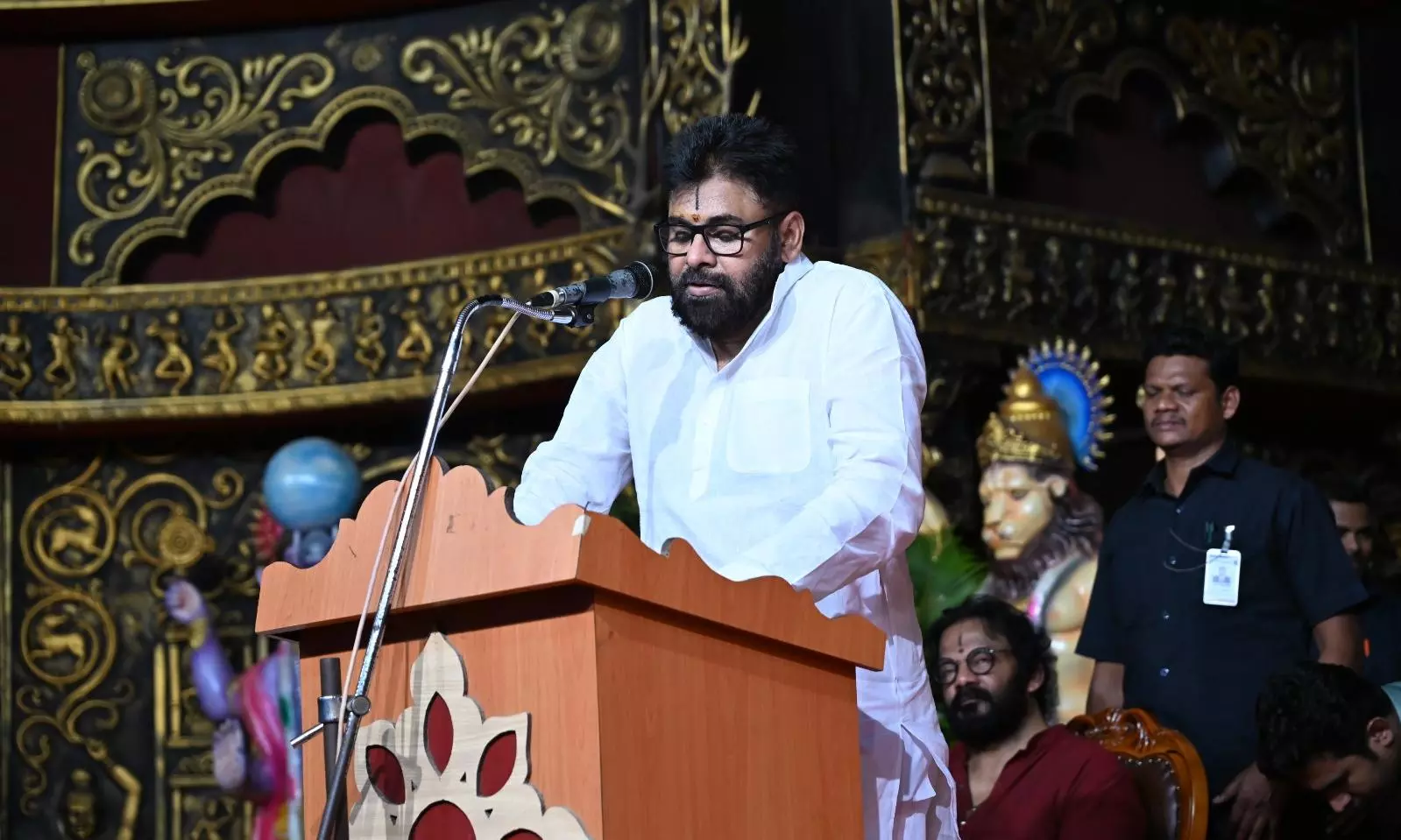
Udupi: Andhra Pradesh Deputy Chief Minister Pawan Kalyan on Sunday delivered a deeply reflective address, weaving philosophy, personal faith and cultural conviction as he paid tribute to the legacy of Jagadguru Madhwacharya and the enduring strength of the Bhagavad Gita and Sanatana Dharma during his visit to Udupi.
Speaking at the in the valedictory of the month long Gitotsava at Udupi Sri Krishana Math Kalyan said that being a Sanatani does not mean hating anyone, emphasising that the Gita’s message guides him to act as an instrument of Dharma, perform his duty without expectation, and stand by truth even when alone.
On the occasion, Sri Sugunendra Tirtha Swamiji of Paryaya Puthige Matha conferred the Title 'Abhinava Krishnadevaraya,' upon Pavan Kalyan.
Kalyan began his address in Kannada, greeting Swamijis, devotees and the media before switching to English.
He sought the permission from the people in Kannada language “Kannada Naadina janateyalli vinamra poorvakavagi mundia bhashana angla bashe munduvarisalu vinantisuttidene,” (With humble respect, I request permission of Kannada Nadu to continue my address in English).
“Let me speak in Macaulay’s English,” he remarked, adding that although Macaulay believed English would weaken India and the Sanathana Dharma, the language instead helped Indians connect more deeply with one another.
“Though I don’t know complete Kannada, it is through English that I became closer not just to Kannada but to all Indian languages,” he said.
The DCM referred to German philosopher Arthur Schopenhauer.
“He says if anybody wants to brainwash India to bring European through process, instead of we changing we go to change the very core of European culture,” he said adding “that is the strength of Sanatana Dharma—rooted in the Vedas and the Gita.”
Adding further, he noted, “The Gita says stand up for your Dharma and your culture. When you uphold your own Dharma, you are not antagonising any other religion. When I say I am a Sanatani, it does not mean I hate Islam or Christianity. My Dharma never taught me to look down upon or hate others.”
Kalyan said “today we see a world where Sanatana Dharma is often targeted — we have seen it in Tamil Nadu, we have seen it ridiculed, disguised as freedom of speech. Let me say from the holy platform of Madhwacharya that silence is no longer an option.”
He reminded the gathering that Acharya Madhwa was not just a saint but a revolutionary thinker, someone who proved that devotion requires strength. “The idol of Sri Krishna in Udupi holds churning stick and rope. To get butter — wisdom — you must churn the ocean of life and face struggle,” he said.
Referring to the Gita, he pointed out that India’s original handwritten Constitution features an illustration of Krishna imparting the Gita to Arjuna.
“This afternoon, I posted on social media about the opportunity bestowed on me and shared a picture of the majestic sketch of Krishna imparting the Gita to Arjuna in our original handwritten Constitution. The original handwritten Constitution of India — the very document that defines our republic — features this illustration alongside the Directive Principles,” he said.
“Our Constitution makers intentionally placed it there because the Directive Principles describe the nation’s moral vision: justice, welfare, responsibility, equality and righteous governance. And what better symbol for these ideals than Krishna guiding Arjuna on the path of Dharma?” he questioned.
Kalyan said that “some think Dharma and the Constitution are two different, but they are not. Dharma is the moral compass and the Constitution is the legal compass. They are complementary, and both aim toward the same direction — a peaceful and compassionate society.”
He added that this convergence was possible because Sanathana Dharma was never a blind superstition.
“It was a science — and it is a science encoded in the form of spiritual wisdom,” he said, noting that the world today studies its principles and applies them across cultures.
According to him, “the Gita has shaped world thought for centuries. It speaks to the human soul, not to a particular region. It answers three universal questions: Who am I? What is my duty? How do I act rightly amidst confusion? No text explains this with such simplicity and depth.”
Kalyan said he draws immense strength from Lord Krishna. “I do not know Sanskrit, but I know the essence — do your duty and don’t expect results. Keep going. Whether I lose or win, I do not care; I keep battling. I have taken that spirit from the Gita,” he said.
He added that every day people face their own “mini Kurukshetra,” encountering situations that test integrity, courage and the ability to choose what is right. “In moments of solitude, the Gita guides us,” he said.
Explaining the message he takes from it, Kalyan noted, “We are not the doers; we are just instruments (nimitta matrudu). The Gita taught me Nishkama Karma — whatever role you have, do it completely without caring for the results. If I do good, let the results speak. If I stand by truth and stand alone, so be it. The Gita teaches that victory is where Dharma is.”
Speaking on cow protection, he recalled how a friend gifted him a cow two decades ago—an act that eventually led to him running a goshala with 60 cows today.
He referred to ‘Gokulam’ project in Andra Pradesh and stressed on the need for cow protection with people’s initiative.
“Cow protection is not just emotion; it is a core principle of Dharma,” he said. He urged village communities to set up shared goshala models rather than blaming others.
He suggested that villages can form local societies dedicated to Go Rakshana. Efforts are underway, he added, to promote community goshalas so that every village can collectively protect its cows instead of engaging in blame or conflict.
Citing that Govindudu or Lord Krishna himself emphasized cow protection, he said that if even one family in each village adopts a Gowmata, the turbulence can be avoided. He pointed out that people spend significant amounts on clubs, luxuries, and weddings, and urged them to consider dedicating a small portion of that for the protection of cows and Dharma.
Before blaming other religions, he said Hindus must introspect and ask whether they are fulfilling their own responsibilities.
Kalyan became emotional while recalling his childhood.
“I do not come from a family of scholars but Bhatks. My father was a great devotee of Hanuman. Whenever I fell sick, he would place me on his lap and chant the Taraka Mantra—‘Hare Rama Hare Krishna’. This mantra helped in healing me,” he said. “Even today, when children come to me feeling low or unwell, the only mantra I recite is the same.”
Describing Udupi as a place filled with spiritual vibrations, he said the town’s glory is inseparable from Jagadguru Madhwacharya, worshipped as the incarnation of Vayu.
“Coming to Udupi I could feel the spiritual vibration which is hard to describe. It is not just just a temple town but spiritual powerhouse of Bharat. The glory of Udupi became even greater because of Jagadguru Madhwacharya who is worshipped as the third incarnation of Vayu. In his divide form he installed the idol of Krishna and founded asta mutt. His dwaita philosogy brought clairity and purpose to spiritual life and continue to inspire countless devotees even today,” he added.
Kalyan also hailed the contributions of the current seer of Puthige Matha- Sri Sugunendra Tirtha Swamiji in globalising Hindu Dharma, citing the Koti Gita Yajna as an example of their dedication.
“I have also decided to participate in this,” he added.
Referring to Udupi and its link with Bhatka Kanakadasa, the DCM said “This shows Bhakti is greater than caste, status or power—Sanatana Dharma embraces, never excludes.”
Calling the ongoing Laksha Kantaha Geeta Parayana a shield of national strength, Kalyan said the event reflects India’s spiritual resilience.
“Read the Gita not to memorise verses, but to gain strength. Dharma is not weak or meek. To protect Dharma, you need strength—and reciting the Gita empowers you,” he told the gathering.
Addressing Gen Z and millennials, he urged them to read the Gita as a practical guide.
“If you are depressed, it is a counsellor. If you are confused, it is a mentor. If you are a leader, it is a moral compass,” he said.
“Every day we face our own Kurukshetra. The Gita walks with us through every decision and every inner battle.”
