Visakhapatnam Airport Halts Civilian Flights After Seven Decades

Commercial flights shift to Alluri Sitarama Raju International Airport after 70 years.
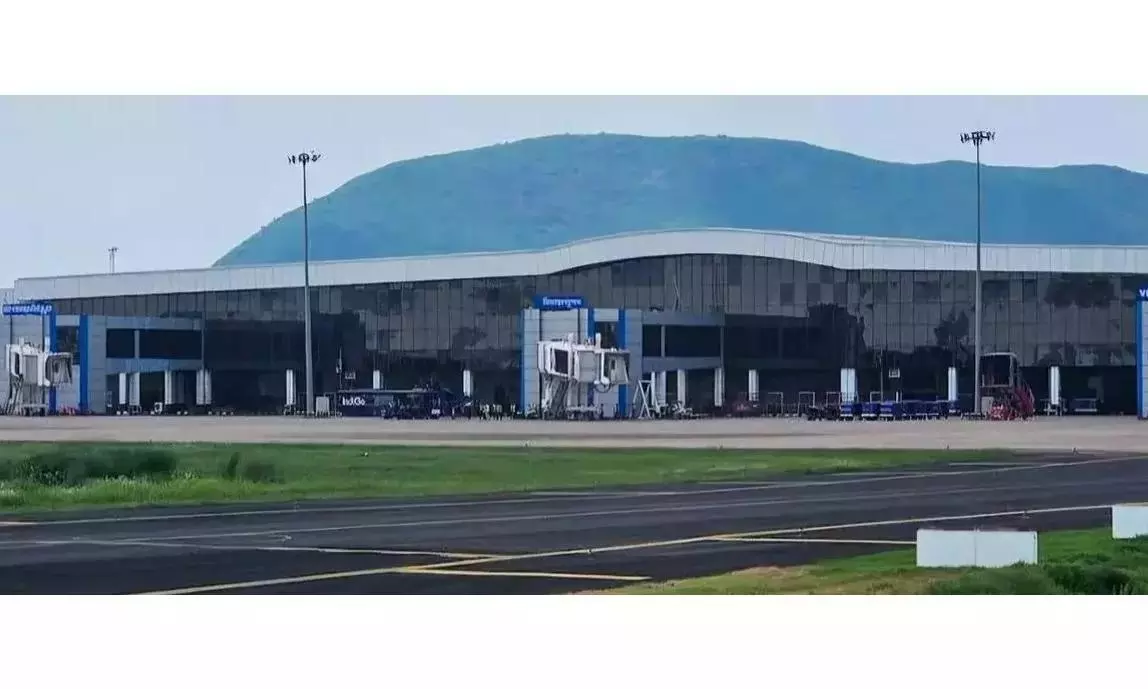
Visakhapatnam: Visakhapatnam’s skies are set for a historic transition –from old to new with a massive infrastructure build-up.
On August 17, scheduled commercial flights at the Civil Enclave of INS Dega will cease, closing a civilian aviation chapter that began more than seven decades ago.
From that day, the newly built Alluri Sitarama Raju International Airport at Bhogapuram in Vizianagaram district will take over as the region’s primary gateway.
This marks both an end and a beginning in north coastal Andhra Pradesh’s aviation journey.
The civil aviation ministry has issued two gazette notifications confirming that the new airport will be commissioned --at 12.01 am on August 17 – at the hands of Prime Minister Narendra Modi. Following this, scheduled commercial flights at the Visakhapatnam civil enclave will close for 30 years. This is in line with the condition stipulated when site clearance for the Bhogapuram project was granted in January 2016.
The closure applies only to scheduled commercial services. The enclave will continue to handle non-scheduled operations and the airbase will remain active for military purposes. Aircraft operated by the Armed Forces, police, government agencies, flights during national emergencies, and government-chartered VIP aircraft are exempted from the restriction.
In a separate notification, the ministry officially renamed the Bhogapuram greenfield airport as the Alluri Sitarama Raju International Airport, honouring the legendary tribal freedom fighter.
Another significant aspect of the transition is transfer of the IATA airport code VTZ, which has represented Visakhapatnam on global aviation networks for decades. Effective August 17, the code will change to Bhogapuram, making it the region’s official commercial aviation gateway.
The PM would inaugurate the airport in the presence of Chief Minister Chandrababu Naidu.
The shift marks the end of civilian commercial operations at an airport that has been closely intertwined with Visakhapatnam’s evolution from a modest port town into one of India’s major coastal cities. Established in 1941 as a military airfield during the Second World War, the airport opened to civilian flights in 1954, becoming the region’s first commercial aviation facility.
Operating from INS Dega, it remained one of the country’s few airports where civilian and defence operations coexisted, reflecting Visakhapatnam’s strategic importance as the headquarters of the Eastern Naval Command.
As the city’s industrial, educational, pharmaceutical, and information technology sectors expanded, the airport evolved alongside it. The arrival of jet aircraft in the 1970s, infrastructure upgrades through the 1990s, and a modern integrated terminal in the late 2000s significantly improved passenger handling capacity.
The airport attained international status in 2010, enabling direct overseas connectivity and strengthening links with destinations in the Middle East and Southeast Asia. Passenger traffic grew steadily, crossing one million annually before the pandemic, reinforcing the airport’s role as a vital transport hub for north Andhra.