Vijayanagara-era Padala Mandapam at Alipiri Set for Scientific Restoration

The Archaeological Survey of India would begin the work on December 8 after a bhoomi puja at the site.
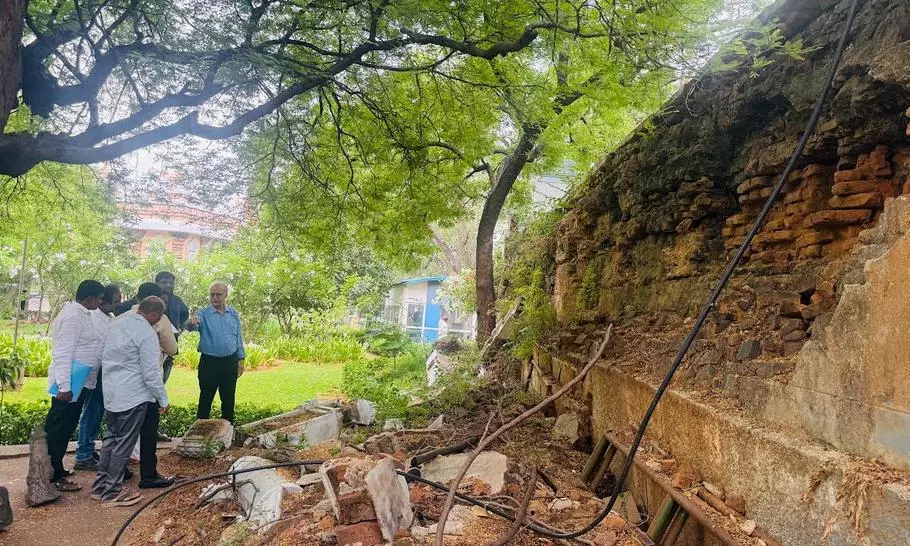
Tirupati: The 450-year-old Padala Mandapam at Alipiri, facing the threat of collapse, would undergo a complete scientific restoration without altering its original Vijayanagara character.
The Archaeological Survey of India would begin the work on December 8 after a bhoomi puja at the site.
The mandapam, located at the starting point of the Tirumala footpath, has deteriorated over the years. Stones, plaster and portions of the structure have fallen off, leading to cracks, tilting of the pillars and weakening of the walls. Decades of erosion and rains worsened the situation, making the structure unsafe for the thousands of pilgrims who walk past it every day.
Within the TTD, there were discussions on whether to demolish the structure and rebuild it or restore it using traditional practices. Before making a decision, the devasthanams sought the technical opinion of the ASI. In response, a central team inspected the mandapam earlier this month.
The team was led by ASI director (Epigraphy) K. Muniratnam Reddy, along with Bengaluru deputy engineer Srinivasulu and Hyderabad deputy engineer Krishna Chaitanya and other experts. They confirmed that the mandapam could be restored scientifically without dismantling its heritage.
“The original stones and pillars are strong, and they can be reset in their positions after proper documentation. There is no question of demolition”, Muniratnam told Deccan Chronicle.
Estimated to cost around `4 crore, the restoration work is being funded by the Lord Venkateswara Charitable and Religious Trust, Pune. The trust had supported conservation works at Srikalahasti, Simhachalam and Srisailam. The same traditional methods would now be used to preserve the heritage of the Padala Mandapam at Alipiri.
Explaining the process, ASI directors said every step would follow strict documentation before any stone is moved. “Each architectural member including roof slabs, beams, wall blocks, and floor stones, will be assigned a documentation number along with its exact orientation. These numbers will be marked on the stones, and levels such as floor, beam and roof will be recorded based on fixed reference points. Before touching a single stone, we will document everything,” Muniratnam said.
Detailed drawings, including plans, elevations and sectional views, would be prepared with the documentation numbers. These drawings would be produced in both digital and physical formats using tools like AutoCAD. The structure would also be photographed and videographed completely, including drone imaging and photogrammetry.
All material would be recorded and preserved, and the conservation could begin with scientific removal.
“Using scaffolding and supports, damaged and loose stones will be removed without breaking them. These stones will be systematically arranged nearby in layouts that show where they will be replaced. A new foundation will be built using traditional methods to ensure stability. After that, the original stones will be reset exactly according to the documentation, layer by layer,” the ASI director said.
Once reset, the roof would be water-tightened by using age-old techniques. If stones are broken, they would be repaired and reused. “We will not replace any architectural member unless it is completely missing. Even broken parts will be mended, not discarded,” Muniratnam said.
Once restored scientifically, the mandapam would remain stable for at least another 700 years, he said.
