Two Faces Of Kalamkari In Srikalahasti – Balancing Livelihood And Legacy

4 July 2025 9:43 PM IST4 July 2025 9:43 PM IST
Free training centres and dedicated artisans protect the legacy of hand-drawn, natural-dye Kalamkari, offering livelihoods to local women.
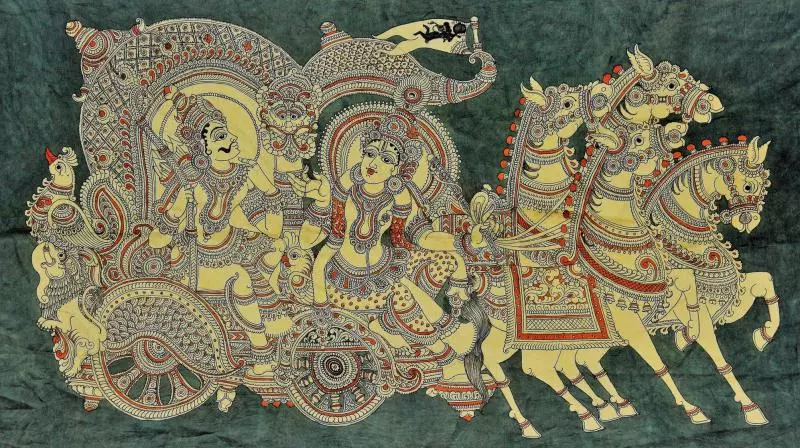
Artisans at Bhanodaya Kalamkari Centre in Srikalahasti practise the age-old craft, using vegetable and mineral dyes to create intricate mythological designs by hand. (Image:DC)
TIRUPATI: In the temple town of Srikalahasti, Kalamkari has become both a livelihood and legacy. For many local women, the traditional textile art has provided a rare opportunity to earn with dignity, despite limited education or mobility.
There are artisans who continue to preserve the original, labour-intensive methods of the craft, resisting commercial shortcuts that risk diluting the art’s essence. At the Bhanodaya Kalamkari Centre, women from surrounding villages arrive daily with cloth and brushes in hand. Most of them are over 50, with few employment options. They learn at the centre the Srikalahasti style of Kalamkari, which involves freehand drawing with a pen (kalam) using natural dyes made from vegetables and minerals. The designs often feature mythological stories or intricate floral patterns.
“At my age, I cannot go out and work in the sun. But I’ve learned the traditional Kalamkari art here and now earn around ₹10,000 to ₹15,000 a month,” said 60-year-old Kanthamma, who works at the centre. Krishnaveni, another artisan, added, “I didn’t want to be idle or dependent. Today, I earn nearly ₹18,000 a month crafting Kalamkari designs”.
Nearly 90 per cent of the employees at the Bhanodaya centre are women, many of whom are from Srikalahasti and nearby places like Varadaiahpalem, Kobaka and Tada. The centre provides free training and allows flexible work hours.
“Once the women acquire the skills, they are encouraged to work from home or at the centre, depending on their convenience. Payments are made per piece, giving them flexibility and an incentive to produce more. Most of these women come from poor backgrounds and have very limited formal education”, said Paluri Padmavathi, who leads the Bhanodaya organisation.
Despite changes over time, Kalamkari is economically significant in Srikalahasti. Around 500 artisans in the town are engaged in modified forms of the art. But only a few continue to follow the traditional process. The region records an estimated monthly turnover of ₹2 crore in Kalamkari products, catering to both domestic and international markets.
Revival of Kalamkari in Srikalahasti is traced back to 1957, when freedom fighter Kamaladevi Chattopadhyay visited the town and encouraged local teacher Jonnalagadda Lakshmaiah to pass on his knowledge. His son late J. Gurrappa Chetty continued the tradition and received the Padma Shri award in 2008. Today, the legacy is being carried forward by his son, J. Niranjan, a fourth-generation artisan.
Niranjan has worked to raise the profile of traditional Kalamkari on national and global platforms. In 2006, he played a key role in securing the Geographical Indication (GI) tag for Srikalahasti Kalamkari. His artworks have been displayed at Tirupati and Delhi airports, apart from several railway stations. In 2014, his work “Tree of Life” won a bronze medal at the International Craft Competition in China.
“At my age, I cannot go out and work in the sun. But I’ve learned the traditional Kalamkari art here and now earn around ₹10,000 to ₹15,000 a month,” said 60-year-old Kanthamma, who works at the centre. Krishnaveni, another artisan, added, “I didn’t want to be idle or dependent. Today, I earn nearly ₹18,000 a month crafting Kalamkari designs”.
Nearly 90 per cent of the employees at the Bhanodaya centre are women, many of whom are from Srikalahasti and nearby places like Varadaiahpalem, Kobaka and Tada. The centre provides free training and allows flexible work hours.
“Once the women acquire the skills, they are encouraged to work from home or at the centre, depending on their convenience. Payments are made per piece, giving them flexibility and an incentive to produce more. Most of these women come from poor backgrounds and have very limited formal education”, said Paluri Padmavathi, who leads the Bhanodaya organisation.
Despite changes over time, Kalamkari is economically significant in Srikalahasti. Around 500 artisans in the town are engaged in modified forms of the art. But only a few continue to follow the traditional process. The region records an estimated monthly turnover of ₹2 crore in Kalamkari products, catering to both domestic and international markets.
Revival of Kalamkari in Srikalahasti is traced back to 1957, when freedom fighter Kamaladevi Chattopadhyay visited the town and encouraged local teacher Jonnalagadda Lakshmaiah to pass on his knowledge. His son late J. Gurrappa Chetty continued the tradition and received the Padma Shri award in 2008. Today, the legacy is being carried forward by his son, J. Niranjan, a fourth-generation artisan.
Niranjan has worked to raise the profile of traditional Kalamkari on national and global platforms. In 2006, he played a key role in securing the Geographical Indication (GI) tag for Srikalahasti Kalamkari. His artworks have been displayed at Tirupati and Delhi airports, apart from several railway stations. In 2014, his work “Tree of Life” won a bronze medal at the International Craft Competition in China.
While the craft’s popularity has grown, particularly among textile designers and exporters, much of what is seen today is mass-produced or chemically processed.
Niranjan says traditional Kalamkari is now relatively rare, largely due to the time and labour it demands. “It takes nearly 20 days to complete one piece using traditional methods. We prepare the colours ourselves, using natural sources. The drawing is done entirely by hand. It takes time and effort, but that is what gives it value”, he pointed out.
However, he is concerned over the declining number of traditional artisans. “Today, many products imitate the Kalamkari look. But they are not made using the original process. That’s affecting the art. If more people return to the original process, this town can once again be known not just as a centre of devotion, but as the true home of traditional Kalamkari,” Niranjan observed.
Niranjan says traditional Kalamkari is now relatively rare, largely due to the time and labour it demands. “It takes nearly 20 days to complete one piece using traditional methods. We prepare the colours ourselves, using natural sources. The drawing is done entirely by hand. It takes time and effort, but that is what gives it value”, he pointed out.
However, he is concerned over the declining number of traditional artisans. “Today, many products imitate the Kalamkari look. But they are not made using the original process. That’s affecting the art. If more people return to the original process, this town can once again be known not just as a centre of devotion, but as the true home of traditional Kalamkari,” Niranjan observed.
( Source : Deccan Chronicle )

Next Story