The Long History Behind Tirumala Brahmotsavams

From Pallava patronage to Vijayanagara rule, Brahmotsavams evolved over centuries
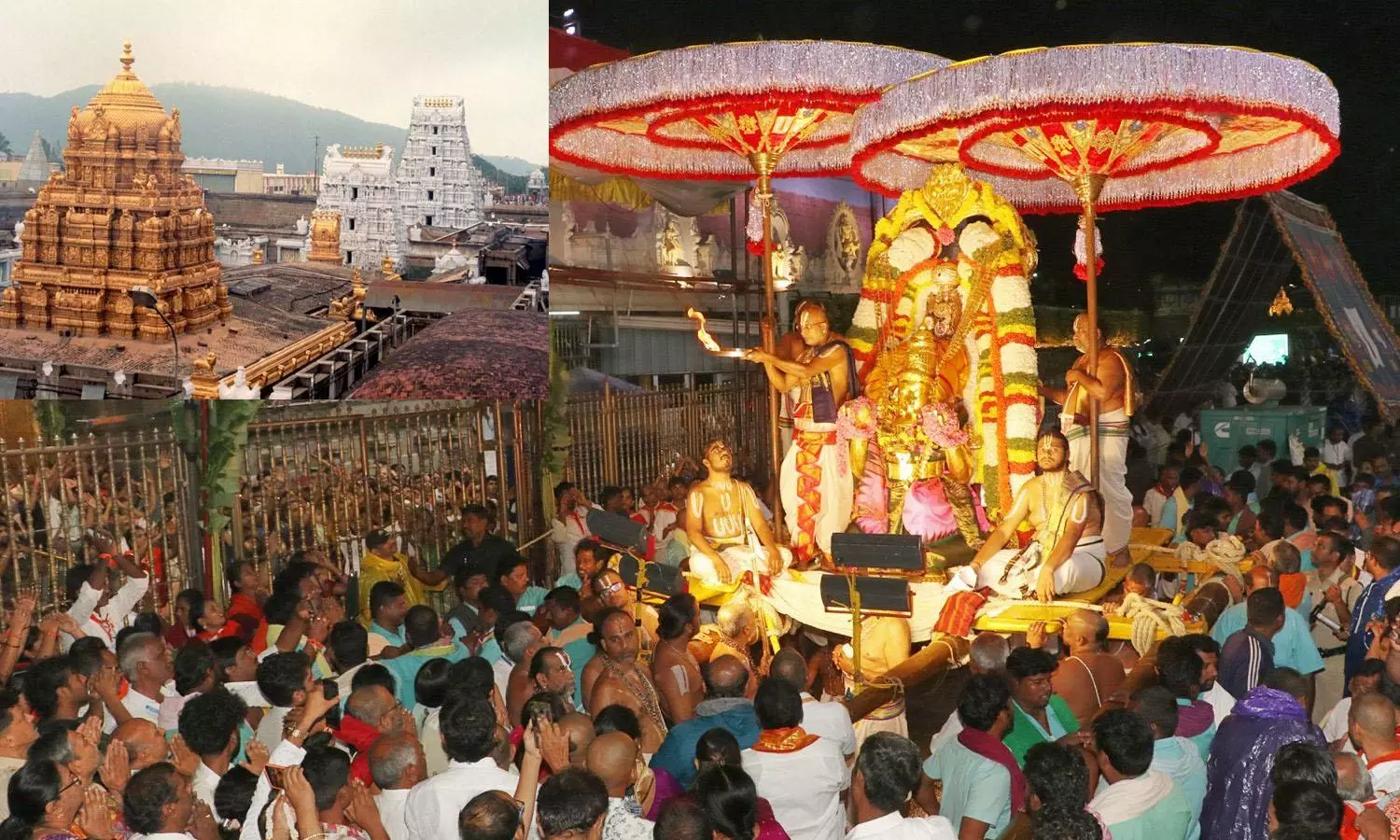
Tirupati: As Tirumala prepares for the annual Brahmotsavams from September 15 to 23, the nine-day festival carries a history of more than a millennium. The processions, Vahana Sevas and rituals seen today are the result of centuries of additions and changes under different rulers, temple administrators and devotees.
According to Puranic accounts, Brahma conducted the first festival after Lord Srinivasa manifested on Venkatachala, giving it the name Brahmotsavam. Historical records, however, show that the festival evolved over centuries.
Inscriptions engraved on the Tirumala temple walls are among the most telling evidence, recording donations of land, jewellery and other offerings, as well as the establishment of new festivals.
One of the earliest landmarks is associated with Pallava queen Samavai Sri Perundevi. In 966 CE, she presented a one-foot silver Bhoga Srinivasa Murthy idol to the Tirumala temple and donated ornaments and land for the festivals. Her inscription on the northern wall of the first Prakaram records Brahmotsavam celebrations in the Purattasi and Margazhi months, providing evidence of the festival tradition in the 10th Century.
The festival calendar expanded during the Chola and Yadavaraya periods. Panguni Brahmotsavam is associated with Vira Narasimha Yadavaraya, who ruled from 1209 to 1263. In 1254, a Chittirai Brahmotsavam was added during the reign of Chola ruler Vijaya Gandagopala Deva, while an Aadi Brahmotsavam was established around 1300-1330 under the Yadavaraya feudatories.
By the time the Vijayanagara Empire emerged, five Brahmotsavams were being conducted annually. During the Vijayanagara period, the festival calendar expanded substantially under successive rulers of the Sangama, Saluva, Tuluva and Aravidu dynasties.
Another important development came around 1339, when Malayappa Swamy, along with Sridevi and Bhudevi, came to be used as the Utsava Murtis. Today, the tradition of taking the Utsava deities in a procession on different vahanams remains central to the Brahmotsavams.
The inscriptions also show the continuing changes in the festival tradition. A Maasi Brahmotsavam was established in 1387 during the reign of Harihara II, while an Aippasi Brahmotsavam was added in 1429 during the reign of Devaraya II. The emperor Sri Krishnadevaraya later added the Thai Brahmotsavam in 1513.
Historical records show that between 1539 and 1616, as many as ten annual Brahmotsavams were held, while another historical compilation notes that five inscriptions between 1558 and 1638 refer to 11 Brahmotsavams being conducted in a year. Most of those years, however, saw ten festivals annually.
Krishnadevaraya's contributions occupy an important place in this history. Inscriptions record his first visit to Tirumala on February 10, 1513. The same year, he established a new Brahmotsavam in Thai, marking the month of his birth. His contributions also included jewellery, gold and other offerings to the temple.
After Krishnadevaraya, the tradition continued under Achyutaraya. The first reference to the Kartikai Brahmotsavam appears in 1533, while an inscription from 1534 records a donation for the festival. In 1539, Tallapaka Pedda Tirumalayyangar was associated with the establishment of the Aani Brahmotsavam, further increasing the number of annual Brahmotsavams.
Records show that between 1539 and 1616, as many as ten annual Brahmotsavams were recorded. Another historical compilation notes that five inscriptions between 1558 and 1638 refer to 11 Brahmotsavams being conducted in a year, though most of those years had ten festivals annually.
The history of the festival also reflects changes in temple administration. A Mackenzie Survey record of 1803 referred to 28 festivals at Tirumala, although studies cite discrepancies in the record. In 1843, the temple administration passed on to the Mahants of Hathiramji Mutt and this continued under them until 1933, when the Tirumala Tirupati Devasthanams was established and the temple administration was brought into an institutional system.
With the growth of pilgrim numbers, the Brahmotsavams became a large institutional festival requiring arrangements for accommodation, transport, security, medical services, sanitation, Annaprasadam and pilgrim information. The nine-day festival is the result of centuries of tradition, royal patronage, donations and changes in temple administration.
As Malayappa Swamy takes to the Mada streets this September, the age-old tradition will continue in Tirumala in its present form.
HIGHLIGHTS:
A Millennium of Srivari Brahmotsavams
966 CE — Pallava queen Samavai Sri Perundevi donates silver Bhoga Srinivasa Murthy, ornaments and land; inscription records Brahmotsavam celebrations
1209–1263 — Vira Narasimha Yadavaraya period; Panguni Brahmotsavam associated with this period
1254 — Chittirai Brahmotsavam added during the reign of Chola ruler Vijaya Gandagopala Deva
1300–1330 — Aadi Brahmotsavam came into being under the Yadavaraya feudatories
Around 1339 — Malayappa Swamy, with Sridevi and Bhudevi, begins being used as the utsava murtis
1387 — Maasi Brahmotsavam started during Harihara II's reign
1429 — Aippasi Brahmotsavam added during Devaraya II's reign
February 10, 1513 — Krishnadevaraya makes his first recorded visit to Tirumala
1513 — Thai Brahmotsavam introduced by Krishnadevaraya, marking the month of his birth
1533 — First reference to Kartikai Brahmotsavam during Achyutaraya's reign
1534 — Inscription records a donation for the Kartikai Brahmotsavam
1539 — Aani Brahmotsavam associated with Tallapaka Pedda Tirumalayyangar
1539–1616 — Inscriptions record as many as 10 annual Brahmotsavams
1558–1638 — Five inscriptions refer to 11 Brahmotsavams in a year, though most years had 10
1803 — Mackenzie Survey records 28 festivals at Tirumala, with historical studies noting discrepancies
1843 — Temple administration passes on to the Mahants of Hathiramji Mutt
1933 — TTD established, bringing temple administration into an institutional system
2026 Salakatla Brahmotsavams
Sept 15: Dwajarohanam | Pedda Sesha
Sept 16: Chinna Sesha | Hamsa
Sept 17: Simha | Mutyapu Pandiri
Sept 18: Kalpavriksha | Sarva Bhoopala
Sept 19: Mohini | Garuda
Sept 20: Hanumantha | Swarna Ratham | Gaja
Sept 21: Suryaprabha | Chandraprabha
Sept 22: Rathotsavam | Aswa
Sept 23: Chakrasnanam | Dwajavarohanam
What shaped the Brahmotsavams?
Puranic tradition: Brahma is believed to have conducted the first festival for Lord Srinivasa, giving it the name Brahmotsavam
Inscriptions as evidence: Temple-wall inscriptions provide the principal historical record of the festival's evolution.
Royal patronage: Pallava, Chola, Yadavaraya and Vijayanagara rulers and their feudatories contributed to the expansion of the festival calendar
Women patrons: Pallava queen Samavai Sri Perundevi's 966 CE endowment is among the earliest recorded milestones.
Endowments: Land, jewellery and other offerings helped support the conduct of festivals
Festival expansion: The calendar grew from 2 Brahmotsavams to 5, and later to 10 in most years, with inscriptions even recording 11 in a year
Malayappa Swamy: From around 1339, Malayappa Swamy with Sridevi and Bhudevi became the utsava murtis used in processions
Krishnadevaraya's role: First recorded Tirumala visit on February 10, 1513; introduced the Thai Brahmotsavam in the month of his birth
Tallapaka contribution: Tallapaka Pedda Tirumalayyangar was associated with the 1539 Aani Brahmotsavam
Administrative transition: Mahants of Hathiramji Mutt took over in 1843; TTD was established in 1933
