Stone Set For 2nd Pumping Station To Strengthen Amaravati Flood Defence

The new pumping station will have a capacity to lift 8,400 cusecs of flood water from the Kondaveeti Vagu and discharge it into the Krishna River, thereby preventing inundation in the capital region.
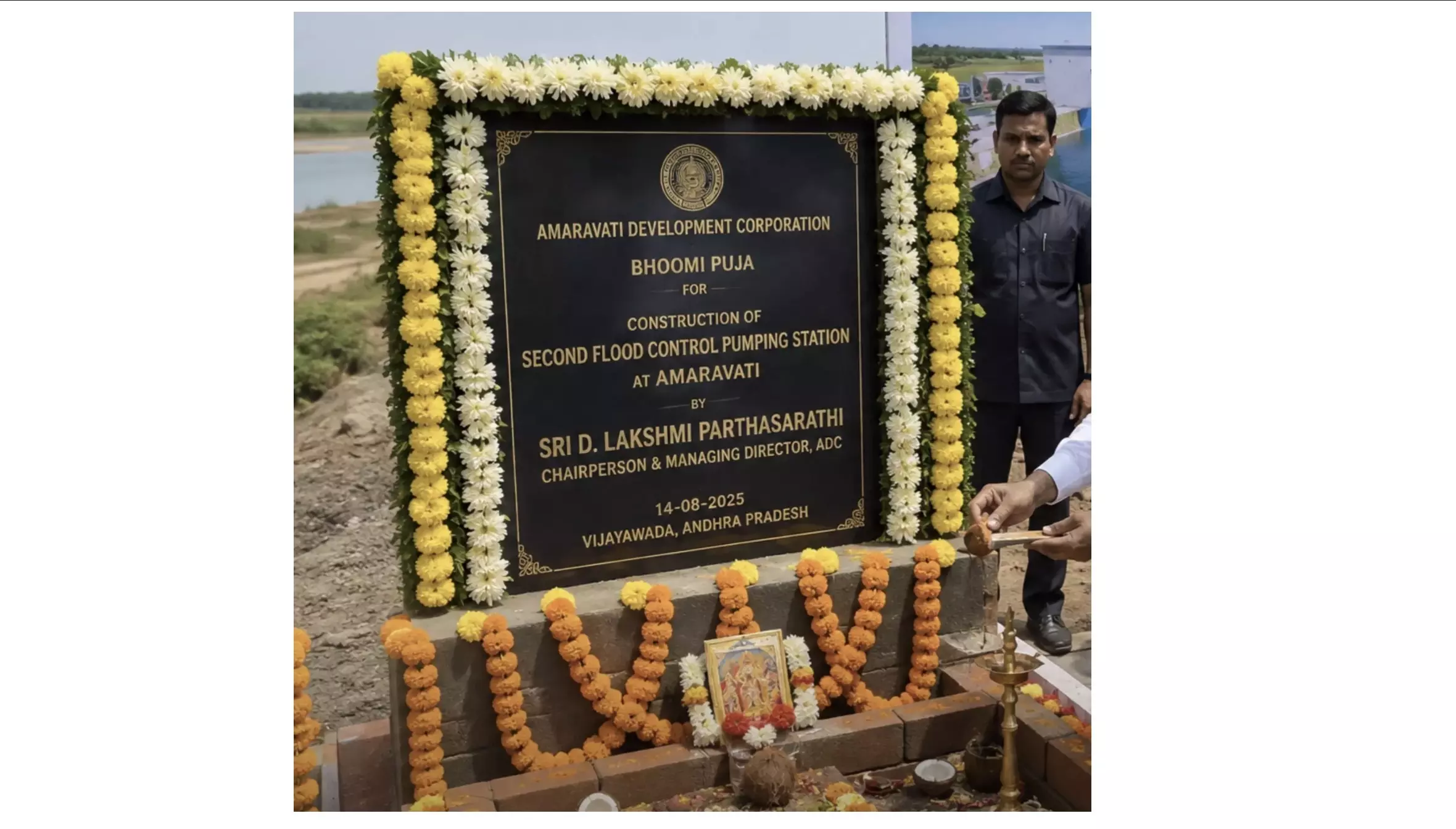
Andhra Pradesh government on Friday performed the bhoomi puja for a second flood-control pumping station at Amaravati to strengthen the capital's flood-defence infrastructure.
Amaravati Development Corporation (ADC) chairperson and managing director D. Lakshmi Parthasarathi set the foundation stone for the facility. Together with the existing pumping station on Kondaveeti Vagu along the Krishna river bund, the new facility will become the “double engine” for the capital.
With 13 vertical-lift pumps (12+1), the new pumping station will have a capacity to lift 8,400 cusecs of flood water from the Kondaveeti Vagu and discharge it into the Krishna River, thereby preventing inundation in the capital region.
The government has taken up the second pumping station project keeping in view the need for a stronger flood-management mechanism as the capital expands. The pumping station is expected to be operational by February 2028.
The ADC chairperson directed officials and executing agencies to adhere to the quality standards and complete the construction within the stipulated time frame.
On the day, Parthasarathi held discussions with Mangalagiri AIIMS executive director Prof. A. Shanta Singh over improving road connectivity to Amaravati. The discussions included construction of a railway over bridge (ROB) near AIIMS as part of the extension of the E-13 road, which is being developed as another gateway to the capital.
The E-13 road currently stretches 6.3 km from Neerukonda to Yerrabalem. The road is to be extended from Yerrabalem through AIIMS towards Vijayawada-Guntur route and the old Madras Highway, NH-16, to meet future traffic requirements. The extension includes a 3.52-km elevated corridor, taking the total length of the E-13 corridor to 9.82 km.
Construction of the 609 metre long ROB will require about 3.34 acres of the AIIMS land. AIIMS authorities have responded positively to the proposed development, according to officials.
Others who attended the ADC chairperson’s meet with the AIIMS ED included ADC chief engineer B. Narasimha Murthy, superintending engineer B. Srinivas and AIIMS deputy director Shashikanth.
