Rains Lash AP; Highest 7.1 cm Rainfall in Kakinada

Heavy rain, strong winds expected; temperatures drop sharply across coastal districts
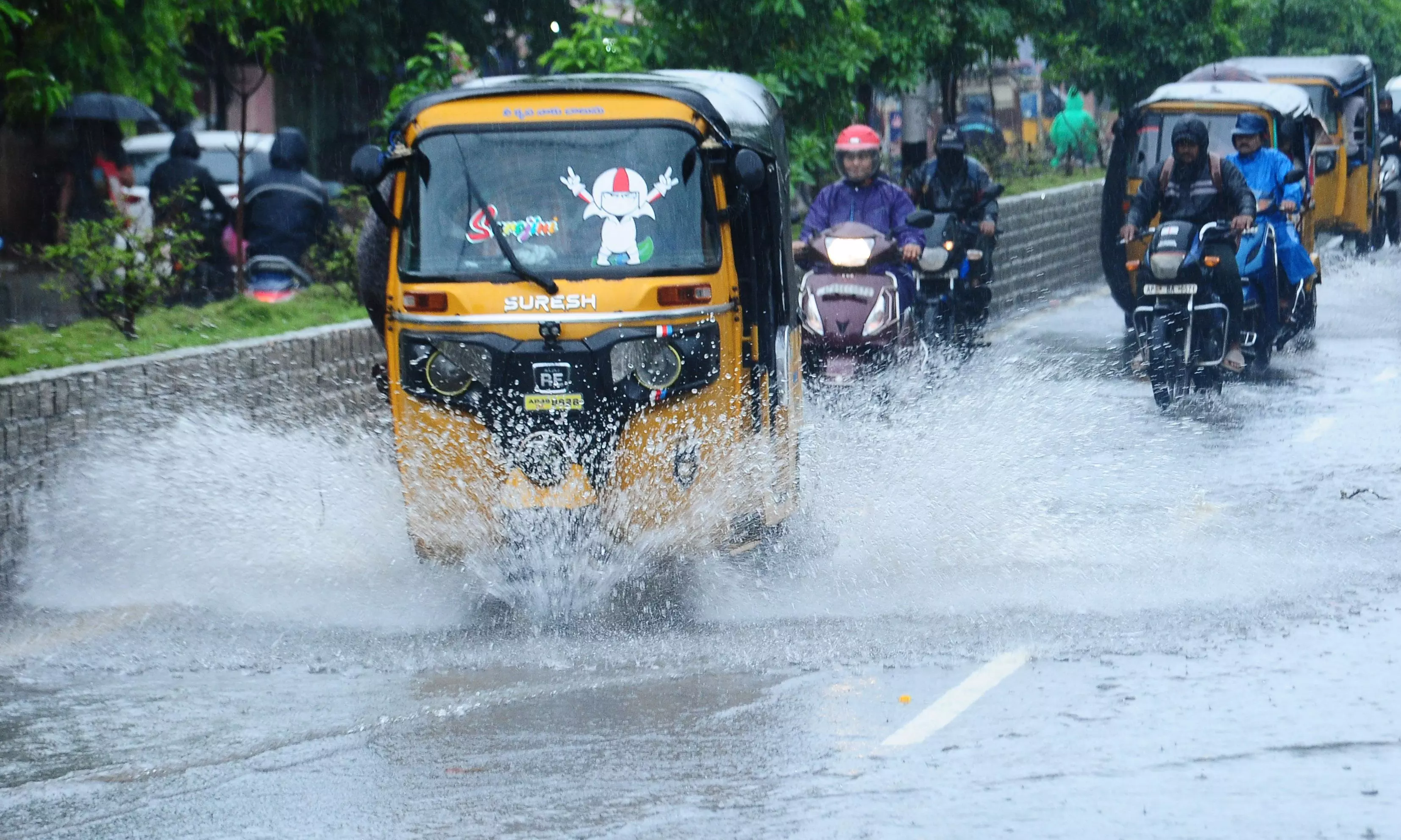
Visakhapatnam: Rains lashed many parts of Andhra Pradesh on Sunday, bringing down the temperature by two to nine degrees Celsius throughout the state.
Indian Meteorological Department (IMD) has forecast an orange warning for some places and a yellow warning for many other areas in the state on Monday.
Normal life had been partially affected in many regions. Street vendors remained off the roads.
Kakinada in Andhra Pradesh experienced the highest rainfall of 7.1 cm on Sunday, followed by 4.2 cm in Tuni (Kakinada district), 2.6 cm at Narsapur (West Godavari), 2.5 cm at Gannavaram (Krishna), 7 mm in Bapatla, 6 mm in Tirupati, and 2 mm at Nellore.
People of coastal Andhra Pradesh got a break from hot temperatures, as the weather turned cool and breezy on Sunday.
A report from IMD, Amaravati, said Nandyal remained the hottest in the state on Sunday with 42 degrees Celsius, followed by Kurnool (41.4 °C), YSR Kadapa (40.9 °C), Nellore (40.4 °C), Tirupati (40.3 °C) and Kavali (39.4 °C).
Rain brought down the temperature in Tuni to 26.5 °C on Sunday, 9.9 °C below normal. Kakinada recorded 29.1 °C, down by 7 degrees, Gannavaram 31.4 °c, down by 7.7 degrees, and Narsapur recorded 27.6 °C. Most parts of coastal AP (CAP) recorded maximum temperatures between 26 °C and 34°C.
The weather agency has forecast that parts of the ASR, Kakinada, East Godavari, West Godavari, Konaseema, Eluru, Krishna, NTR and Guntur districts will experience heavy rains with gusty winds on Monday (May 5).
The IMD predicted that heavy rainfall at isolated places over CAP and thunderstorms accompanied with lightning are likely at isolated places over CAP and Rayalaseema on Tuesday (May 6). Gusty winds with speeds of 40–50 kmph are likely at isolated places over the CAP and Rayalaseema.
The meteorological department has advised people to find sturdy shelter immediately, opting for well-constructed buildings and avoiding seeking refuge in open structures and under trees.
