Skyroot’s Vikram-1 Reaches Orbit in Pathbreaking Launch

Maiden “Mission Aagaman” launch from Satish Dhawan Space Centre marks India’s entry into private orbital launch capability
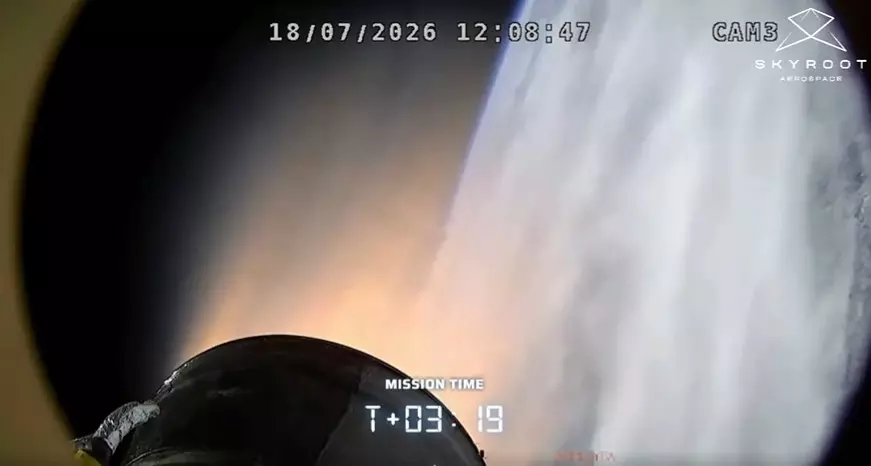
SRIHARIKOTA: Hyderabad-based Skyroot Aerospace scripted a historic chapter in India’s space journey on Saturday, becoming the country's first private rocket builder and launcher after its Vikram-1 debut orbital launch vehicle performed like a veteran and met all mission parameters on its first launch.
In doing so, Skyroot opened up the space sector to private commercial participation by demonstrating that an Indian private company could build a rocket and launch it from Indian soil. With Mission Aagaman (Arrival), India became the third country, after the US and China, to have a private rocket company successfully launch an orbital vehicle.
“Hello space, we have arrived!” Skyroot Aerospace said after the launch. “Vikram-1's Test Flight-1 has completed its mission. The first ever Indian private sector launch has been successfully completed.”
The company plans to launch Vikram-2, capable of carrying up to 1,000 kg to low-Earth orbit, in 2027, while also developing a fully reusable launch vehicle. Once the technology is proven, Skyroot intends to offer "on-demand" fast, affordable launches for small satellites, positioning itself as a “space cab” for the growing global small-satellite market.
The seven-storey, all-carbon-composite, four-stage launch vehicle, built at Skyroot’s Infinity campus in Hyderabad, was powered by 3D-printed engines and high-thrust solid motors.
Vikram-1 lifted off at 12.05.30 pm, after a brief technical halt, from the Satish Dhawan Space Centre (SDSC), Sriharikota. In a record-setting flight of about 15 minutes, the rocket flawlessly cleared the launch pad, followed its designated trajectory and placed multiple technology-demonstration payloads into an orbit about 450 km above the Earth.
High-resolution onboard cameras transmitted breathtaking live images of Earth from space, drawing applause from scientists at the Launch Control Centre and enthusiastic cheers from students watching the mission.
The achievement was seen as a major outcome of the space sector reforms launched by the Centre in 2020, which opened the space ecosystem to private participation. Backed by the Indian Space Policy and supported by the Indian Space Research Organisation (Isro) and IN-SPACe (Indian National Space Promotion and Authorisation Centre), the mission underscored the rapid rise of Indian space start-ups, now numbering about 400 in just six years.
The launch was delayed by about 35 minutes due to a navigation-related issue, but once the countdown resumed, the mission unfolded flawlessly. The crucial third-stage separation occurred as planned. The first three stages were powered by solid motors, followed by the successful performance of the fourth (S4) stage, powered by Skyroot’s 3D-printed Raman-I liquid engine.
After a precise engine cut-off, Vikram-1 successfully injected Skyroot’s SCOPE mission to measure flight data, Cosmoserve Space’s Embrace robotic arm, Grahaa Space’s SOLARAS nanosatellite to study spacecraft subsystems, and German company DCubed’s payload to verify in-orbit micro-deployment and release mechanisms.
Adding an emotional touch to the mission, Vikram-1 carried hundreds of commemorative cards signed by scientists, astronauts, investors, policymakers, Skyroot employees and well-wishers. Among them was a special handwritten postcard from Prime Minister Narendra Modi bearing the words “Vande Mataram.”
Following the successful orbital insertion, Skyroot and Isro officially declared Mission Aagaman a “Grand Success.”
Built with a lightweight all-carbon-composite structure, Vikram-1 is a four-stage launch vehicle standing 24 metres tall and comprising three solid-fuel stages and one liquid-fuel upper stage. Capable of carrying payloads of up to 350 kg to low-Earth orbit (LEO), it is designed to offer fast, affordable launches for small satellites, positioning it as a “space cab” for the growing global small-satellite market.
The mission also represents a significant technological leap for Skyroot, which successfully launched the Vikram-S sub-orbital demonstrator from Sriharikota in November 2022.
Calling it a defining moment, Skyroot Aerospace CEO and founder Pawan Kumar Chandana said it was the first time an Indian private company had independently built an orbital rocket, brought it to the launch pad and successfully sent it into orbit. He noted that the achievement was made possible by a team with an average age of just 28 years and highlighted that the rocket was built almost entirely using advanced carbon-composite technology.
Congratulating the Skyroot team, Isro and IN-SPACe, Chandana said the successful Vikram-1 mission had opened the door for more private space ventures, strengthened India's position in the global commercial launch market and marked the beginning of a new chapter in the country’s space ambitions.
The Indian Space Research Organisation (Isro) played a crucial role by providing extensive technical and infrastructure support. The space agency enabled access to its solid motor casting and static testing facilities at Sriharikota, where the first-stage motor was cast and tested and the second-stage motor was validated.
The Raman-I upper-stage engine was tested at Isro’s Liquid Propulsion Systems Centre (LPSC). Isro also assisted with vehicle preparation, stage transportation, trajectory analysis, launch-pad integration and round-the-clock safety oversight, while IN-SPACe facilitated access to Isro facilities, technical consultancy, mission-readiness reviews and launch clearances.
