Pasuvula Panduga Marks Centuries-Old Bull-Taming Tradition in Tirupati, Chittoor Villages

On the ground, however, Pasuvula Panduga continues in several places, with villagers maintaining that organisers of bull taming enjoy political backing.
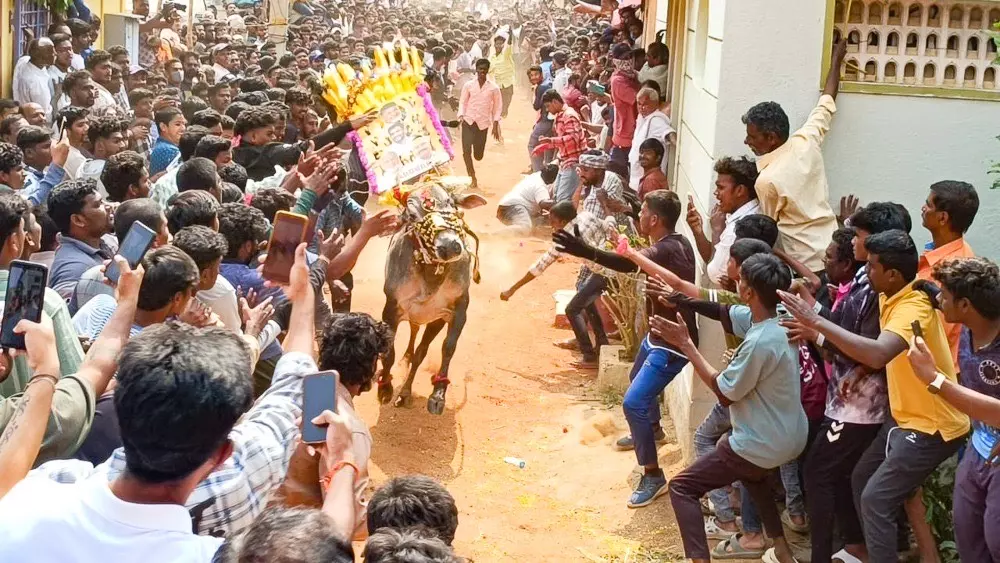
Tirupati: Despite a police ban and repeated warnings, the traditional bull-taming sport known as “Pasuvula Panduga” continues to be held in several villages of Tirupati and Chittoor districts during the Sankranti season. The bull taming attracts large crowds, often leaving multiple participants injured. Villagers defend holding of the event as a centuries-old tradition.
As day breaks on Kanuma, village lanes that are otherwise quiet begin to fill with people, drumbeats and restless cattle. For many rural families, Pasuvula Panduga, also called Goppa Mylaru Panduga, is not merely an event but a custom closely tied to their farming life. Elders recall watching the sport as children, fathers speak of taking part in their youth, and young men see it as a moment to test courage and earn recognition in the village.
The bull-taming sport, often compared to Tamil Nadu’s Jallikattu, has been practised in this region for more than 150 years. Traditionally, it is held on the third day of Sankranti, when cattle are worshipped for their role in agriculture. In recent years, however, the festival has been organised earlier than usual in several villages.
This Sankranti season, events had been held ahead of schedule in parts of Vadamalapet mandal and Patha Sanambatla in Chandragiri mandal of Tirupati district. Villages, such as Sanambatla and Nuthiguntapalle hosted the sport days before the festival, attracting large crowds and resulting in injuries as participants tried to control charging bulls in narrow lanes.
Villagers insist that Pasuvula Panduga is different from Jallikattu. In this version, bulls and cows are released from cattle sheds into narrow streets, while young men run alongside them to grab wooden planks tied to their horns. These planks are brightly painted and often carry pictures of film stars or political leaders. Winning one is considered a matter of pride, and stories of such feats are remembered long after the festival ends.
However, the celebration remains at odds with the law. Police have banned bull-taming events, citing the risk to people and animals. Orders have been issued across Tirupati and Chittoor districts to prevent such sports, along with cockfighting and gambling. Police officers spoke to village elders in advance in an attempt to stop the event.
On the ground, however, Pasuvula Panduga continues in several places, with villagers maintaining that organisers of bull taming enjoy political backing.
The dangers associated with the sport are still remembered. In 2022, bull-taming events in villages across Chandragiri, Kuppam and Palamaner areas left nearly 30 people severely injured. Animal welfare activists charge that cattle are sometimes given intoxicants to make them aggressive, a charge organisers deny, saying the festival is meant to honour cattle, not harm them.
Near Tirupati, Arepalle Rangampeta, which usually hosts Pasuvula Panduga during Kanuma, postponed the event this year after two villagers died due to health issues. However, neighbouring Pullaihgaripalle organised bull taming. Farmers offered prayers to village deities before releasing bulls from cattle sheds spread across the village. As drums echoed and crowds cheered, young men ran alongside the animals, risking injury to seize the decorated planks.
Several participants suffered minor injuries, but crowds stayed on, indicating continuation of the tradition despite bans, risks and growing debate.
- The bull-taming festival remains a key part of Sankranti celebrations in many villages.
- Villagers say the tradition connects generations and reflects rural life.
- Large crowds and injuries mark the event each year.
