North Andhra Records Nesting of 3,460 Olive Ridley This Season With 3.9 Lakh Eggs

The overlap between nesting season and fishing activities continues to hinder the conservation of Olive Ridley turtles.
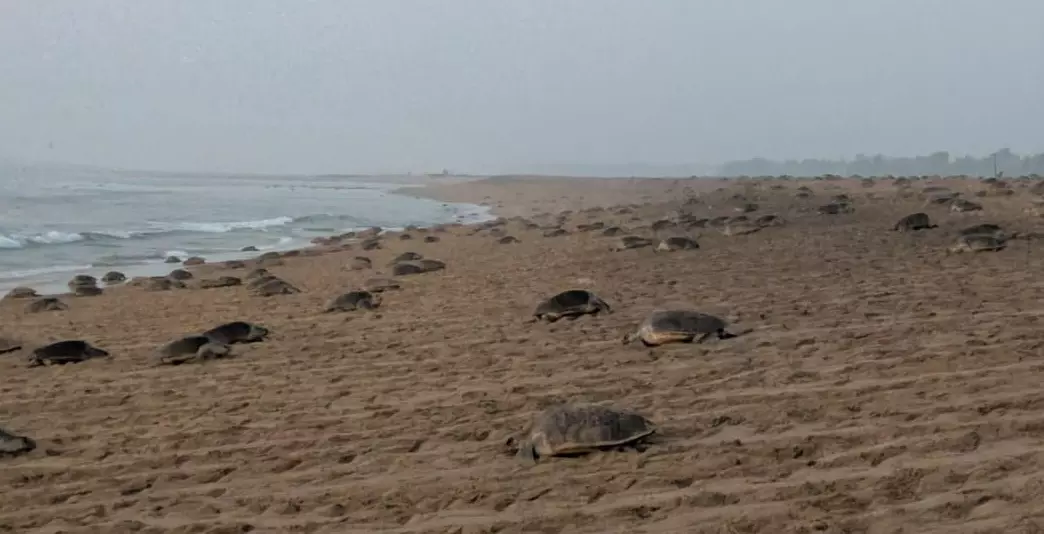
Visakhapatnam: Conservationists in the northern coastal districts of Andhra Pradesh are witnessing a promising season for Olive Ridley turtles, with thousands of their eggs remaining under protection while 2,313 hatchlings have been released into the sea as on March 15 across the Visakhapatnam Circle.
Officials report nesting of a total of 3,460 Olive Ridley with the told number of eggs being taken care of being 3,98,170. Chief Conservator of Forests B.M. Diwan Mydeen is overseeing the conservation programme being implemented through 31 hatcheries across Visakhapatnam, Anakapalli, Vizianagaram, and Srikakulam districts. There are 98 watchers protecting the hatcheries.
Visakhapatnam district has four hatcheries. Records show 521 nests that have yielded 57,776 eggs. 1,262 of the eggs have hatched and the hatchlings released into the sea. Anakapalli has one hatchery documenting 80 nests with 7,427 eggs. No hatchlings have been released here yet.
Vizianagaram has 10 hatcheries with the nesting being 436 with 48,570 eggs. Srikakulam, which has seen the most activity, reports 2,423 nests with 284,397 eggs. 1,051 hatchlings have been released so far. Collectively, these efforts span a 344-km stretch of coastline, forming a crucial conservation zone.
The International Union for Conservation of Nature classifies Olive Ridley turtles as vulnerable. They are protected under Schedule I of the Wildlife Protection Act of 1972. Andhra Pradesh’s coastline is a vital element of their protection and conservation. Srikakulam’s 193-km coastline has emerged as a hotspot, with nesting observed in villages, such as Vajrapukotturu, Kalingapatnam, and Bhavanapadu.
In Vizianagaram, nesting activity is along a 28-km stretch in Chepala Kancheru and Puligaddapalem, while Visakhapatnam's 70-km coastline has seen nesting at R.K. Beach and Sagarnagar. Anakapalli has recorded nesting in Muthyalammapalem, Pudimadaka, and Atchutapuram.
Despite these positive developments, officials acknowledge that threats to the Olive Ridley turtles persist. Fishing operations remain a major cause for turtle mortality, with trawl nets, gill nets, and ghost nets often ensnaring turtles. Additional threats include predation by dogs, jackals, and birds, habitat loss, and disorientation caused by artificial lighting.
Marine pollution from plastics and oil spills, along with challenges posed by climate change, such as altered sex ratios, further complicate conservation efforts. The overlap between nesting season and fishing activities continues to hinder the conservation of Olive Ridley turtles.
This season is building on last year's achievements, when 398,647 hatchlings had been successfully released along the northern coastal districts.
