Massive Coastline Erosion in AP, Says Study from 1990 to 2022

Kakinada, West Godavari districts bear the brunt
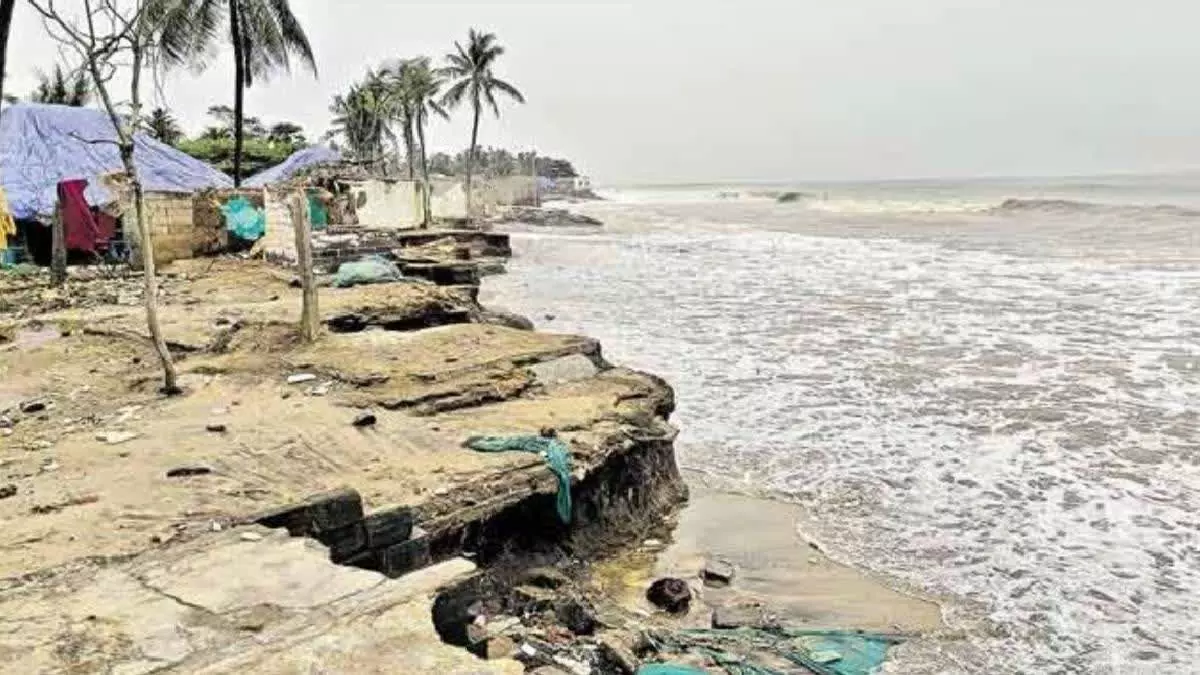
Vijayawada:Andhra Pradesh faced massive coastline erosion in the past three decades, when districts like Kakinada and West Godavari bore the brunt.
A study on shoreline change along AP’s eastern coast, covering the period from 1990 to 2022, showed that erosion was evident in 31 per cent of the total stretch, sand was stable at 24.9 per cent of the length and the sand in 44.0 per cent of the coast was of an accreting nature. AP’s shoreline is stretched over some 1000 kilometres.
The national centre for coastal research quantified the land loss and gain due to shoreline change in hectares by geo-processing between 1990 and 2018 with symmetric difference tools.
Accordingly, the ‘land loss and land gain’ in hectares approximately recorded, respectively, are: Nellore: 266-491; Prakasam:91-399; Guntur:35-1,348; Krishna:1,834-1,322; West Godavari:172-235; East Godavari:2,529-2,456; Visakhapatnam:70-224; Vizianagaram:39-41 and Srikakulam:65-487.
Moreover, the most eroding coastlines located in coastal districts, (hot spots) which require priority attention are: Tirupati-SHAR; Prakasam-Binginpalli: Krishna-Southern coast of Krishna delta, Krishna delta region, Hamssaladeevi beach and Palathumbalapalayem; West Godavari-Pedamaiinavanilanka beach; Konaseema-Odalarevu beach: Kakinada- Bhiravapalem, Coringa Mangroves, West of Hope Island, Uppada, Neman beach, Ponnada and Konapapapetta and Visakhapatnam-Pedanagamayyapalem.
The NCCR working under the Union ministry of earth sciences, has been monitoring shoreline erosion along the Indian coast since 1990 by using remote sensing data and GIS mapping techniques.
The central government has initiated a series of steps to combat sea erosion and protect India’s coastal areas. Accordingly, coastal regulation zone notifications were issued to conserve and protect the unique environment of coastal stenches and marine areas. Mangrove and shelterbelt plantations help to control coastal erosion.
The Union Budget 2023-24 had announced ‘Mangrove Initiative for Shoreline Habitats and Tangible Incomes (MISHTI) to promote and conserve mangroves to work as a bio-shield. The 15th Finance Commission recommended Rs 1,000 crore for resettlement of displaced people affected by erosion for 2021-26 under the national disaster response fund. In addition, an amount of Rs 1,500 crore was earmarked for mitigation measures to prevent river and coastal erosion.
The coastal management information system under the central sector scheme, 'Development of Water Resources Information System’ , has been developed considering the importance of data on coastal processes towards coastal protection measures. The Indian national centre for ocean information services and the ministry of environment have prepared the Coastal Vulnerability Index maps for the entire coastline of India.
Moreover, the AP government is planning to implement the ‘Great Green Wall’, a five km wide and 1,053 km long vegetative barrier, along its coastline to act as a living ecological shield to mitigate the impacts of climate change including cyclones, storm surges, tsunamis, sea-level rise and coastal erosion. Its broader objective is to enhance the state’s green cover to 50 per cent by the year 2047.
BOX
EROSION- DISTRICTS
The shoreline change status among the coastal districts in AP (1990-2022) records that Kakinada suffered erosion to an extent of 52.8 per cent, while the stable stretch was 15 per cent and accretion 32.1 per cent. For other districts, the rates are as follows: West Godavari:erosion-52.5 per cent, stable-2.1 per cent and accretion-45.3 per cent; Krishna:erosion-43.8 per cent, stable-9.3 per cent, accretion-46.9 per cent; Nellore:erosion-33.3 per cent, stable-39.5 per cent, accretion-27.3 per cent; Srikakulam: erosion-31.6 per cent, stable-35.53 per cent, accretion-33.1 per cent; Konaseema:erosion-31.1 per cent, stable-7.3 per cent, accretion-61.6 per cent; Visakhapatnam:erosion-25.9 per cent, stable-51.3 per cent; accretion-22.8 per cent; Prakasam:erosion-25.3 per cent, stable-34.1 per cent, accretion-40.6 per cent; Tirupati:erosion-22 per cent, stable-24.5 per cent, accretion-53.5 per cent; and Bapatla:erosion-20 per cent, stable-5.3 per cent, and accretion-74.7 per cent.
