Leopard sightings spread fear in Tirupati’s academic hubs

5 Feb 2025 7:50 PM IST5 Feb 2025 7:50 PM IST
A series of leopard sightings near university campuses in Tirupati has heightened the anxiety among students and faculty members.
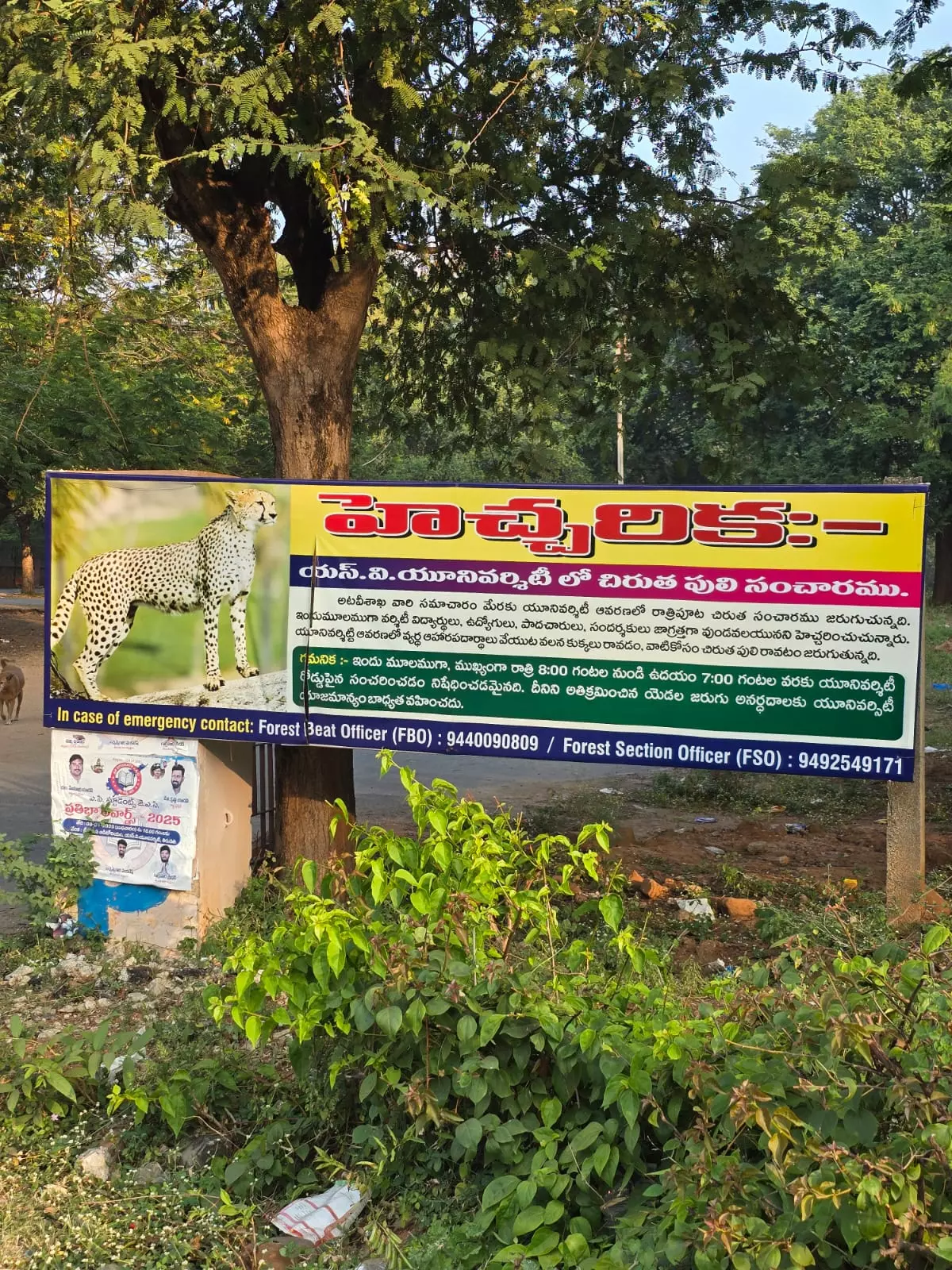
A cautionary sign near Sri Venkateswara University in Tirupati warns students and residents about a leopard being sighted in the area.(Image: DC)
Tirupati: A series of leopard sightings near university campuses in Tirupati has heightened the anxiety among students and faculty members. Fear continues to grip the area, particularly in institutions abutting the forest along the Alipiri-Cherlopalli road, despite assurances of the Forest department that the big cat does not pose a direct threat to humans.
During the past three months, the wild cat has been spotted nearly 15 times, the recent ones being on the campuses of Sri Venkateswara University (SVU), S.V. Vedic University and S.V. Veterinary University. The alarming frequency of encounters has disrupted normal life for students, who are hesitant to step out alone, especially after dark.
A sighting reported near the central library of SVU led to swift action from university authorities and forest officials. But their search yielded no concrete evidence.
Wildlife authorities say movement of any leopard into human-dominated areas is primarily driven by food availability, particularly stray dogs that thrive on food waste disposed near hostels.
“Leopards do not attack humans unless provoked. Their presence in urban fringes is largely due to the easy availability of prey. If waste management is improved, the stray dog population will decline, and the leopard will return to its natural habitat,” a senior forest officer of the Tirupati Wildlife Management Circle maintained.
In response to growing concerns on Wednesday, a four-layered team comprising forest officials, university security personnel, NSS volunteers and students launched a perambulation operation. They combed the areas where the leopard had been sighted in an attempt to identify its hideout.
Forest and university authorities have issued advisories asking students to remain cautious, move in groups, and avoid isolated areas at night. They have also warned against tampering with traps set up for capturing the leopard, emphasising that human interference could hinder efforts to safely relocate the wild cat.
As a long-term solution, wildlife conservationists and university administrators are advocating construction of a 10-foot-high iron fence along the Alipiri-Cherlopalli corridor.
“Universities, in coordination with TTD, municipal authorities and forest department, must take urgent steps to curb the stray dog population through better waste disposal. Without such measures, the issue will persist,” said Dr. P. Harikrishna, NSS coordinator at SVU.
( Source : Deccan Chronicle )

Next Story