Kummari Veedhi Diya Makers Keep Tradition Alive

The Prajwal Vani Welfare Society, under the Visakha Kushideep Project launched in 2013, is training special children with Down syndrome and autism to make diyas and decorative items. This year, they have made 2,000 diyas, including 1,000 candle diyas.
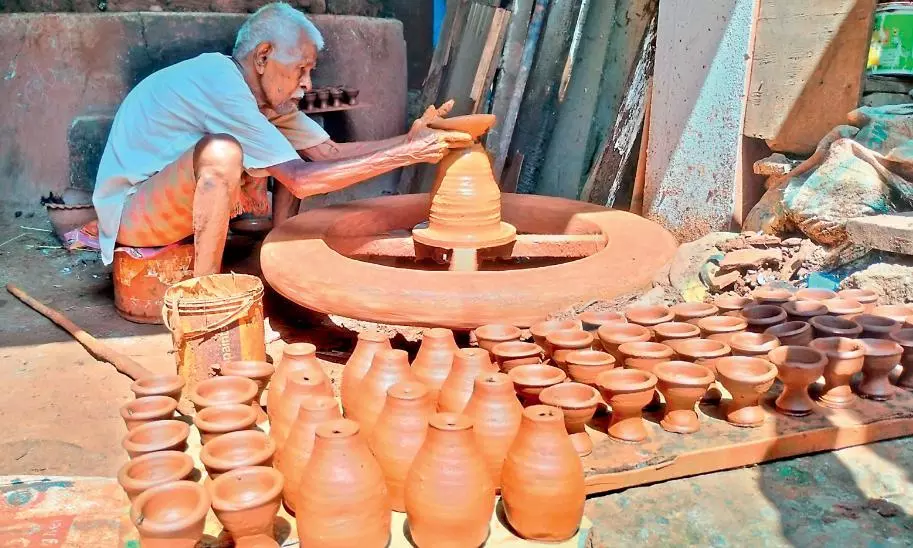
Visakhapatnam: As Diwali approaches, the narrow lanes of Kummari Veedhi in Visakhapatnam’s Akkayyapalem area come alive with traditional diya-making. Here, artisans, including 93-year-old Pardes from Srikakulam, continue the age-old craft despite declining sales caused by machine-made alternatives.
Additionally, local NGOs are empowering especially abled individuals and children to join the festive production, creating new opportunities to continue the city’s pottery heritage.
“I am 93 and will be 94 this year. I make 100 to 150 diyas a day, working from 6 a.m. to 4 p.m. My son helps me in the morning before going to college. My daughter-in-law and grandchildren handle the sales,” Pardes explained. He sells each diya for Rs.2 and a clay flower pot for Rs.6.
The potter said business has declined due to machine-made diyas flooding the market. “After machine diyas came, our sales have gone down. The material for making flower pots is also hard to find now,” he stated. Last year, he made 10,000 diyas on his own and hopes to reach 15,000 this year.
Other potters face similar challenges. Raju, another artisan from Kummari Veedi, said customers prefer imported designs over locally made products, forcing some potters to switch to more commercially viable options.
The Prajwal Vani Welfare Society, under the Visakha Kushideep Project launched in 2013, is training special children with Down syndrome and autism to make diyas and decorative items. This year, they have made 2,000 diyas, including 1,000 candle diyas.
Suchitra, the founder of the society, explained that the children have crafted nine varieties of diyas, including regular basic diyas, specialty chimney diyas, elephant-shaped diyas, designer diyas, star diyas, Panch diyas (a set of 5 diyas), candle diyas, and wick diyas.
Children paint diyas using red, green and blue colours, specifically chosen to support visual recognition for those with Down syndrome. The colours help these children understand, sort and count the diyas.
Further, members of the deaf and visually impaired community are also preparing diyas.
The Visakha Kushideep Project has transformed lives. Aadhithi Varma, an autistic child kept locked at home until age six and a half, joined the centre six years ago. After counselling and support, she began speaking, writing and forming friendships.
She has gone on to complete her 10th through open schooling, apart from vocational intermediate. Aadhithi is now pursuing a regular degree at SKML College while living independently in the city. She contributed to this year's diya painting.
Naveen, who has Down syndrome and limited exposure during early years due to health issues, began learning at age four. He has completed 10th and intermediate and is now pursuing graduation. He travels independently by bus or app-based transport. He has designed 200 of the 2,000 diyas, the society children have made this season.
