Kukkuta Shastram Is Believed to Influence Rooster Fights During Sankranti Festivities

14 Jan 2026 9:16 PM IST14 Jan 2026 9:16 PM IST
Rooted in age-old beliefs and practices, this “science of roosters” is continuing to guide seasoned pandem rayullu (bettors) during the current festive season.
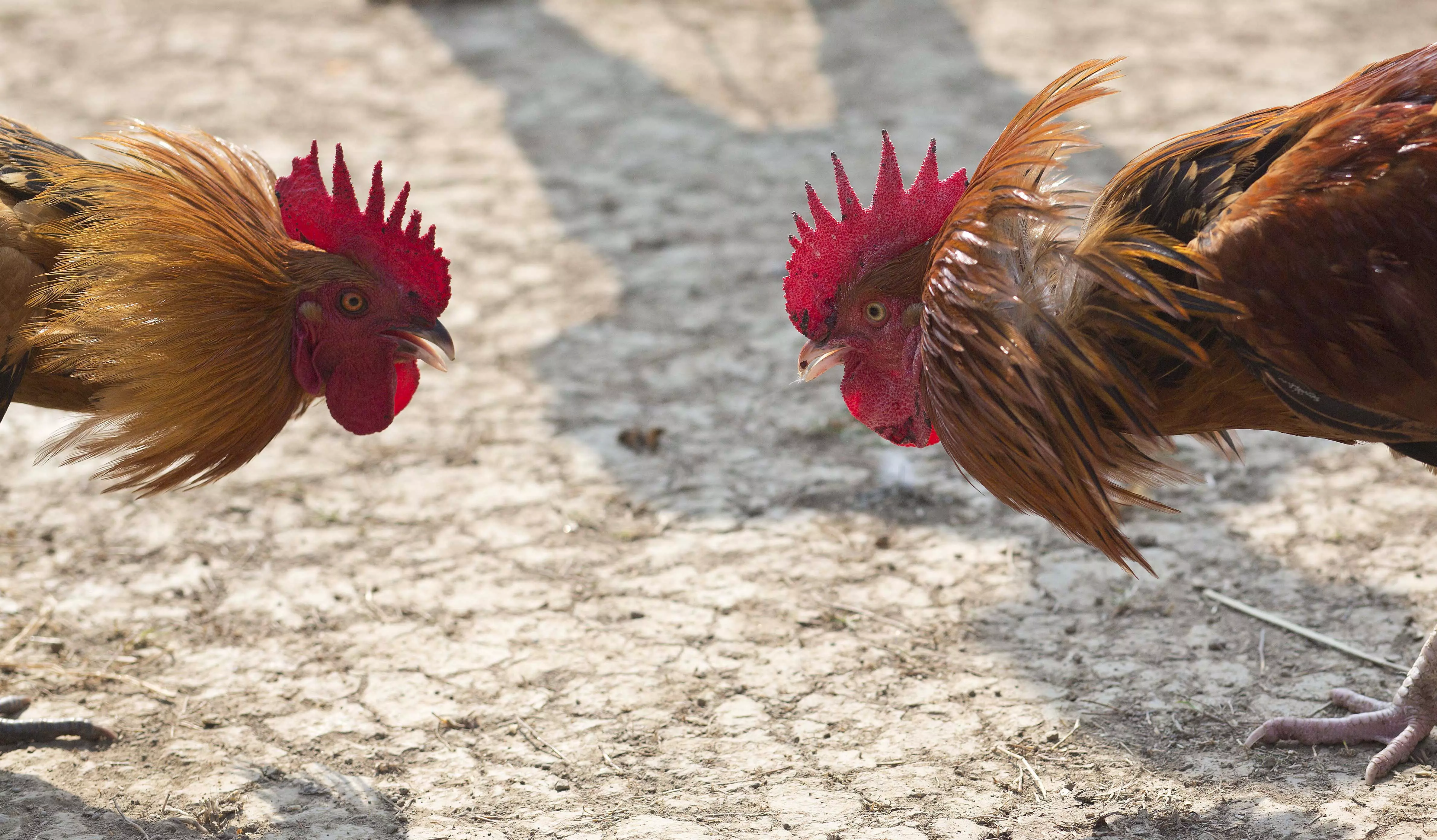
Two roosters ready to fight
VIJAYAWADA: There is an entire Kukkuta Shastra, a traditional body of knowledge, governing the rooster combats. The shastra plays a pivotal role in organising the cockfights during the Sankranti festivities, ranging from selection of the breed to the timing and manner in which birds are released into the arena.
Rooted in age-old beliefs and practices, this “science of roosters” is continuing to guide seasoned pandem rayullu (bettors) during the current festive season.
In Sanskrit, kukkuta means rooster. Practitioners of cockfights believe that no rooster fight should take place without a careful reading of Kukkuta Shastram. Based on this traditional almanac, predictions are made about which rooster will perform better against another, taking into account physical traits, temperament and even celestial influences.
Experts say two factors are crucial in cockfighting: the breed of the rooster and the training it receives. Popular fighting varieties include Tella Nemali, Kodi Nemali, Gowda Nemali, Kaki Dega, Nemali Kakkera, Nalla Kakkera, Rasangi, Gajju Kakkurai, Abras and Erra Dega.
These breeds are classified according to their feather colour and distinctive physical features. Once identified, roosters are trained intensively for nearly 18 months before being introduced into the fighting ring.
Rooster breeders say the day of the week and phase of the moon influence outcomes. Some breeders are convinced that during certain pakshas, the digestive strength of specific breeds weakens, affecting their performance. These aspects could affect Dega roosters, renowned for their aggression and agility, or Nemali breeds, weighing up to three kilograms, prized for their muscular build, sharp eyesight and powerful, pointed claws.
Cockfight enthusiasts point to the ancient palm-leaf manuscripts as proof that the practice has deep historical roots. These texts are said to document rooster varieties, their fighting characteristics and winning combinations.
Astrology too plays a role in decision-making. Based on the day’s star and tarabalam, breeders choose the colour and breed of the rooster that they will release into the arena for a fight.Traditional belief holds that Gowda Nemali and Nemali roosters fare well on Bhogi, Kaki Dega and related breeds dominate on Sankranti, while Dega and Erra Kaki Dega excel on Kanuma.
A Kaki Dega owner P. Rajesh disclosed they nurture their roosters in accordance with Kukkuta Shastram. They consult the almanac before releasing a specific bird into the arena.
Rajesh went on to reveal that the win depends on the star power of the rooster as well as its owner. “Sometimes, we have to face defeat in the arena if the star power of the opposite rooster and its owner is stronger,” he observed.
( Source : Deccan Chronicle )

Next Story