Illegally Modified Kaveri Bus Trapped Passengers Within The Inferno

According to guidelines of the central government’s MoRTH (Ministry of Road Transport and Highways), every bus should have emergency doors, windows, escape hatches, and even trap doors on the floor to ensure passenger safety, alongside passenger convenience
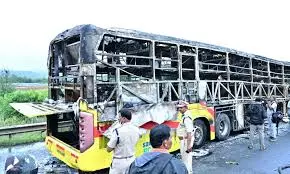
KURNOOL: Most passengers on the Kaveri bus on Friday could not escape after the fire incident as the emergency door got jammed. The illegally re-designed bus obstructed their exit.
According to guidelines of the central government’s MoRTH (Ministry of Road Transport and Highways), every bus should have emergency doors, windows, escape hatches, and even trap doors on the floor to ensure passenger safety, alongside passenger convenience.
However, many travel bus operators modify these approved guidelines to create berths unofficially to maximise profit. In the case of the V. Kaveri bus, though it had been registered in Telangana in 2018, it obtained approvals from union territory Daman and Diu, and subsequently Odisha. In the process, the bus operator changed its officially approved seating to 40 berths, a blatantly illegal act.
Experts pointed out that such restructured buses reduce space for emergency windows and doors, putting passengers at risk and even trapping them, like in Friday morning’s blaze.
“On the lower deck of many sleeper buses, the berth structure or sidewall design reduces usable openings, making it difficult for passengers to exit quickly during an emergency,” said Dr. Ravi Kumar Mandava from the mechanical wing of IIIT-DM, Kurnool. He pointed out that windows should have quick-release latches or breakable glass, be clearly marked as emergency exits in red letters, along with hammers or other tools for escape.
However, bus operators are prioritising profits over passenger safety by developing designs that ignore these critical safety features. “Each bay in the bus, where passengers sleep or sit, should have easily accessible emergency windows. At least six such windows along with the main door, driver exit, and rear exit; can provide adequate safety without taking up much space,” said Prof. V. Naga Prasad Naidu from the Mechanical Engineering Department of JNTU, Anantapur.
Deputy Inspector General of Police Dr. Koya Praveen, who inspected the accident site and the bus, made it clear that the design of the ill-fated bus and facilities did not ensure passenger safety.
Speaking of floor trap doors, these areas are often used by travel bus operators for transporting goods to enhance profits, thereby shutting an escape route that could save lives in an emergency.
