The lab is being set up under the IIT-H’s Technology Innovation Hub on Autonomous Navigation (TiHAN) Foundation
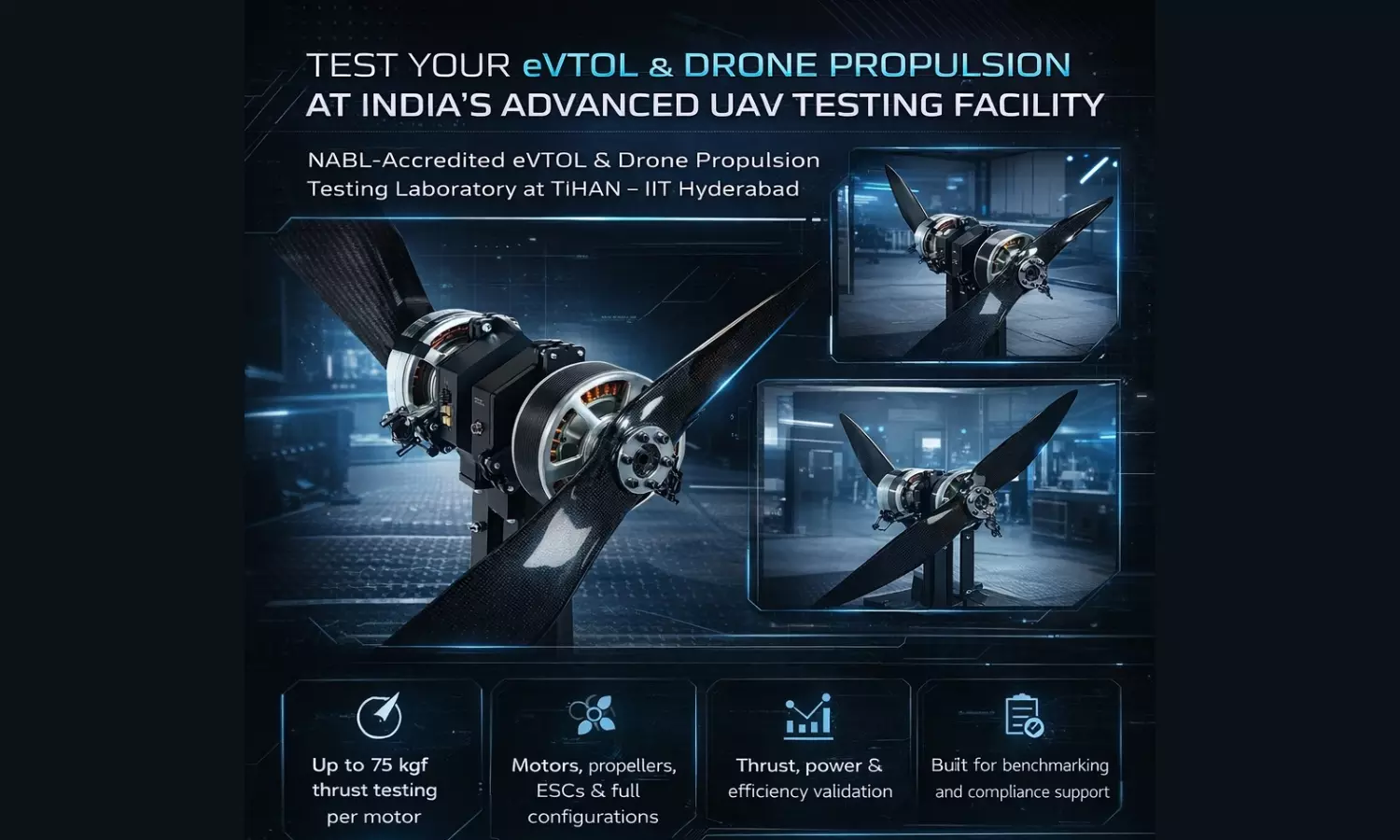
Hyderabad: Many drone start-ups that earlier had to test their vehicles informally or send abroad for validation can now do so in the city, with the IIT-Hyderabad operationalising a lab for the purpose.
IIT-H’s eVTOL (vertical take-off and landing) and drone propulsion testing laboratory is accredited to the National Accreditation Board for Testing and Calibration Laboratories. The lab is being set up under the IIT-H’s Technology Innovation Hub on Autonomous Navigation (TiHAN) Foundation. The accreditation, in line with ISO/IEC 17025 standards, allows propulsion systems to be tested in a calibrated and traceable environment.
For manufacturers, this means thrust and performance data generated at the facility can be used for benchmarking, research documentation and regulatory processes.
According to the institute, the laboratory supports testing of single, coaxial and staggered propulsion configurations, with thrust capacities ranging from 0.1 to 70 kilogram-force. The infrastructure supports testing up to 75 kilogram-force per motor, covering small drones as well as heavier payload platforms.
Dr Santosh Reddy, chief executive officer of TiHAN, said that NABL-accredited measurements include thrust, DC current, DC voltage, power and thrust efficiency at nominal speed. RPM and temperature measurements are also available. The facility can test brushless DC (BLDC) motors with controllers rated from 29 kV to 3000 kV along with propeller assemblies used in unmanned aerial vehicles.
“Reliable propulsion validation is a critical step before deployment. Until now, many teams did not have easy access to accredited testing infrastructure within the country,” the official said.
He added that this facility provided a structured environment where propulsion systems can be evaluated with calibrated instruments and documented performance data.
The lab is expected to support unmanned aerial vehicle original equipment manufacturers, advanced air mobility ventures, defence-linked research units and academic teams. As drone use expands into logistics, surveillance, agriculture and urban mobility, propulsion reliability is emerging as a central concern. With certified testing now available locally, developers have one less barrier between prototype and field deployment.

