Ganesha Worship in North Andhra, a Legacy of Ancient Kalinga

This system links the present-day temples with a spiritual heritage stretching over two millennia.
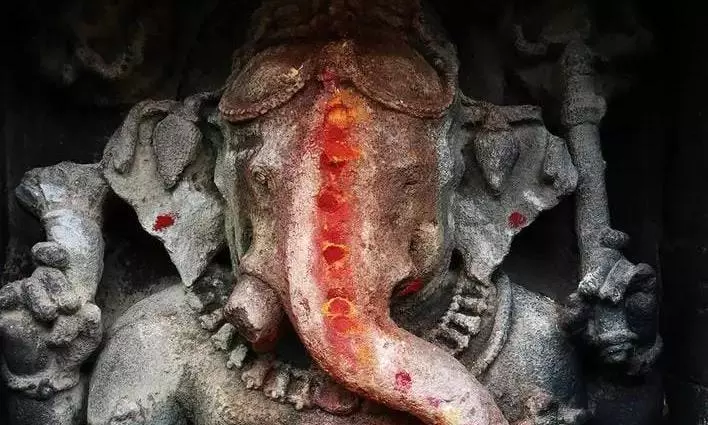
Visakhapatnam: Worship of Lord Ganesha in a little-known town of Srimukhalingam in Srikakulam district -- once the capital of Kalinga Empire -- is an unbroken tradition for long.
This system links the present-day temples with a spiritual heritage stretching over two millennia.
Epigraphist Bishnu Mohan Adhikari notes that traces of Ganesha worship can be identified as early as the reign of Kharavela, the legendary Kalinga ruler of the 1st century BCE. In the rock-cut caves of Kalinga, depictions of Ganesha suggest that the elephant-headed deity was revered even in those early times as the remover of obstacles and that the Lord is first to be worshipped before any sacred ritual.
The Mathara dynasty (4th–6th Century CE), which ruled over parts of modern-day Srikakulam up to Pithapuram, further enriched this tradition.
Numerous Ganesha sculptures from the Mandasa (Srikakulam) region adjoining Mahendragiri stand as testimony. With the advent of the Eastern Ganga dynasty in the 6th Century CE, Ganesha worship received a renewed architectural and devotional expression.
Ruling from their capital Kalinganagara (Mukhalingam), the Gangas built a series of shrines where Ganesha found a central place.
“The Madhukeswara group of monuments in Mukhalingam is particularly significant. Within this complex, devotees can still find the Siddha Vinayaka, Nrutya Ganesha and Varada Ganesha, each with unique iconographic features,’’ Bishnu Mohan told Deccan Chronicle.
He said a striking example is the Dundi Ganapati temple, constructed in the rare Khakhara style of Kalinga architecture in the 8th Century. Another Pidha Deula style shrine dedicated to Ganesha stands at the southern boundary of the Madhukeswara temple, emphasizing the deity’s importance.
Interestingly, Ganesha also appears in the Saptamatrika panel of the Varahi Durga temple at Mukhalingam, reflecting his role as a guardian deity within the Shakta tradition. Ganesha image carved inscriptions of Eastern Ganga ruler Narasimha Deva (1396 CE) further confirm that Ganesha worship was not just popular among common devotees but it also enjoyed royal patronage.
Beyond Mukhalingam, the Ganesha tradition spread across Srikakulam’s sacred landscape. Ancient temples such as the Vaidyanatha, Poteswara, Somewara and Bhimeswara temples house Ganesha idols as Paswa Devatas (integral deities of Siva temples).
Similar traditions continued in Parvatipuram and Vizianagaram districts. Temples like Neeliswara at Narayanapuram, Sangameswara, Kamalingeswara at Gallavali, and Dibbilingeswara feature distinctive Ganesha sculptures, carved into the walls in unmistakable Kalinga style.
The continuity of this tradition is visible even in Odisha’s Puri, where the clay idols of Ganesha crafted for annual worship echo the same iconography seen in Uttarandhra’s ancient temples.
This cultural linkage becomes clearer when one recalls that the Eastern Ganga kings shifted their capital from Kalinganagara (Mukhalingam) to Cuttack under Anantavarman Chodaganga Deva, carrying their devotional and artistic traditions with them.
Ganesha finds a place even in great Vaishnavite shrines such as Srikurmam and Simhachalam, Ganesha. Within the Beda Mandapa of the Varaha Lakshmi Narasimha temple at Simhachalam, a finely carved Kalinga-style Ganesha idol stands in quiet dignity. “:Though primarily Vaishnava shrines, they incorporated Ganesha as he was Agrpūjya—the first to be worshipped,” says Adhikari.
This reflects the Smarta tradition of Kalinga, where harmony among multiple ( five deities) was the cornerstone of devotion.
Today, Ganesha worship in north Andhra is not just a matter of ritual but a living heritage, opines Bishnu Mohan Adhikari, who deciphered 200 plus inscriptions in these regions. Each idol carved in stone tells a story of continuity, faith and a deep-rooted connection of the region with ancient Kalinga’s cultural legacy.
