EOS-05 Completes First Orbit-Raising Manoeuvre

Satellite moves closer to designated geosynchronous orbit
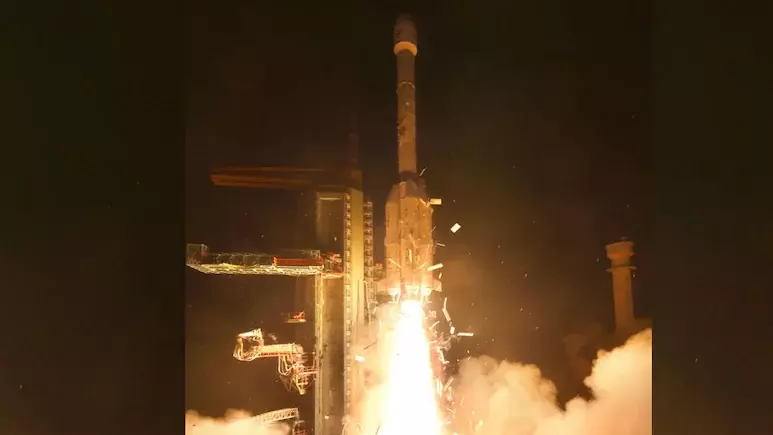
Nellore: India’s latest Earth observation satellite EOS-05 has successfully completed its first orbit-raising manoeuvre, marking a crucial step towards reaching its designated geosynchronous orbit (GSO) at 85.5° East.
The manoeuvre was carried out on September 5 at 8.19 p.m., with the satellite’s Liquid Apogee Motor (LAM) firing for 5,406.4 seconds. Following the manoeuvre, the satellite is estimated to be in an orbit of 20,000 km × 31,129 km. ISRO said further orbit-raising manoeuvres would be conducted in the coming days to place EOS-05 in its operational orbit.
EOS-05 was launched aboard GSLV-F17 from Sriharikota on September 4 and injected into a sub-geosynchronous transfer orbit (Sub-GTO). ISRO describes it as a state-of-the-art Earth observation spacecraft and India’s first imaging satellite designed to operate from geosynchronous orbit.
The GSLV-F17 placed EOS-05 at an apogee of around 31,000 km, higher than the planned 29,000 km, reducing the propulsion work required. Its perigee was around 171 km.
Weighing 2,367 kg, EOS-05 is the heaviest satellite launched by a GSLV so far. Once positioned in geosynchronous orbit, it is expected to provide high-frequency Earth imaging and continuous monitoring of large geographical regions. The satellite has an operational life of about nine years, according to ISRO Chairman V. Narayanan.
ISRO plans additional orbit-raising manoeuvres to position EOS-05 in its final orbit, around 36,000 km above Earth.
