Elephant Tusks Seized In Telangana Raise Suspicions Of Seshachalam Link

On June 25, the SOT arrested Rekulakunta Prasad, a driver from Rajula Colony in Rayachoti, Annamaiah district, and recovered two elephant tusks weighing 5.62 kg.
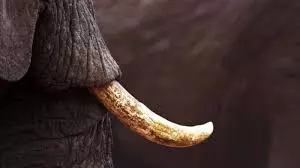
TIRUPATI: A recent seizure of elephant tusks by the LB Nagar Zone’s Special Operations Team (SOT) in Telangana has raised concerns over a possible resurgence of wildlife smuggling networks linked to the Seshachalam forests. Long known as a hub for red sanders smuggling, the region is now under scrutiny for potential ivory trafficking activity.
On June 25, the SOT arrested Rekulakunta Prasad, a driver from Rajula Colony in Rayachoti, Annamaiah district, and recovered two elephant tusks weighing 5.62 kg. The tusks, estimated to be worth around ₹3 crore in the international market, were allegedly being smuggled for sale.
During preliminary questioning, Prasad, who has a prior record in red sanders smuggling, claimed the tusks originated from the Seshachalam forests. This statement has triggered concern within the Andhra Pradesh forest department, particularly in Tirupati district, where senior officials have launched an internal inquiry.
The case has also brought renewed attention to an incident from 2013, when a wild elephant died in the Talakona range of the Seshachalam forests. At the time, forest officials extracted the tusks and stored them at the Bhakarapeta forest depot after cataloguing their dimensions and weights.
In 2023, a major security lapse occurred when two tusks and two 12-bore pump-action guns were reported stolen from the same depot. A case was registered but no arrests were made, and the investigation remains unresolved.
The timing and nature of the theft, combined with the recent seizure, have led to speculation that the tusks recovered in Telangana could be the same as those stolen from the forest depot. “We cannot rule out the possibility. The physical characteristics match, but scientific confirmation is required”, said a senior forest official, speaking on condition of anonymity.
Police from both Telangana and Andhra Pradesh, in coordination with their respective forest departments, are reportedly considering DNA testing to establish the origin of the ivory. “As per the Wildlife Crime Control Bureau (WCCB) protocol, DNA profiling can help identify the biological source of ivory. The WCCB, under the Ministry of Environment, Forest and Climate Change, maintains a database for such investigations”, the forest official added.
However, forest officials in Andhra Pradesh have denied that the seized tusks were part of their inventory, a contradiction that has complicated the investigation. Adding to the complexity are growing concerns about counterfeit ivory. Officials have indicated that smuggling networks may be using 3D-printed replicas to divert attention while trafficking genuine ivory across borders.
According to sources, authorities from both states are working to verify the origin of the seized tusks. WCCB experts may be brought in once the ivory is formally handed over to the Andhra Pradesh Forest Department. “Only a thorough investigation, including DNA analysis and a complete audit of forest stock, can determine whether ivory trafficking has indeed re-emerged in the Seshachalam region”, the forest official said.
