Eastern Ghats Offer Perfect Climate for Wallabies, IGZP Sees Reproductive Success

With the wallaby joey now part of IGZP’s vibrant ecosystem, young visitor ahiti remarked, “The zoo continues to be a site of both biodiversity and conservation success, but I hope to see more global species represented in Visakhapatnam’s Zoo.”
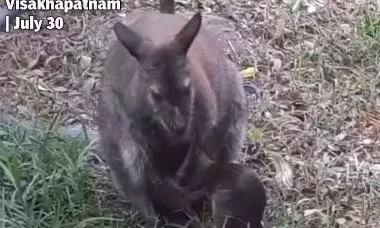
Visakhapatnam: The Eastern Ghats offer a suitable habitat for wallabies -- and the population at the Indira Gandhi Zoological Park (IGZP) is steadily increasing.
The zoo recently celebrated the birth of a red-necked Wallaby joey, who is safely nestled in its mother’s pouch. This new arrival brings the total number of wallabies at IGZP to three, highlighting the zoo’s success in creating a nurturing environment for these temperate-region marsupials.
Red-necked Wallabies, native to Australia’s forests and bushlands, are characterised by their reddish neck fur and agile movements.
Education officer at IGZP, B Divya, stated, “The joey’s arrival is not just a moment of wonder for visitors; it’s a testament to IGZP’s careful management and climate adaptation practices.”
Zoo officials have noted that the moderate weather of the Eastern Ghats, combined with habitat enrichment efforts, has allowed the wallabies to adapt well to their new environment in Visakhapatnam. While IGZP does not currently house kangaroos, which are often viewed as the larger relatives of wallabies, there is a growing interest in marsupial species among local visitors and conservationists.
Divya xplained, “Wallabies are compact and forest-dwelling, standing 60–90 cm tall and weighing between 15–25kg. In contrast, kangaroos can reach heights of up to 2 metres and weigh as much as 90kg, thriving in Australia’s open plains. Both species belong to the macropod family and raise their young, called joeys, in pouches. But they differ significantly in size, habita and social behaviours, she said.
With the wallaby joey now part of IGZP’s vibrant ecosystem, young visitor ahiti remarked, “The zoo continues to be a site of both biodiversity and conservation success, but I hope to see more global species represented in Visakhapatnam’s Zoo.”
