Death of PVTG Tribal Highlights Transport Woes in Anakapalli Agency

A PVTG man's death has exposed poor road connectivity in Anakapalli agency after his family was forced to carry his body to their village.
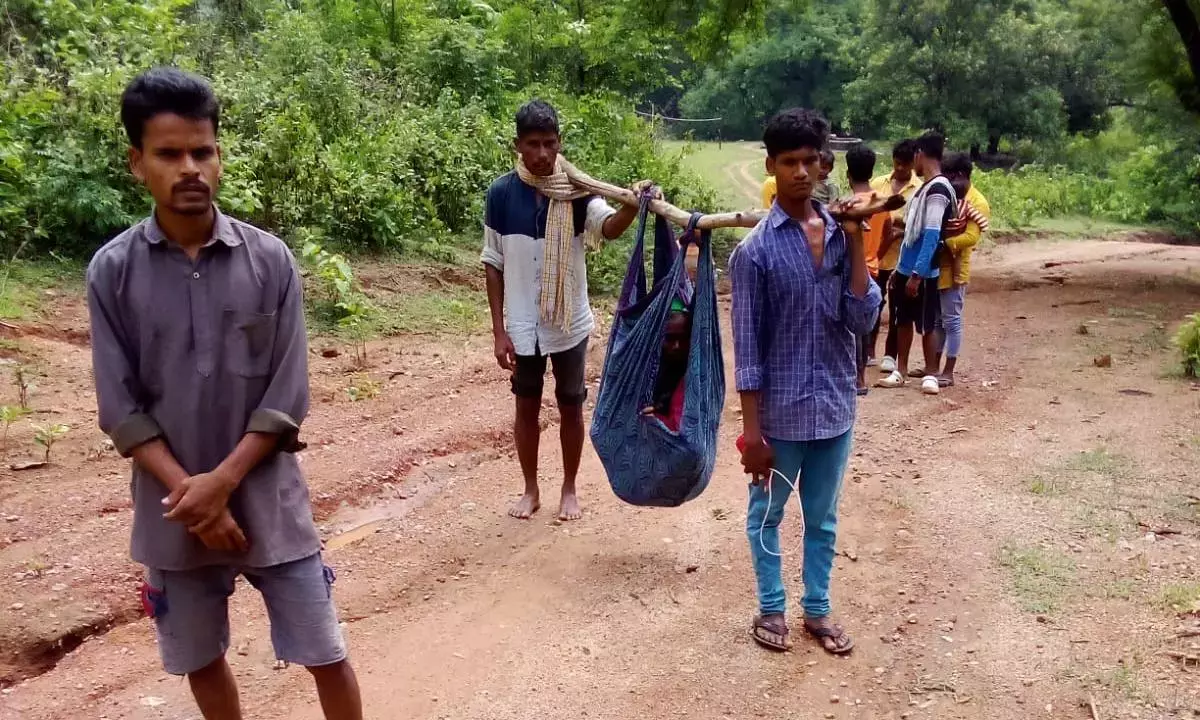
Korra Subbarao, 56, a resident of Kondu, a Particularly Vulnerable Tribal Group (PVTG) village in Arla panchayat of Rolugunta mandal in Anakapalli district, died while undergoing treatment at the Narsipatnam Hospital on Sunday morning.
Unable to afford the cost of transporting the body to Kondu, his family waited for five hours at the hospital before an ITDA ambulance could be arranged through the intervention of officials.
The Narsipatnam area superintendent informed the family that the ambulance service is restricted to the agency limits and could not be extended to villages at the foothills like Kondu. Subbarao’s son Kondababu then sought help from CPM district committee member K. Govinda Rao, who escalated the matter to the Narsipatnam RDO. After contacting the Paderu ITDA project officer, an ambulance could be arranged to transport the body from Narsipatnam Area Hospital to Pithrigadda village.
However, midway between Arla and Pithrigadda, the ambulance failed to climb the steep incline. Subbarao’s family and villagers thus had to carry the body manually for one-and-a-half kilometres to reach their village.
The death has once again highlighted the poor state of road connectivity in the region. According to villagers, funds amounting to ₹4.10 crore had been sanctioned under the NREGA scheme in December 2024. Villagers allege that only crushed stone had been laid in the name of the road, which got washed away by rains. Though four culverts had been constructed in 2023–24 spending ₹29 lakh, they are not connected by roads.
Finally, tribal residents on their own filled potholes to make the stretches between culverts navigable. But this can be used only by two-wheelers. The family and villagers had to thus carry Subbarao’s body Kondu by foot.
Tribal leaders have demanded that a proper road be constructed, so that they are not forced to bear hardships during emergencies.