Constitution Empowers Even Tea-Seller to Become PM: Naidu

Welcoming CJI Gavai, Naidu praised his simplicity and sense of fairness.
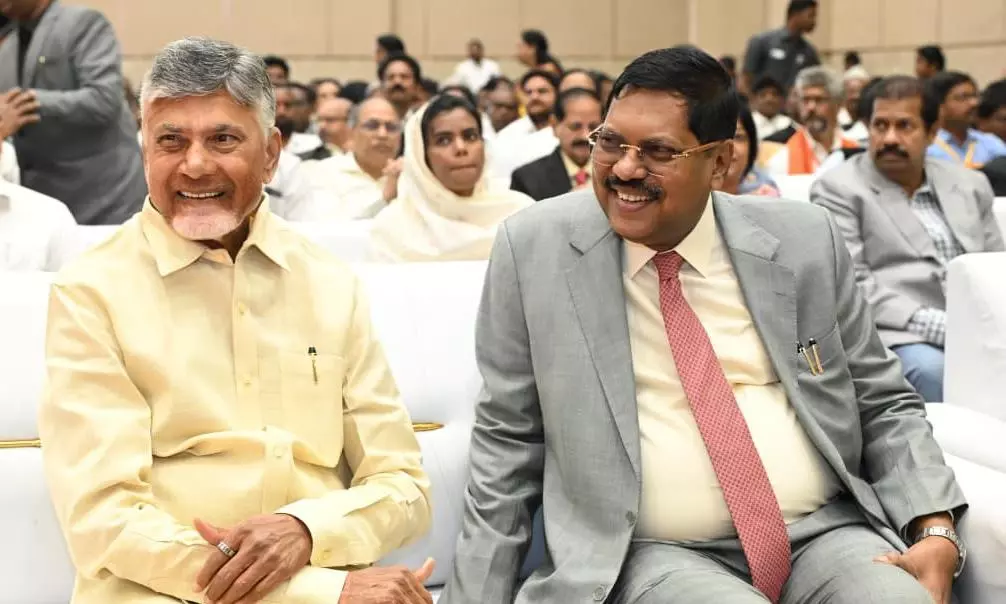
Vijayawada: "Our Constitution made it possible for a tea-seller to become the Prime Minister. That is the power of democracy and equality,” claimed Chief Minister N. Chandrababu Naidu on Sunday.
He was speaking at an event marking the 75th anniversary of the Indian Constitution, in Mangalagiri, organised by the state high court advocates association.
Also present were Supreme Court Chief Justice, Justice Bhushan Ramakrishna Gavai, AP High Court Chief justice Justice Dhiraj Singh Thakur, senior judges and advocates. The dignitaries jointly inaugurated the conference by lighting a traditional lamp.
Welcoming CJI Gavai, Naidu praised his simplicity and sense of fairness. “Though he holds the highest judicial office, Justice Gavai remains humble and deeply committed to equality. His judgments reflect a strong sense of justice and compassion,” Naidu said.
Paying tribute to framer of Indian Constitution, BR Ambedkar, the chief minister described him as the “architect of a set of extraordinary laws that safeguard the rights of all citizens.” Democratic equality, he said, had given India the opportunity to prove its strength and unity.
Reflecting on India’s economic progress, Naidu said the country had transformed remarkably through reforms. “In 2014, India ranked as the world’s 11th-largest economy. Today, we have emerged as the fourth largest. Next year, we hope to become the third largest and, by 2038, the second largest. By 2047, India aims to be the world’s largest economy,” he said.
The CM said, “When democracy goes astray, the judiciary serves as its corrective force. The judiciary can set democracy back on the right track.”
Naidu also commented on the changing media landscape, noting, “In the age of social media, everyone has become a writer and editor, sometimes misusing the medium for personal attacks.” He stressed the need for social and economic equality, saying that public policies must focus on bridging the gap between rich and poor.
“We must build a society where opportunities are equal for all. Only then can inequalities disappear. Our goal is to create a healthy, wealthy and happy society,” he said, urging collective effort toward inclusive growth.
Naidu praised PM Modi’s upholding of the tenet of Vasudhaiva Kutumbakam (one world–one family), adding that nations must respect one another’s sovereignty. He cited the Centre’s Operation Sindur as an example of India’s firm stant on international cooperation and national security.
The Chief Minister said the youthful population and abundant human resources were the natioin’s greatest strengths. He called on wothies like Chief Justice Gavai to continue guiding the nation toward justice, equality and progress.
Constitution reflects India’s democratic ethos, says AP Chief Justice
Vijayawada: Chief Justice of the Andhra Pradesh High Court, Justice Dhiraj Singh Thakur, said on Sunday that the adoption of the Indian Constitution marked the beginning of a new era rooted in equality, accountability and social justice. He was speaking at a conference marking 75 years of the Constitution.
Justice Thakur said India had travelled a long democratic journey since the Constitution came into force, overcoming several challenges. Before Independence, he noted, British rulers exploited India’s wealth and suppressed its people without any accountability. “The struggle for freedom and self-rule emerged from this era of exploitation,” he said, adding that the Constitution was drafted during an emotional and transformative period in the country’s history.
He said the framers of the Constitution ensured equal opportunities for all citizens while providing special safeguards for the poor, backward communities and minorities. He highlighted the thoughtful inclusion of reservations for Scheduled Castes and Scheduled Tribes, emphasising that national integration, democracy and social cohesion remained guiding principles during the drafting process.
Justice Thakur also referred to several landmark judgments—Shankari Prasad, Sajjan Singh, Golaknath, Kesavananda Bharati and S.R. Bommai—which he said had significantly shaped constitutional interpretation in India.
He additionally cited major legislative reforms such as the Women’s Reservation Act, the Prevention of Sexual Harassment at Workplace Act and the Lokayukta Act as examples of the justice system’s continued evolution in line with constitutional values.
