CM Naidu Meets Nirmala Sitharaman, Seeks Centre’s Support To Reduce Shrimp Feed Costs

The Chief Minister requested the Centre to promote the domestic market for shrimp and aquaculture products.
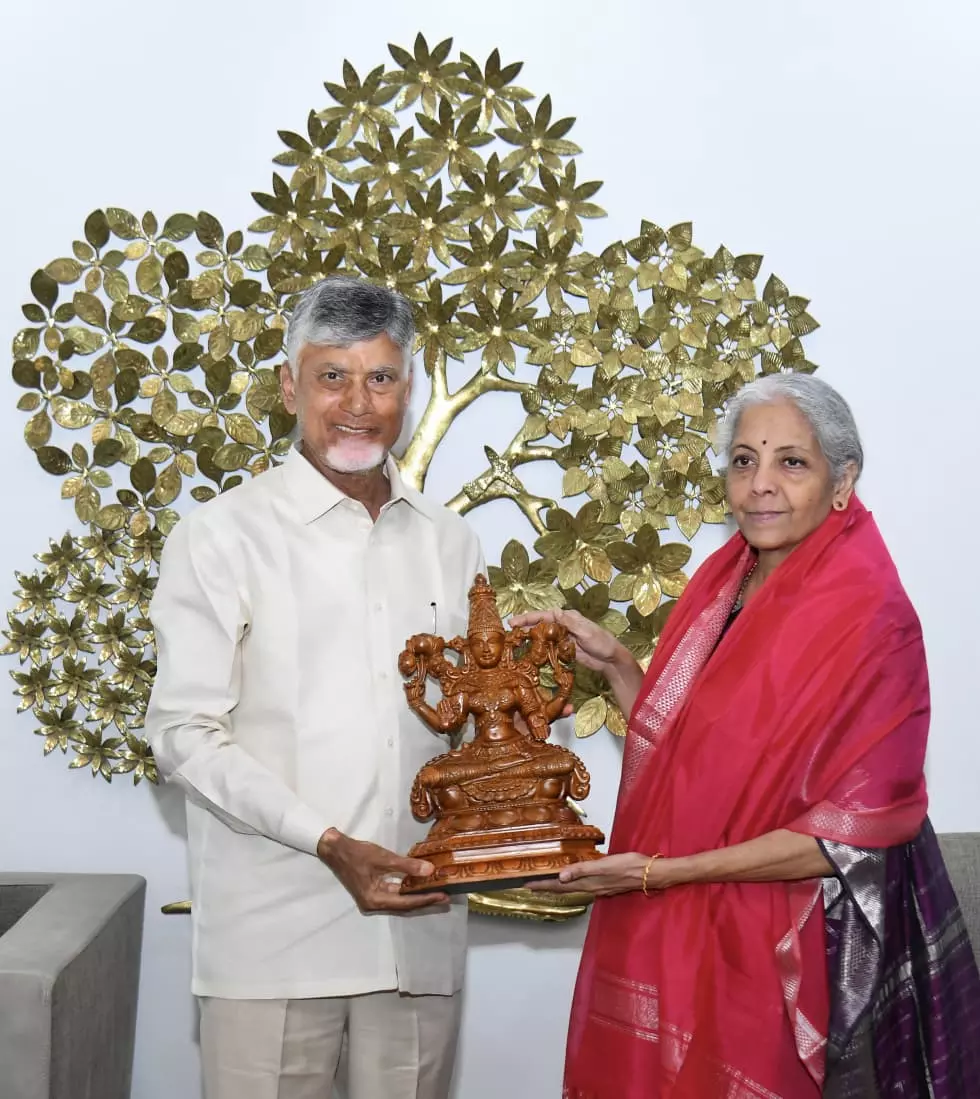
Amaravati: Chief Minister N Chandrababu Naidu urged the Union Government to adopt policy measures to stabilise the prices of raw materials used in shrimp feed production, highlighting that the sharp increase in input costs is severely affecting aqua farmers and seafood exports.
During a meeting with Union Finance Minister Nirmala Sitharaman at the Chief Minister's Camp Office on Friday, the Chief Minister said the aquaculture sector provides livelihoods to lakhs of farmers, workers, processing units, exporters, hatcheries, feed manufacturers and several allied industries. Even a minor disruption in feed availability has a direct impact on aqua farmers' livelihoods and export performance, he noted.
Referring to representations made by the Shrimp Feed Manufacturers Association, the Chief Minister said shrimp feed prices increased significantly between January and April this year, pushing production costs up by more than 20 percent. Fish feed prices increased from Rs.1.55 lakh to Rs.2.40 lakh per tonne, fish oil from Rs.2.80 lakh to Rs.4.40 lakh per tonne, and soy lecithin from Rs.68,000 to Rs.1.10 lakh per tonne. Together, these increases have added nearly Rs.25,000 to the cost of producing one tonne of shrimp feed.
The Chief Minister requested the Centre to promote the domestic market for shrimp and aquaculture products, encourage Farmer Producer Organisations (FPOs), strengthen market linkages, support branding, processing and retail integration and establish an institutional framework to protect the sector from fluctuations in global demand.He also sought financial assistance through the National Fisheries Development Board (NFDB) for establishing the Andhra Pradesh Prawn Producers Coordination Committee with a Rs.100-crore corpus fund.
The Chief Minister urged the Union Government to negotiate with the United States to reduce tariffs on Indian seafood exports. He pointed out that the US has imposed a 5.77 percent countervailing duty on Indian shrimp exports and is also considering an anti-dumping duty. He warned that the proposed reciprocal tariffs by the US administration would severely affect Andhra Pradesh, which accounts for nearly 80 percent of India's shrimp exports.He noted that nearly 30 lakh people in the State depend on the aquaculture sector for their livelihood and requested the Centre to seek either the removal of the existing 30 percent customs duty on seafood exports or an exemption in the interest of farmers. He also urged the Centre to identify and expand access to alternative international markets for aqua products.
The Chief Minister informed the Union Finance Minister that placing tobacco products in the highest GST slab since the introduction of GST has adversely impacted tobacco farmers. Industry stakeholders have expressed concern over the heavy excise duty on cigarettes, which is further subjected to GST.He said manufacturers in Andhra Pradesh and Karnataka have reduced procurement. As a result, this year's auction process in Andhra Pradesh has been significantly slower than last season. Against an estimated production of 230 million kilograms, only 34 million kilograms have been procured so far.The Chief Minister warned that reduced procurement is affecting farmers, agricultural labourers, auction workers, transport operators and MSMEs. He also highlighted that the widening price gap between legal cigarettes and illicit tobacco products could encourage smuggling and tax evasion. He urged the Centre to take immediate measures to safeguard tobacco farmers.
The Chief Minister sought full Central support for the Rayalaseema Integrated Horticulture Development Plan. He informed the Union Minister that Kurnool, Anantapur, Kadapa, Chittoor, Sri Sathya Sai, Nandyal, Annamayya, Tirupati, Prakasam and Markapuram districts together account for 55 percent of the State's horticultural production.The State aims to increase the horticulture cultivation area to 14.41 lakh hectares and raise production to 435 lakh metric tonnes by 2030.He said the development of 201 horticulture clusters with an investment of Rs.14,906 crore would benefit nearly nine lakh farmers.To ensure water security, the State proposes 23 irrigation projects at an estimated cost of Rs.20,884 crore, creating irrigation potential for nine lakh new acres while stabilising irrigation in 4.3 lakh acres.The Chief Minister also proposed upgrading 5,721 kilometres of rural roads at a cost of Rs.4,562 crore to improve connectivity, reduce transportation costs and enhance market access for farmers.The government expects investments of Rs.40,000 crore from the public sector and Rs.60,000 crore from the private sector under the plan. These investments are projected to generate an annual Gross Value Added (GVA) of Rs.81,000 crore and create employment opportunities for 19.7 lakh people.The plan also targets a 10 percent increase in agricultural productivity through modern technologies while reducing post-harvest losses by 4.5 million metric tonnes.
The Chief Minister said the initiative aligns with the objectives of Viksit Bharat and Swarna Andhra 2047.He invited the Union Finance Minister to participate in the launch of the Horticulture Hub on August 6 and 7.
The Chief Minister informed the Union Finance Minister that the State has proposed the establishment of the Indian School of Agriculture (ISA) as part of the Rayalaseema Integrated Horticulture Development Plan, in partnership with Reliance Industries.He said the institution would serve as a global Centre of Excellence for agricultural innovation, focusing on artificial intelligence, digital agriculture and climate resilience.The ISA will promote advanced research in climate-smart agriculture, digital farming, post-harvest systems and global market intelligence. It is also expected to attract investments in food processing, logistics and agri-tech through public-private partnerships.Reliance Group will serve as the anchor partner and facilitate the establishment of startups, incubators and accelerators. The institution also plans to collaborate with global companies including John Deere, Microsoft, Google, NVIDIA, Nestlé and Cargill for research and innovation.The ISA will offer world-class academic programmes, including an MBA in Agricultural Leadership, a Master's in Digital Agriculture, and Executive MBA programmes.The Chief Minister said the State Government will sign an MoU with Reliance Group on August 3 and land for the institution has already been identified.He added that beyond academic excellence, the Indian School of Agriculture will function as a premier think tank and innovation engine for Andhra Pradesh's agricultural transformation and requested the Centre's support in establishing this prestigious institution.
