Caught Between Storm And Debt, Fisherwomen Face Uncertainty

Despite playing a crucial role in the fisheries economy, fisherwomen allege they receive little institutional support.
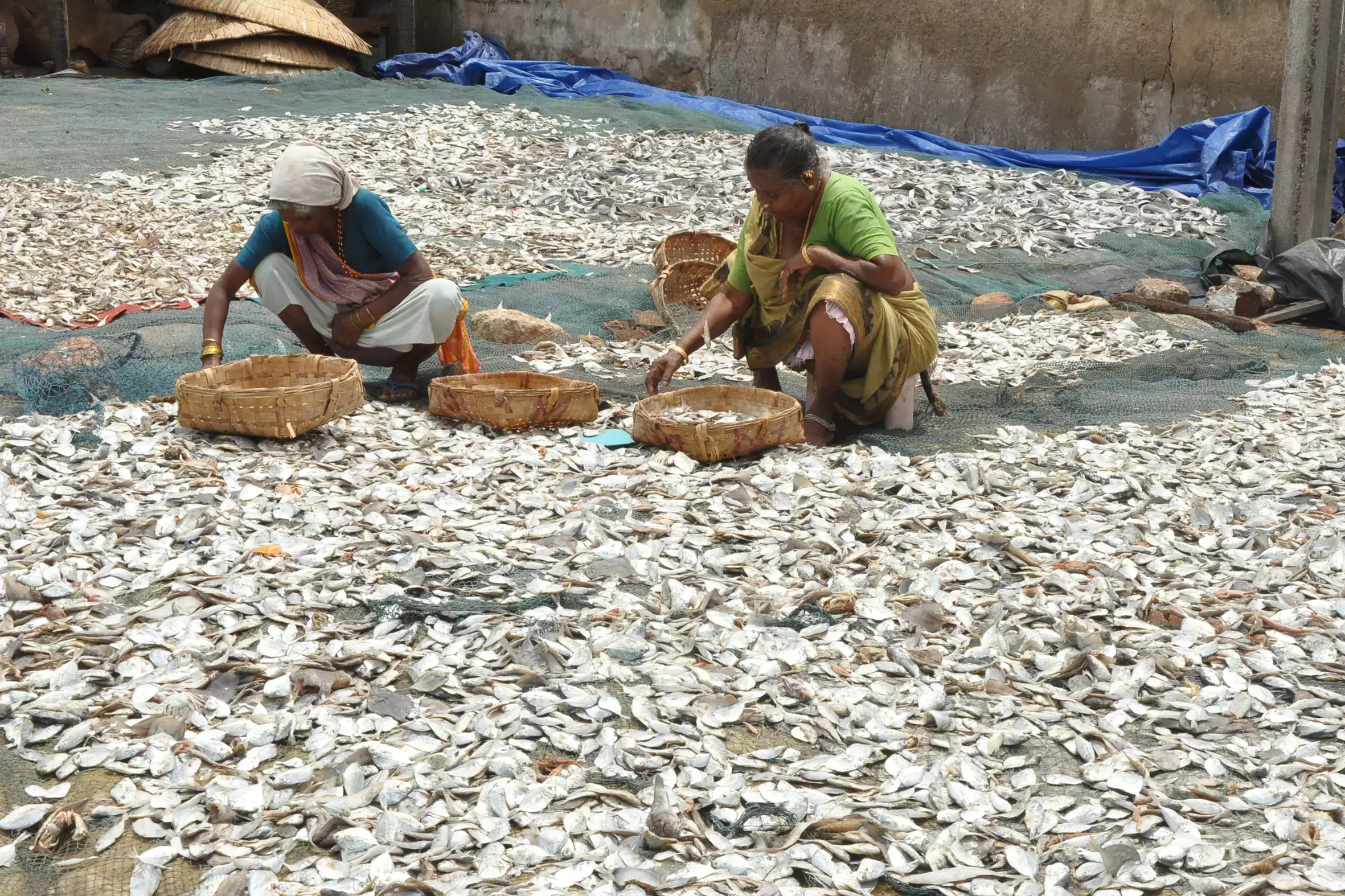
Visakhapatnam: As the cyclonic threat intensifies off the Andhra Pradesh coast, concern is mounting among fisherwomen across the coast, whose livelihoods have been severely disrupted by rough weather and the suspension of fishing activities.
While the authorities have warned fishermen not to venture into the sea, women involved in fish trading, processing and marketing say the crisis is pushing them deeper into financial uncertainty.
Often overlooked in discussions about the fisheries sector, fisherwomen form the backbone of the post-harvest economy.
Their work begins as soon as fishing boats arrive at the harbour.
They participate in fish auctions, purchase fish in bulk, transport the catch to markets, clean fish for customers, process and dry fish, and ensure products reach consumers.
For thousands of coastal families, these women are key contributors to household income.
"The fish trade requires significant investment and carries enormous risk," said Nolli Mangamma, a fish trader at the fishing harbour.
"If market prices decline after we purchase fish at auctions, we need absorb the losses.
There’s no guarantee to profit."
According to the women, the recent deep depression and intensifying cyclone have brought fishing activities to a standstill, drastically reducing the availability of fresh fish and disrupting the entire supply chain.
With fewer boats going out to sea and catches dwindling, their daily income has been severely affected.
"Our livelihoods have been thrown into uncertainty," said C Korlamma.
"Whenever the weather turns hostile, many of us depend on the dried fish trade to survive.
It provides some security when fishing operations are suspended."
However, even dried fish trading depends heavily on favourable weather conditions.
Continuous cloud cover and cyclone-related rain pose a major threat to the drying process.
"A light shower is enough to ruin fish laid out for drying," Potti Manga explained.
"Once the fish gets wet again, it loses quality and market value, resulting in heavy losses."
B Polamma said she has repeatedly suffered financial setbacks due to unpredictable weather.
"There have been times when I spent Rs 20,000 to Rs 30,000 to purchase fish, only to recover less than half of my investment after selling it," she said.
The women say the scale of investments involved in fish trading is often underestimated.
Many traders invest between 10 lakh and 20 lakh in their businesses.
So they rely heavily on loans and informal borrowing.
"I have debts of nearly `10 lakh," said N Nallamma.
"It is impossible to continue in this trade without borrowing.
Taking risks is part of our profession, but the burden becomes unbearable when business comes to a halt," she adds.
Despite playing a crucial role in the fisheries economy, fisherwomen allege they receive little institutional support.
They point out that government welfare schemes and compensation packages are largely focused on fishermen operating boats, while women engaged in trading and processing activities remain outside the safety net.
They also say loans available through Self-Help Groups are inadequate to meet the substantial capital requirements of the fish business.
Several women noted that fisherwomen associations at the harbour have yet to deliver meaningful benefits.
The economic strain has become so severe that some women seek domestic work on days when fish sales are poor.
As the cyclone threat looms over the coast, many fear that prolonged adverse weather could push already vulnerable fishing families deeper into debt and hardship.
