Bharatiya Vigyan Sammelan in Tirupati from Friday
The Tirupati meet marks the seventh edition of the BVS and the first in South India.
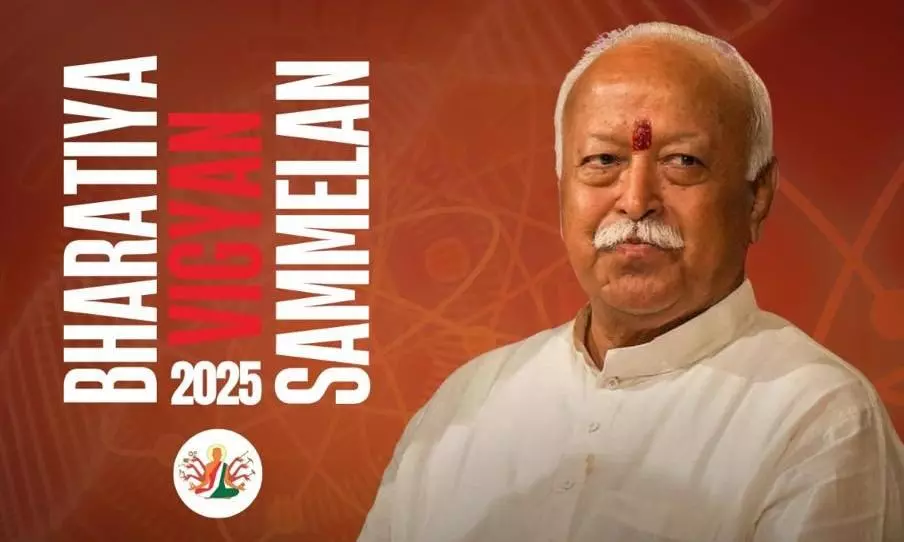
Tirupati: A national-level science conference, styled as the Bharatiya Vigyan Sammelan (BVS-2025), starts at National Sanskrit University in Tirupati on December 26.
The event is aimed at linking India’s traditional knowledge systems with contemporary scientific research.
The Tirupati meet marks the seventh edition of the BVS and the first in South India. The inaugural session would be attended by Union minister of state for science and technology Jitendra Singh, Chief Minister Chandrababu Naidu and RSS chief Mohan Bhagwat, among others.
Organised under the theme “Bharatiya Perspective of Integral Development”, the meet seeks to examine how ideas rooted in India’s civilizational experience can respond to present-day challenges in areas such as health, agriculture, sustainability and technology.
The valedictory session would feature deputy chief minister Pawan Kalyan, PM’s Economic Advisory Council member Shamika Ravi and secretary to the department of science and technology, Abhay Karandikar.
The four-day conference would bring together 1,500 delegates. Among the eminent speakers are former CSIR director general Shekhar C Mande, former DRDO chairman G Satheesh Reddy, national innovation foundation director Arvind C Ranade and Alok Chaturvedi of Purdue University.
Directors of IITs, heads of national research institutions and vice-chancellors of universities would also take part.
A central focus of BVS 2025 is to strengthen links between traditional practices and modern scientific methods, while encouraging science communication in regional languages alongside English. The meet would highlight contemporary scientific contributions from India, showcase grassroots innovations by farmers, artisans and local communities, and explore practical applications of traditional science and technology in health, agriculture, sustainability and ecological conservation.
The programme includes discussions on holistic health systems such as Ayurveda, Vriksha-Ayurveda and Pashu-Ayurveda under the One Health approach, Indian mathematics and astronomy, architecture and civil engineering rooted in Vastu principles, language and linguistics, agriculture and allied sectors, materials and metallurgy, energy and resource conservation, biodiversity, performing arts, traditional crafts and design, and policy and intellectual property issues related to science and technology.
A science expo would run alongside the academic sessions, along with programmes for students, a science book fair, science magic shows and school-level competitions.
