AP’s Troubling History of Tragedies at Shrines

Simhachalam deaths revive safety concerns at temples; experts urge urgent structural, policy reforms.
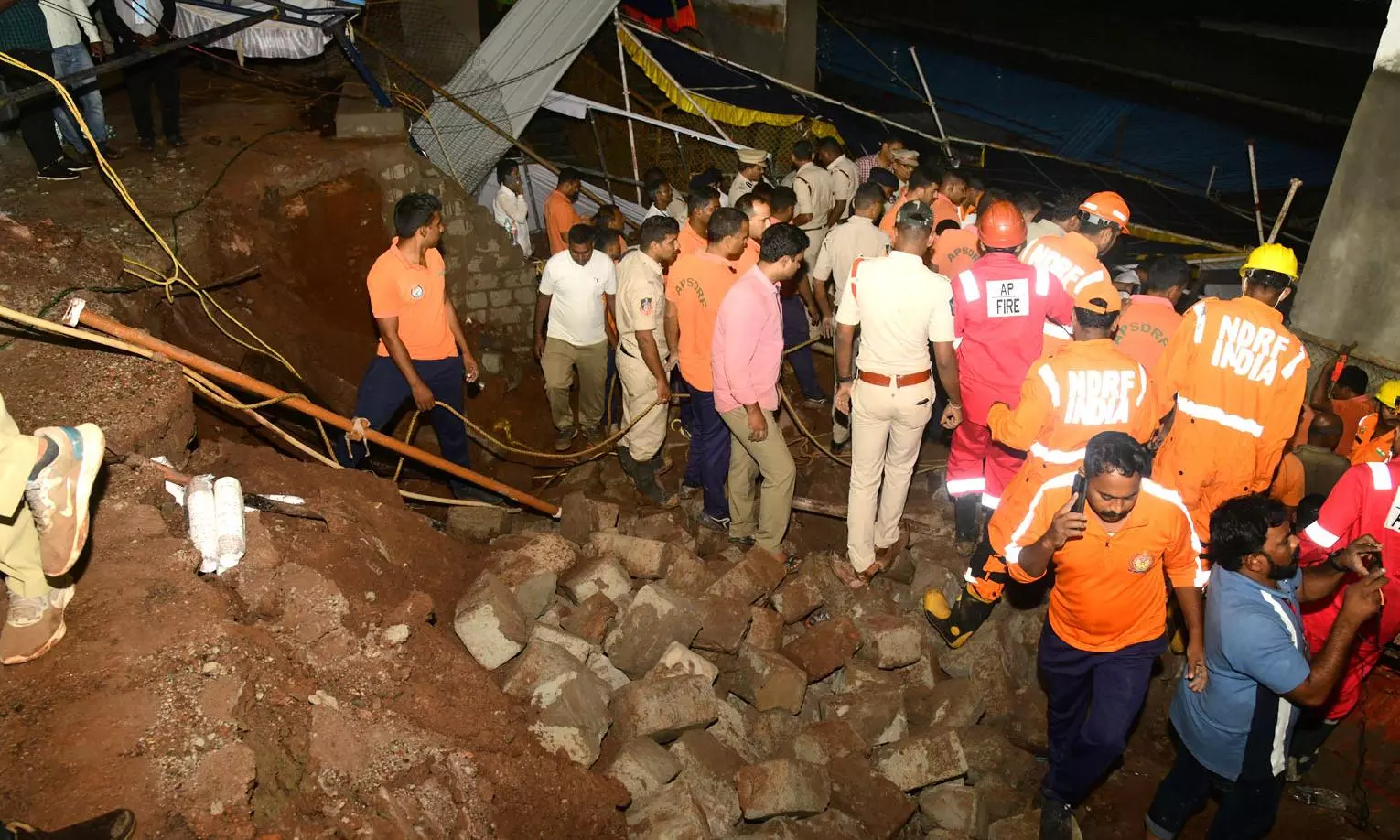
Tirupati: The death of seven devotees in the small hours of Wednesday in a wall collapse at the Simhachalam temple has underscored the casual safety drills at large religious gatherings in Andhra Pradesh.
The tragedy, which took place amid heavy rains during the annual Chandanotsavam festival, caused special concern also as the wall was a recently built.
The incident reignited debate over poor crowd management, lack of adequate infrastructure and weak administrative accountability at major pilgrimage sites.
The series of incidents in recent times reveals a troubling pattern of systemic failures during peak religious festivities. One of the most harrowing examples was the Godavari Maha Pushkaralu stampede in Rajahmundry in July 2015. The once-in-144-years event had drawn millions of pilgrims. Chaos broke out at the Kotagummam Pushkar Ghat on the first day, shortly after the chief minister, Chandrababu Naidu, completed a ceremonial bath. A sudden surge of the crowd, when the gates opened, led to the stampede that claimed 29 lives, mostly women and elderly devotees.
The Justice CY Somayajulu Commission, which investigated the incident, absolved the government of direct responsibility. It claimed that the tragedy was caused due to overcrowding caused by “undue and unwarranted publicity” around the event’s Muhurtham.
The inquiry report also pointed to inadequate planning, poor interdepartmental coordination and lack of crowd control measures, but no individual or agency was held accountable.
In another mishap, on January 3, 2008, six devotees died and 20 more were injured in a stampede near the Kanaka Durga Temple in Vijayawada during the final day of Bhavani Deeksha. An estimated 1.5 lakh devotees had gathered there, overwhelming the infrastructure on the ghat road.
There were subsequent upgrades of facilities and increase in the number of personnel, but recommendations such as real-time crowd monitoring systems and structural redesigns were addressed only in part.
On January 8, 2025, six devotees died and several others were injured in Tirupati, a day before the Vaikunta Ekadasi. The incident occurred at the Vaikunta Dwara darshan ticket counter near Padmavathi park. The crowd became uncontrollable. Despite the presence of police and TTD staff, the absence of effective crowd control and lack of coordination among officials was glaring.
A probe was ordered and three officials were transferred, but questions remain about deeper systemic flaws.
Other tragic incidents, though smaller in scale, also point to ongoing issues. In 2012, three devotees died of suffocation while waiting in a queue at the Srisailam temple. In 2003, a stampede during the Garuda Seva procession at the Sri Venkateswara Temple in Tirumala left 20 devotees injured.
Experts say these recurring tragedies highlight the need for structural and administrative reforms.
Satya Narayan, a retired professor of urban safety engineering, advocates adoption of AI-powered surveillance systems that can detect abnormal crowd patterns and alert the authorities about real-time risks.
"We must move beyond manual policing. Technologies like AI analytics, drones and intelligent camera networks are essential," he said.
Satya also stressed the need for periodic structural audits. “Many temple layouts are outdated. They were not designed to handle today’s devotee footfalls. Regular assessments of load capacity and pedestrian pathways are critical,” he stated.
Aditi Rao, a crowd safety consultant, proposed the formation of a statutory festivals safety commission with regulatory powers. She suggests mandatory safety audits for events that could draw over 10,000 participants.
Rao also proposes the setting up of a disaster management authority to develop a national safety framework for religious events and the maintenance of a centralised database of crowd-related incidents to guide the authorities in future preparedness.
