AP Begins New Chapter in Mining With Jonnagiri Gold Biscuits

The gold biscuits, already on sale, are in three denominations — 50 grams, 100 grams, and 500 grams.
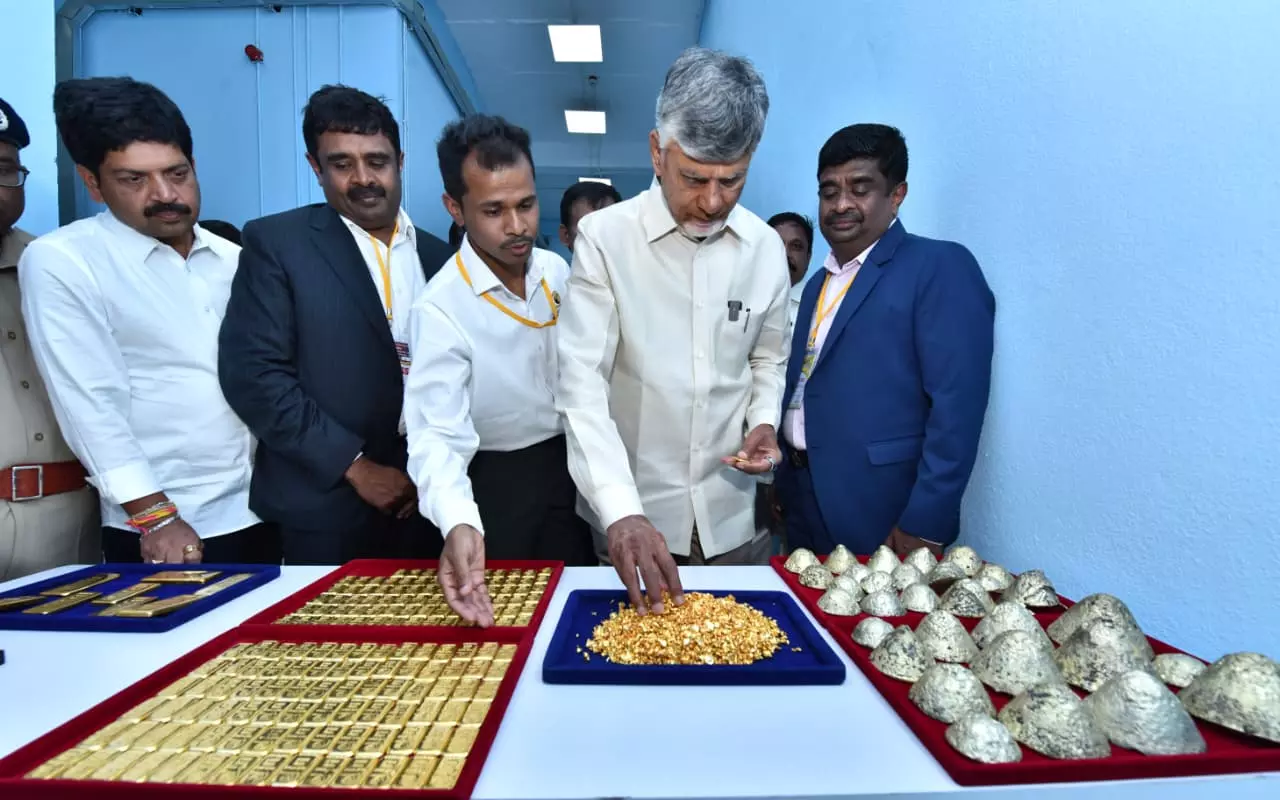
Vijayawada:Andhra Pradesh has opened a new chapter in its mining and industrial history with the first commercially available gold produced from Jonnagiri Gold Fields in Kurnool district making its way to the bullion market.
The launch of the indigenous 24-carat gold biscuits, produced by Geomysore Services India Pvt. Ltd. from the ore extracted at Jonnagiri, is being hailed as a landmark achievement for the state and a significant step towards strengthening India’s domestic gold production.
Chief Minister N. Chandrababu Naidu formally handed over the first batch of Geomysore’s gold biscuits to prominent businessmen from the Kurnool region on June 24. Jonnagiri gold biscuits are currently available at select jewellery outlets in Kurnool’s renowned Sharaf Bazaar near the historic Kondareddy Buruju.
The gold biscuits have been introduced in three denominations — 50 grams, 100 grams, and 500 grams. The larger 500-gram biscuit has attracted particular attention for its distinctive design featuring the map of Andhra Pradesh, along with the inscription “Jonnagiri Gold Mine” and the hallmark “999”, signifying 99.9 per cent purity.
Certified as 24-carat gold, the biscuit is currently valued at over ₹75 lakh.
Jewellery traders say the smaller denominations got sold out within days of reaching the market, reflecting their strong demand and AP investors eager to own gold sourced from the state’s own soil.
Industry representatives reveal that nearly 100 kilograms of gold has already been produced, although supplies are yet to be streamlined for large-scale distribution.
Local jewellers described the launch of Jonnagiri gold as a historic moment, underlining that its quality matches imported bullion of international standards. They point out that India has traditionally depended heavily on imported gold. Increased domestic production could help reduce import dependence, conserve valuable foreign exchange reserves, and contribute to the national economy.
Despite being mined and processed within the country, Jonnagiri gold, however, attracts the same duties, taxes, and GST applicable to imported bullion. As a result, there is no immediate price advantage for buyers. Yet, industry experts believe its long-term significance lies in strengthening domestic sourcing and enhancing self-reliance in the precious metals’ sector.
The development has revived the demand for a Special Economic Zone or dedicated jewellery cluster in Kurnool district. Business leaders point out that Kurnool region is uniquely positioned to emerge as a major gems and jewellery manufacturing hub, with gold sourced from Jonnagiri and diamonds from the nearby Vajrakarur belt.
The SEZ or cluster could create large-scale employment opportunities for goldsmiths, artisans, and workers, while accelerating economic growth across Rayalaseema.
Traders estimate that between 3,000 and 4,000 families in Kurnool depend directly or indirectly on the jewellery trade. With Andhra Pradesh now producing its own gold, Jonnagiri could become a catalyst for industrial expansion and a symbol of economic aspirations of the state being fulfilled.
