AP Assembly Unanimously Passes Two Key Bills

The bills provide for additional cess to make AP roads safer and enable staff to decide whether they want to be with JNTU-K or JNTU-GV
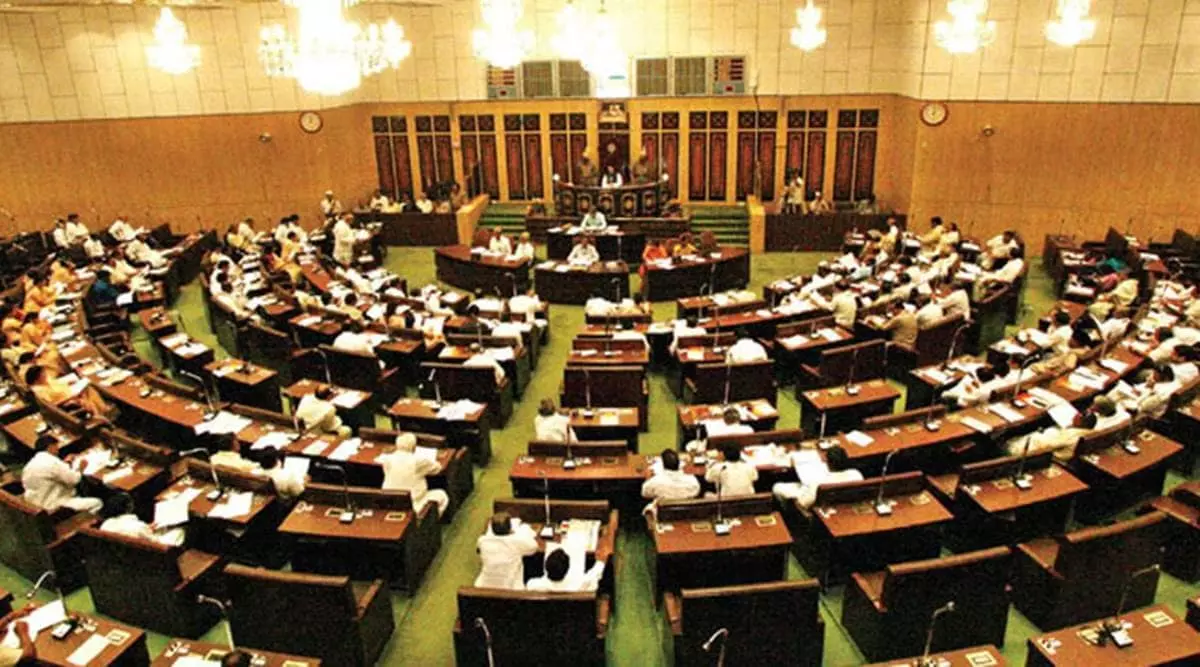
Vijayawada:The 14th day of the fifth Budget Session of the 16th Andhra Pradesh Legislative Assembly witnessed introduction and unanimous passage of two significant amendment bills on Thursday, with ministers outlining their objectives and implications.
Transport minister Mandipalli Ramprasad Reddy introduced the Andhra Pradesh Motor Vehicles Taxation (Amendment) Bill, 2026, while Revenue minister Anagani Satya Prasad, on behalf of the Human Resources Development department, tabled the Jawaharlal Nehru Technological Universities (Amendment) Bill, 2026.
Explaining the intent behind the motor vehicles amendment bill, Ramprasad Reddy pointed out that the central government has reduced the GST on motor vehicles from 28 per cent to 18 per cent, resulting in reduction of vehicle prices.
Consequently, the state government has proposed a 10 per cent road safety cess to be levied on vehicles paying lifetime tax at the time of registration. The minister said revenue thus mobilised will be used to strengthen road safety mechanisms across Andhra Pradesh. These include rectifying accident-prone blackspots and implementing measures to reduce road accidents.
According to Ramprasad Reddy, the cess will generate approximately ₹22.5 crore revenue per month and around ₹270 crore annually for the state.
On the JNTU amendment bill, minister Satya Prasad explained that Jawaharlal Nehru Technological University, Kakinada (JNTU-K) had been established under the Jawaharlal Nehru Technological Universities Act, 2008. At that time, faculty and staff had been given the option of choosing their place of service.
In 2021, the government enacted another amendment, which created Jawaharlal Nehru Technological University, Gurajada, Vizianagaram (JNTU-GV) while retaining the JNTU-K. However, there had been no explicit provision in the parent Act enabling teaching and non-teaching staff to exercise their option regarding service allocation between the two universities.
Satya Prasad said as the transitional provisions of the 2008 Act are no longer in force, administrative difficulties have arisen in the distribution of staff between JNTU-K and JNTU-GV, affecting academic and administrative functioning. The present amendment seeks to create a clear legal framework allowing faculty and employees to opt for service in either university within a specified period, subject to seniority and availability of vacancies.
