Amaravati’s Tree Translocation Model Wins Global Praise

Global delegation praises eco-friendly model worth sharing worldwide
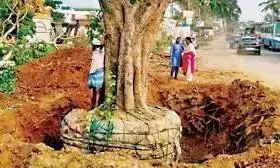
Vijayawada: The innovative tree translocation initiative of the Amaravati Development Corporation (ADC) in the state capital has drawn praise from a delegation of World Bank and Asian Development Bank officials. They said the model was worth emulation around the world.
Notably, as part of Amaravati’s infrastructure expansion, thousands of fully grown trees, some aged between 10 and 15 years, have in recent times been carefully uprooted with their roots intact and shifted to the Anantavaram nursery for preservation. On Thursday, the 13-member World Bank-ADB team visited the sites.
ADC horticulture joint director VS Dharmaja explained the scientific techniques used to safeguard the translocated trees. He said specially designed root bags were prepared, Neem oil mixtures were sprayed using drones to keep pests away, and organic supplements like coco peat provided.
The visiting team was also briefed on the drip irrigation network supplying water directly to the tree roots.
Dharmaja informed the delegation that another 6,000 trees along priority roads such as N-4 and N-11 would also be translocated. Species including Peepal, Banyan, Amla, Baheda, Bahunia, Legistromea, Toddy Palm, Rain Tree, Cassia, Akashamalli, Tabebuia, Kadamba, and Spathodea—all known for their high oxygen generation—were being shifted to the nursery, he said.
The JDO explained that once stabilised, these trees would be replanted near key government complexes such as the AP CRDA building, HoD towers, ministers’ quarters, legislators’ residences and employee housing colonies. He said coconut palms earlier relocated to the N-9 road were already attracting attention with their scenic appeal.
The World Bank-ADB representatives lauded the Anantavaram nursery as an exemplary project, stressing that if countries worldwide gave priority to translocation instead of indiscriminate felling, it would significantly curb greenhouse gases and mitigate climate change impacts. “The Amaravati model would be shared globally as a best practice,” they said.
The representatives from the World Bank were Pablo Cardinale, Gerald Paul Ollivier, Balakrishna Menon Parameswaran, Venkata Rao Bayana, Joseph Ese Akpokodje, Roselind Rajan, Damanjit Singh Minhas and Shriti Munshi. Saswati Ghosh Belliappa and Achyutha Rao Aleti were from the ADB. Senior horticulture consultant P. Vishwaprasad, along with ADC and CRDA officials, also joined the inspection tour.
