Tourism city to span 4,716 hectares along the banks of River Krishna
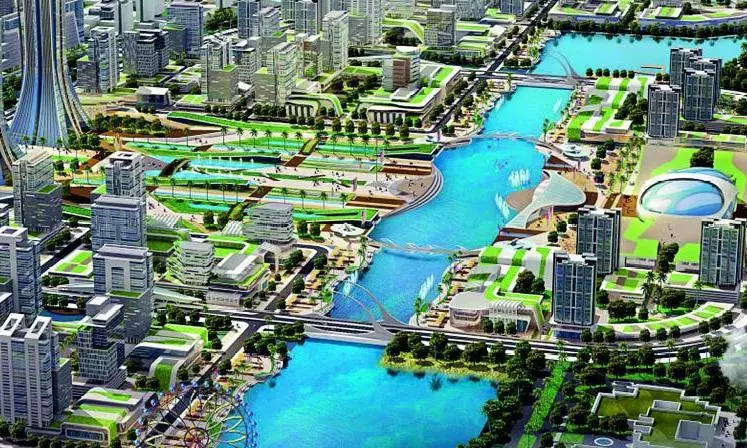
Vijayawada: Chief Minister N. Chandrababu Naidu is aiming to incorporate the concept of Amaravati in nature, with a view to transforming the capital into a model green city.
He has proposed that capital Amaravati be shaped into a modern and eco-friendly green city.
The capital region development authority and the Amaravati development corporation have jointly planned the development of a sprawling tourism city spanning 4,716 hectares along the banks of the Krishna river, near the historic Undavalli Caves.
The Chief Minister advised officials to enhance greenery along major trunk roads, connecting access roads and buffer zones. He stressed the need to develop international standard parks and green areas, ensuring that the entire capital region evolved into a biodiversity hotspot by planting medicinal plants.
Officials said, on the CM’s advice, the administration is implementing well-planned, phase-wise initiatives to establish Amaravati as a benchmark city for future generations, focusing on sustainable tourism, environmental protection, and cultural preservation.
A highlight is the development of a sprawling tourism city spanning 4,716 hectares along the banks of the Krishna river, near the historic Undavalli Caves. This precinct will stand as a hub of spirituality as also cultural heritage and entertainment, offering modern amenities while championing green values and heritage tourism.
Under comprehensive greening initiatives, the Amaravati city’s pollution-free and clean vision is backed by a robust beautification plan. Under this, landscaping will be done on 34 trunk roads for over 640km (1,420 acres), Greening across LPS (Land Pooling Scheme) zones covering 1,244km (709 acres), central medians on trunk roads for 450km (445 acres) and avenue plantations on 22 buffer zone roads, stretching 133.31km (494 acres).
The APCRDA and ADCL also planned a variety of parks under which the Sakhamuru recreation park would be developed in 190 acres, the Malkapuram park in 21 acres, the Lung Space park at Ananthavaram in 31 acres and the biodiversity park at Kuragallu in 200 acres.
The main contribution to Amaravati Capital was from local farmers, as 34,000 acres of land was offered for Amaravati, under LPS, by 29,000 farmers of the Amaravati villages.
For local farmers and landowners who contributed to the capital development, as many as 497 community parks would be developed on 1,602 acres within LPS zones, ranging between one and ten acres each.
Special attention is given to riverfront and water resource beautification, under which greening would be done along Kondaveeti Vagu, Palavagu and Gravity Canal for 96.6km (611 acres). The Krishna river front is to be developed as a major tourism destination for over 22km. Reservoirs in Krishnayapalem and Neerukonda and green belts on Undavalli, Neerukonda and Ananthavaram hills would be coming up on 400 acres.
Further, the expansion of greenery around water sources in multiple localities is planned, namely Ainavolu, Nelapadu, Nidamarru, Navuluru, Thulluru, Velagapudi, Ananthavaram, Shakamuru and Nekkallu, spread across 600 acres.
As for economic development and urban infrastructure, the Amaravati city’s economic backbone will be strengthened by developing a Central Business District (CBD) on the Krishna riverbank. Three regional centres would facilitate business activities and retail complexes, boosting the local economy.
Officials said Amaravati would offer world-class infrastructure for a high quality of life, including cycling tracks, pedestrian paths, metro stations, educational institutions, commercial centres, and parks, all seamlessly integrated within green neighbourhoods.