Age-Old Traditions Give Unique Flavour to Venkatagiri Poleramma Jatara

His ancestors renamed Kalimili as Venkatagiri after his ancestors began ruling the region around 1680.
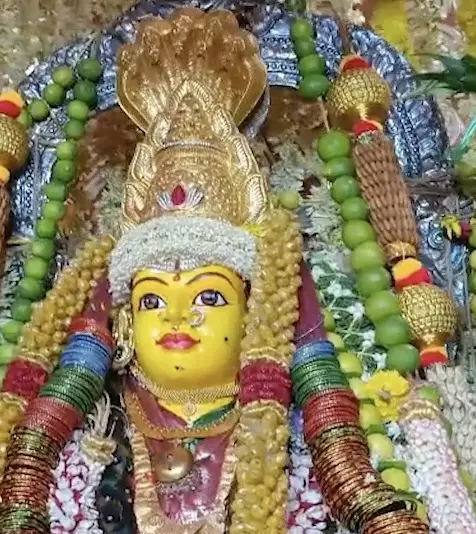
NELLORE: Centuries-old Poleramma Jatara in Venkatagiri reached its grand finale on Thursday evening, with immersion of Her clay idol in the Kaivalya River; bringing the two-day festival to a close.
The annual fete, celebrated in the third week after Vinayaka Chavithi, attracts more than five lakh devotees from across Andhra Pradesh and neighbouring Tamil Nadu and Karnataka. Historical evidence indicates that the Jatara had been celebrated in 1714 under the patronage of Venkatagiri Rajas.
According to the Venkatagiri royal family scion Sai Krishna Yachendra, the town had earlier been known as Kalimili. His ancestors renamed Kalimili as Venkatagiri after his ancestors began ruling the region around 1680.
Though Kalimelamma is regarded as the village deity, Poleramma gained prominence following the cholera outbreak in 1900. Local tradition holds that the deity protected the people from the epidemic. Venkatagiri Rajas worshipped Her and installed Seethala Yantral – geometrical diagrams etched on copper plates, at the four corners of the town. A grand jatara subsequently followed as a thanksgiving gesture. The tradition of jatara has continued ever since.
Even after the royal family handed over the temple to the Endowments department, along with its valuable jewellery in 1991, royal traditions have remained an integral part of the festival. Rituals such as Chatimpu, the traditional announcement of the jatara, and Ghatotsavam continue to commence from the Venkatagiri palace.
The Chatimpu, made through traditional tom-tom announcements on the first, second, and third Wednesdays after Vinayaka Chavithi, continues to have a strong influence on local life. Traditionally, people refrain from conducting auspicious functions from the announcement until the conclusion of the jatara.
The festival preserves a distinctive Kummari community tradition. Artisans from Kummari Street prepare the clay idol on Wednesday night without decorating it or fixing its eyes. After 11 p.m., the idol is taken in procession from Puttinillu (birthplace) in Kummari Street to Mettinillu (in-laws’ home) at Jeenigalavari Street. The eyes are ceremonially fixed only after the idol reaches the latter place.
The idol is then installed outside the Poleramma temple on Thursday for devotees to offer special prayers. A grand procession through the streets follows, culminating with the immersion of the idol in the Kaivalya River on Thursday evening.
The continuation of these rituals across generations has made the Poleramma Jatara a distinctive expression of Venkatagiri’s royal heritage, community traditions, and enduring faith.
