Plasma at Lunar Pole Is More Active, Finds Chandrayaan-3 Lander

Plasma is often called the fourth state of matter, consisting of a mixture of charged particles, including ions and free electrons
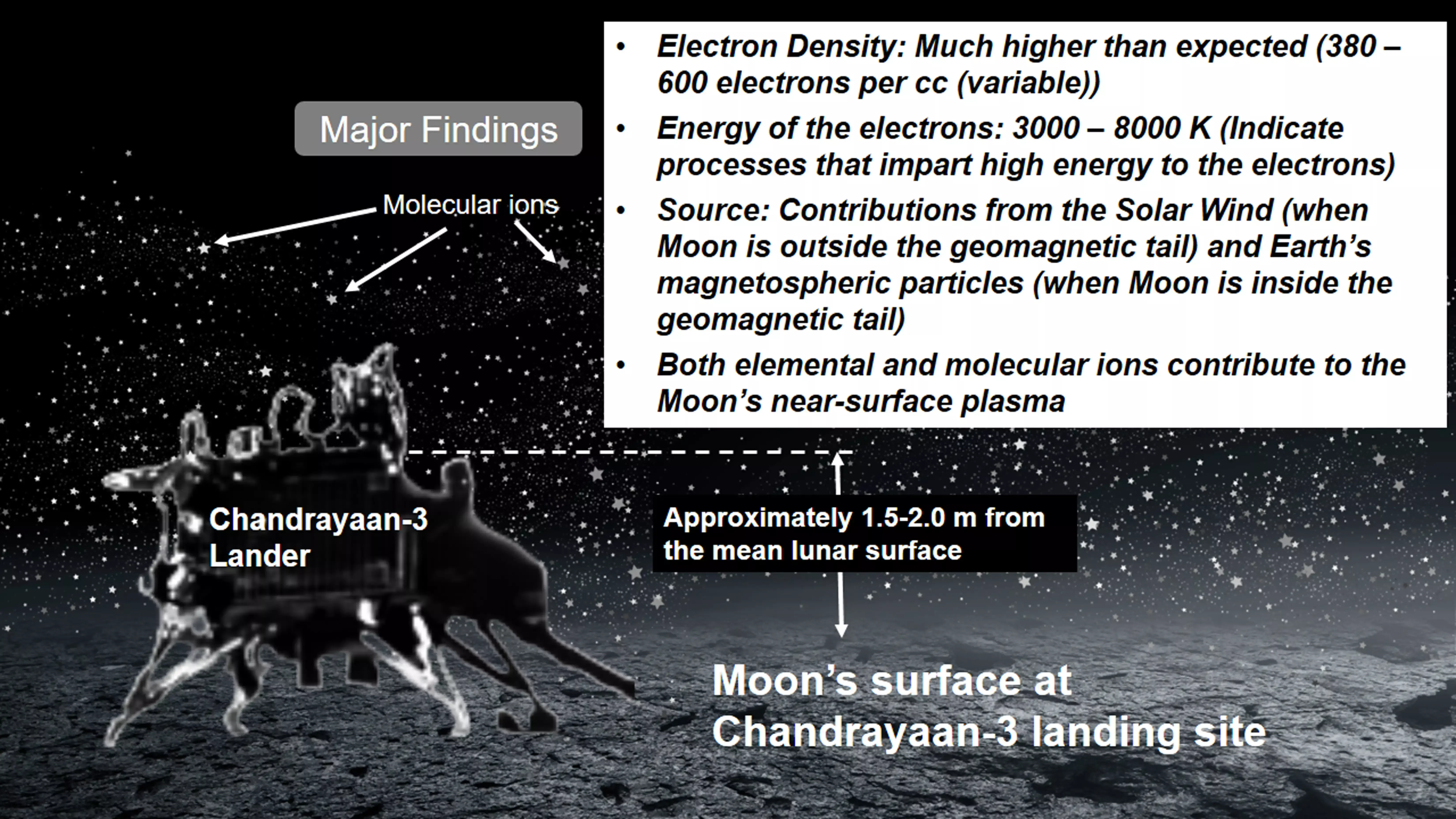
Hyderabad: The electrical environment or plasma near the moon's surface at the south polar region is far more active than previously understood, revealed an analysis of Chandrayaan-3 lander data.
According to data obtained by the RAMBHA-LP — Radio Anatomy of the Moon Bound Hypersensitive ionosphere and Atmosphere – Langmuir Probe — instrument onboard the Vikram lander of Chandrayaan-3, the electron density near the landing site of Chandrayaan-3, named as Shiv Shakti point (69.3° S, 32.3° E) was measured to be between 380 and 600 electrons per cubic centimetre.
This is significantly higher than estimates derived from observations taken at higher altitudes, which are primarily based on observing the changes in the phase of electromagnetic signals from satellites passing the moon’s thin atmosphere at grazing angles.
Plasma is often called the fourth state of matter, consisting of a mixture of charged particles, including ions and free electrons. Despite being electrically neutral overall, plasma is highly conductive and responds strongly to electromagnetic fields.
The results from the RAMBHA-LP experiment provide deeper insights required for the next phase of lunar exploration.
“The highly-charged plasma can cause static discharge on spacesuits, damage to electronics and sensors, and interference with radio communication. An accurate understanding of the plasma environment allows engineers to design safer landers, rovers, and habitats,” the expert explained.
The plasma data will help space-faring companies to properly plan astronaut safety, lunar base design, mining missions, communication and navigation technologies and long-term survival in deep space.
