Pak Shifted 72 Terror Launchpads From Border Areas

BSF officials said force ready for Operation Sindoor 2.0
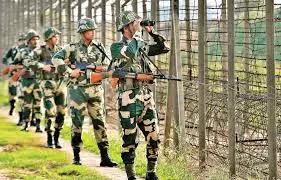
Srinagar: More than six dozen terror launchpads located close to the Line of Control (LoC) have been dismantled and relocated to “depth areas” inside Pakistan following India's devastating Operation Sindoor in May this year, senior Border Security Force (BSF) officers claimed on Saturday.
The BSF, India’s primary border-guarding force along the frontier with Pakistan, further asserted its complete preparedness to carry out fresh precision cross-border strikes and inflict significantly heavier damage should the government of India authorise renewed military action.
Speaking at a rare joint press conference in Jammu to mark the BSF's achievements through 2025, senior officers said that Pakistan was forced to completely reorganise its “terror infrastructure” after the four-day Operation Sindoor, launched in direct response to the 22 April Pahalgam terror attack that claimed 26 lives, mostly tourists.
“After Operation Sindoor destroyed dozens of terror launchpads and training facilities right on the border, Pakistan has shifted the entire ecosystem deeper inside its territory,” BSF DIG (operations and intelligence) Vikram Kunwar said.
Providing specific intelligence-based assessments, he said that approximately 12 launchpads are now operational in the depth areas of Sialkot and Zaffarwal sectors of Pakistani Punjab, well away from the International Border (IB) called "Working Boundary" by Islamabad while another 60 launchpads have been relocated to various rear locations across Pakistan-occupied Jammu and Kashmir (PoJK) and (Pakistani) Punjab.
"The numbers fluctuate constantly. Terrorists do not stay permanently at these sites. Launchpads are activated only when infiltration pushes are planned, usually in small groups of two or three," Mr Kunwar explained. He added that no formal training camps currently exist close to the IB or LoC, and terrorists now receive training in mixed groups instead of earlier sect-wise divisions - Jaish-e-Mohammad in southern sectors, Lashkar-e-Tayyaba in northern sectors.
BSF inspector general (Jammu Frontier), Shashank Anand, issued a strong message to Islamabad, emphasising the force's battle-hardened experience and readiness. "Whether it was the wars of 1965 and 1971, the Kargil conflict of 1999, or the hybrid warfare of Operation Sindoor, the BSF has seen every kind of battlefield. We are fully prepared. If the government gives us another opportunity, we are capable of causing significantly greater damage than we did in May," he asserted.
Mr Anand said that the BSF is scrupulously honouring the current cessation of hostilities but is keeping every Pakistani move under constant surveillance. During the May operation, Pakistani Rangers abandoned several forward posts under intense BSF fire, he claimed, adding that it took Pakistan weeks to recover and reposition troops, and some bunkers have since been reinforced. "All their activities - repair work, fresh deployments, and fortifications - are under our real-time observation. We are recalibrating our plans accordingly. When the time comes, action will be swift and decisive," he said.
He further stated that the BSF is maintaining maximum alert to ensure "zero infiltration" across the IB in Jammu. He said that all anti-infiltration infrastructure damaged during recent floods was fully rebuilt and reinforced within one month, making the grid "two to three times stronger" than before.
He added that troops are equipped with advanced surveillance and mobility systems to maintain effectiveness even in dense fog and harsh winter conditions. The BSF, he emphasised, works in close coordination with the Army, intelligence agencies and other security forces to pre-empt and neutralise every infiltration attempt while responding instantly to emerging threats.
The officers stressed that despite the relocation of launchpads infiltration attempts across the 198-km IB, often referred to as the Jammu-Sialkot border in public parlance, have dropped sharply since Operation Sindoor. "At this moment, there is no abnormal terrorist movement along the border that would raise an immediate alarm," DIG Kulwant Rai Sharma said. He added, "The deterrence created in May continues to hold."
The officers said that the BSF's aggressive posture, coupled with upgraded electronic surveillance, night-vision devices, anti-tunnel detection systems, and quick-reaction teams, has made the IB one of the most difficult infiltration routes for Pakistan-based groups.
The BSF is primarily tasked to guard the 198-km stretch of the India-Pakistan border in Jammu region. Being part of the 2,912 km India-Pakistan border from Gujarat to J&K, it starts at Paharpur in Kathua district and ends at Chicken's Neck corridor in Akhnoor sector where the LOC begins. The LoC is primarily the responsibility of the Indian Army, which serves as the first line of defence against external threats and ceasefire violations, while the BSF acts as a second line of defence, supporting the Army in specific LoC scenarios.
