What merits contemplation is whether we possess sufficient discernment to encounter divergence without reflexively converting it into a hierarchy of virtue. A sari need not signify antiquity, a burqa subjugation, décolletage solicitation, nor an unconventional silhouette impropriety; each may proceed from cultural inheritance, personal conviction, visual sensibility, practicality or bodily ease
Robert Mapplethorpe approached physical form with the exactitude of a sculptor, subjecting the body to an almost classical discipline of proportion, contour, torsion, and negative space. Under his lens, epidermis became a terrain of light and shadow; musculature acquired architectural gravitas; the smallest irregularity could assume compositional significance. Cicatrices, tattooed inscriptions, senescent lines, and anatomical asymmetries were not simply details to be effaced or concealed, but part of the body’s visual and biographical particularity. His oeuvre brought physicality into sustained aesthetic contemplation, treating the human figure not as an abstraction but as a configuration in which structure, individuality, and corporeal presence converged.
Amid the prevailing cult of bodily idealisation, we appear to have developed a profound estrangement from the unadulterated human form. The relentless pursuit of aesthetic rectification subjects individuality to perpetual revision, while the resulting exposure invites the very scrutiny such refinements were ostensibly intended to forestall. We solicit approbation through calculated self-presentation, yet recoil when such visibility subjects us to public appraisal.
The sari itself bears witness to the mutability of modesty; the blouse, now regarded as almost indispensable, was not historically intrinsic to its draping. Yet we continue to invest fabric with moral authority, as though a hemline might confer probity and a few inches of cloth could recalibrate character.
What one age repudiated, another ultimately consecrated beneath gilded ceilings as an exaltation of the human form. Goya’s The Naked Maja, at the Prado, incurred the Inquisition’s censure and was subsequently seized for investigation; yet her languorous poise remains almost impervious to the moral turmoil that sought to suppress it. At the Musée d’Orsay, Manet’s Le Déjeuner sur l’herbe and Olympia provoked their own crises of propriety: the former placed an unclad figure amid gentlemen in contemporary dress, while the latter recast the venerable Venus as a modern woman whose directness and self-possession challenged prevailing conventions. Once condemned as indecorous, it now hangs among the canonical masterpieces of Western painting, its earlier opprobrium yielding to recognition.
John Berger’s Ways of Seeing offers a further perspective on how social conventions condition the apprehension of women. His examination of their historical position within systems of observation and assessment is particularly pertinent to the broader question of how interpretation can acquire an ethical dimension.
There exists an unsettling dissonance in our cultural construction of femininity: we invoke its sanctity while simultaneously subjecting its representation to objectifying scrutiny. If such dignity is to be upheld, why does so much cinematic and advertising iconography continue to instrumentalise the body as an expedient mechanism of persuasion? Décolletage constitutes neither solicitation nor contrivance; nevertheless, its persistent sensualisation can prove as reductive as the puritanism that seeks to proscribe it.
Perhaps the epithet derives its peculiar ubiquity from an entire constellation of concealed resentments: misogyny, marked by its reflexive disparagement of self-determination; patriarchy, with its antiquated presumption of masculine authority over conduct; resentment at qualities that command attention without solicitation; narcissistic mortification occasioned by rejection; and, more insidiously, hostility towards someone whose intellectual distinction, social assurance, natural magnetism or unyielding autonomy renders her impervious to prescribed expectations.
The hypocrisy was particularly grotesque: conventions rigorously imposed on others appeared conspicuously suspended within those households, where mothers and sisters could appear in provocative modes of dress and participate in B-grade cinema without incurring equivalent censure. The contradiction became still more pronounced when some of them subsequently came to be associated with exculpating men implicated in grave violence. What appeared to be moral rectitude thus revealed itself as selective indignation, contingent on whom the judgement was directed at.
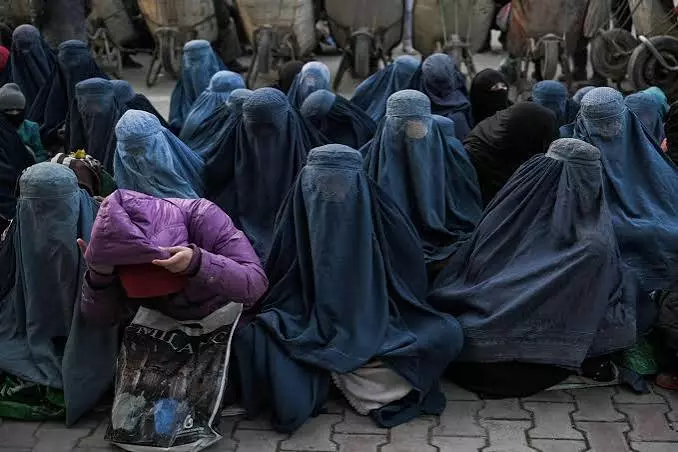
Under Taliban rule, sartorial injunction has become an instrument of female sequestration, with the prescribed burqa rendering public presence inseparable from concealment. Yet the veil acquired an unexpected counterpoint in a Kabul-based musical ensemble, whose 2003 single, Burka Blue, transformed imposed anonymity into audibility.
The issue is more consequential than the perennial rhetoric of “freedom,” with its facile binary between masculine latitude and feminine constraint; the dispute over permitted attire is merely the most visible expression of a far deeper preoccupation. What merits contemplation is whether we possess sufficient discernment to encounter divergence without reflexively converting it into a hierarchy of virtue. A sari need not signify antiquity, a burqa subjugation, décolletage solicitation, nor an unconventional silhouette impropriety; each may proceed from cultural inheritance, personal conviction, visual sensibility, practicality or bodily ease. To apprehend plurality is not to confer approbation upon every variation, but to relinquish the impoverished reflex of construing unfamiliarity as moral deficiency.
Tradition is no immutable inheritance but a perpetually metamorphosing idiom, refracted through successive sensibilities. Perspective alters our apprehension; focal length draws us nearer or consigns us to distance; depth of field can render one particularity luminous while another dissolves into penumbra. Aperture becomes a threshold between revelation and concealment, whereas composition quietly determines the register of what we behold.
Yet the person before the apparatus cannot be held accountable for the authorial calculus by which her likeness is construed. Should the resulting portrayal acquire a debased or reductive character, responsibility rests with the creative intelligence which orchestrated its visual articulation. To indict her for an impression manufactured beyond her authorship is to mistake the canvas for the hand that conceived it.
From the apsaras of Ajanta, rendered in sinuous movement, to the celestial dancers chiseled into the temples of South India, the unclad body could inhabit the sacred without apology or euphemism, articulating mythological narrative and cosmological order—until successive conventions of modesty taught us to conceal what earlier traditions had consecrated to the divine.
We must likewise cultivate an introspective apprehension of our own constitution: our proclivities, the embodiments we elect to assume, our deportment, and the ends to which our energies are consecrated. We must acquaint ourselves with the parameters governing human conduct, distil instruction from lived experience, and exercise circumspection when circumstances are manifestly incongruous or potentially hazardous. Responsibility is inherently reciprocal; none of this, however, vests anyone with the prerogative to transgress the inviolability of another.
The more elusive question lies not merely in the manifest, but equally in the veiled. The impulse may reside as much in concealment as in revelation.
The strings may have changed; the moral knots, apparently, persist.