By invitation: Headless Congress misses opportunities to make dent

The approach and style of the BJP is very much like that of the Congress of the 1970s.
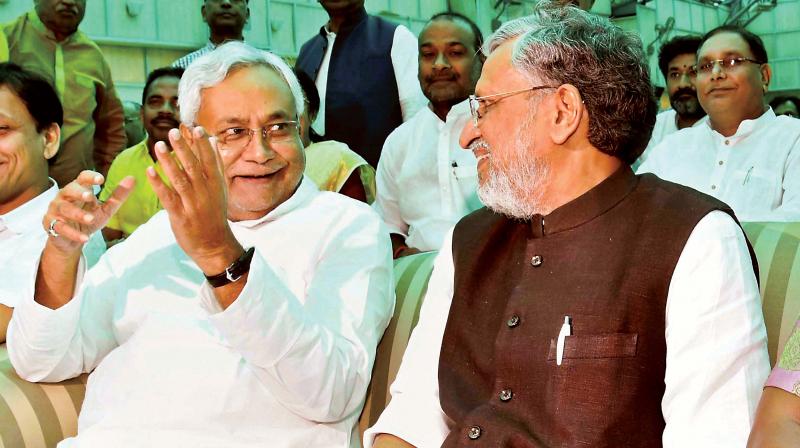
The dramatic developments in Bihar saw a Grand Alliance government overnight changing political colours and transforming itself into a NDA government, albeit under the same Chief Minister. Indian politics has been witness to many such flip-flops in the past too. The CM used a pragmatic and powerful ‘fig leaf’ of a ‘fight against corruption’ to defend his actions and switch allies in his quest for taking care of the interests of Bihar. Whether the people of Bihar back his stance would be tested in the coming months and at the time of the 2019 LokSabha polls. The Bihar developments raised a range of important questions. Does the entry of Nitish Kumar into the NDA fold, mark the formal collapse of the Grand Alliance against the BJP? Would other important and powerful state based parties in different parts of India be similarly tempted or prevailed upon to align with the ruling alliance at the centre? Where do these developments leave the principal national opposition party – the Congress?
Let us examine the last question first. Ever since its rout in the Lok Sabha polls of 2014, the Congress has lost state after state and failed to bounce back. Wherever it has been in direct competition with the BJP, it has conceded defeat or lost the opportunity to form a government on account of mismanaging the political situation (Goa and Manipur). The only state where it was able to come to power since 2014 was in Punjab and here too it defeated a SAD-led coalition of which the BJP was a junior partner. The developments in Gujarat where they have lost a senior leader like Shanker Singh Vaghela and have to ferry their MLA’s to Karnataka to keep them safe from being poached, again indicate the crisis the party faces. The battle in Karnataka in 2018 will be a crucial test of their capacity to retain power in a state where they are in direct competition with the BJP. A setback in Karnataka would be a sure indication of the party facing little hope for an immediate recovery.
The Congress has been in the position of the lead opposition at the national level on several occasions in the past. The defeat of the Congress in 1977, when for the first (and only) time a sitting Prime Minister was defeated from her own constituency in a LokSabha elections was an important turning point in India’s political history. Indira Gandhi awaited her opportunity and capitalized on the infighting in the Janata party, bouncing back to power in 1980. When the Congress under Rajiv Gandhi was defeated by a spirited Opposition led by V.P. Singh on the anti-corruption plank in 1989, it came back to power heading a minority government within two years. After five years of a Vajpayee-led NDA government, the Congress stitched together a UPA Coalition to come back to power in 2004. This time around, even after three years in the Opposition, the Congress is still struggling to come to terms with political reality and has let go off several opportunities to hold the ruling government to account. In the past, la
ding the recovery was a committed and motivated leadership which kept the momentum going and was proactive in seizing the initiative and placing its opponent on the backfoot. The inability of the Congress leadership to challenge the ruling government and put on the defensive is clearly visible. One also does not notice any clear change in strategy of empowering state level mass leaders to lead the political recovery.
With the Congress increasingly conceding the lead Opposition space to state-based parties, one notices that in the last three years, the only serious challenge that the BJP has faced has been from the strong regional satraps. AAP’s victory in Delhi under Arvind Kejriwal, the Grand Alliance under Nitish Kumar keeping the BJP at bay in Bihar and Mamta Banerjee protecting her political turf in West Bengal were the only serious setbacks faced by the BJP. All these reversals for the BJP were at the hands of powerful state based parties with the Congress having a marginal role to play only in Bihar. With Nitish switching sides, the picture here too has now changed. It can also be persuasively argued that ever since it came to power at the national level, that the government and leadership at the centre has successfully targeted the opposition and its leadership and in the process fortified its position.
In the run up to the 2019 elections, one gets the impression that the approach and style of the BJP is very much like that of the Congress of the 1970s. It is benefitting from a hopelessly divided Opposition and has a clear game-plan to further weaken whatever is left of a few opposition pockets of influence. One recalls a slogan that was used to characterize the non-Congress Opposition of the 1970s and 80s: ‘United We Fall Divided We Stand’. This slogan could very well describe the Opposition to the BJP today! Given the fragmentation and divisions among the opposition parties that are challenging the ruling alliance at the centre, the advantage at the moment wrests clearly with the BJP.
In the two years prior to the 2019 elections, the way in which the central government takes forward and implements some of its key initiatives would be closely watched. While the slogans and rhetoric it has come up with are very catchy, the implementation on the ground and the visible impact on the people will be critical. One is also likely to see one or two ‘big-ticket’ measures being announced by the government in the run-up to 2019. The elections in Karnataka in the middle of 2018 and the contest in the three BJP ruled states of Madhya Pradesh, Chhattisgarh and Rajasthan will be a critical test of ‘strength’. The Karnataka contest seems very close from all accounts and with every passing day one notices a surprising new twist and an unexpected turn. Will the Congress be able to retain the state and thus gain back some momentum or will BJP re-capture its southern bastion will have important implications for national politics. In the three BJP ruled states of North India, will the party be able to fend of anti-incumbency, especially given the fact that they have been in power in MP and Chattisgarh for three terms. Will Rajasthan preserve its tradition of always voting out the ruling party? Another defeat for the Congress in these three states would surely give new meaning to the ‘Congress free India’ slogan.
