K.C. Singh | Will EU's Big India Trade Deal Sideline US Tariffs?

Her organisation functions as the EU’s executive branch, proposing laws, managing policies and enforcing the European Union’s law.
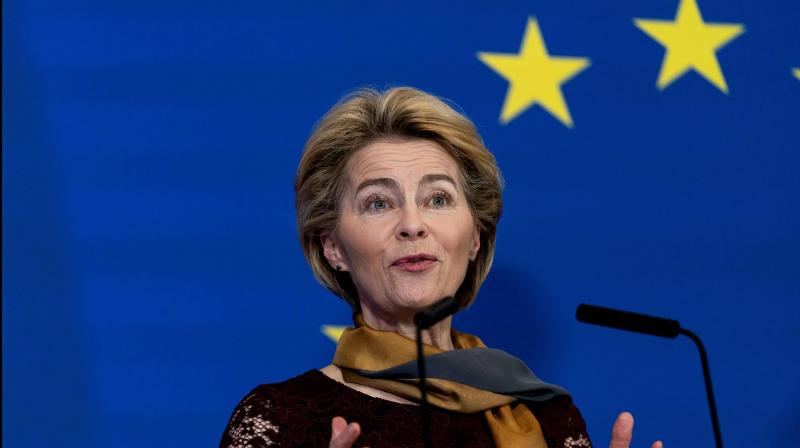
The European Union’s top leaders, for the first time, were the chief guests at India’s Republic Day celebrations on January 26. Ms Ursula von der Leyen is the president of the European Commission. Her organisation functions as the EU’s executive branch, proposing laws, managing policies and enforcing the European Union’s law.
Accompanying her was Antonio Costa, the Indian-origin president of the European Council, which defines the EU’s overall political direction and priorities, bringing together the heads of state but without enjoying any legislative power. It handles high-level decision-making, including the appointment of the president, Ursula von der Leyen. That explains why they were jointly invited, as their coordination is necessary to take forward any important new proposals.
The timing of the visit is crucial, considering the prevailing global environment, which was succinctly captured recently by Canadian Prime Minister Mark Carney in his Davos speech. He said the global order faces a “rupture”, caused by US President Donald Trump’s disruptive approach to global trade, diplomacy and the rules-based international system. India has borne the burden of 50 per cent tariffs on most Indian exports to the US. The threat of further escalation lingers due to the US alleging India-Iran commercial ties, especially oil imports. The India-US trade deal has continued to get delayed, as the United States keeps introducing new irritants.
The EU also has entered a new uncertain phase after initially humouring President Donald Trump into approving a new trade deal. The discord arose over President Trump’s claim on the Denmark-controlled massive landmass called Greenland. Prior to his Davos trip, President Trump absolutely insisted on the US annexing Greenland, using military force if necessary. The churn amongst the European Nato members was almost instantaneous. They debated that use of military force against a Nato member would shatter the crucial alliance. With the US markets plunging, the message was unmissable. Consequently President Trump, in his Davos speech, ruled out employing military force.
However, the Europeans, so far keeping their concerns hidden, now began to seriously deal with the “rupture” in the global order. China had already demonstrated that only a firm stance gets President Trump to climb down from aggressive and punitive positions. Canada also similarly began realigning its trade and foreign policies. It concluded that unless its dependence on the US market was diminished, Mr Trump was unlikely to stop claiming Canada as the 51st province of America.
President Trump has a March summit ahead scheduled with Chinese President Xi Jinping. The implicit US-China bipolarity globally leaves the middle powers in Europe, Africa, Latin America, etc exploring other options. An obvious solution is the crafting of a “Third Pillar”. India and the European Union are the ideal core of such a coalition, if the endangered global order is to be protected.
Otherwise, the strategic independence of even members of the G-7 bloc of developed nations, except the United States, may get compromised. This is so because President Trump uses tariffs not just for obtaining trade-related concessions but also for strategic dominance.
The joint statement after Tuesday 16th EU-India summit has 22 pages. European Council president Antonio Costa posted on X his reading of the summit. He wrote: “EU and India are committed to acting together as anchors of stability in an increasingly fragmented and multipolar world”. He also described three core outcomes. One, the Free Trade Agreement, which Mr Costa describes as “offering partnerships instead of tariffs”. Ms Leyen calls it the “mother of all deals”. It certainly creates a new trading bloc, covering a combined population of two billion people.
The second outcome is a new “Security and Defence Partnership”. Against the backdrop of President Trump’s constant deriding of Europeans for their low defence spending and over-dependence on America, the EU is at last moving towards self-sustaining defences. It creates an ideal basis for defence technology sharing and co-development. Cooperation also covers maritime security, defence industry, cyber and hybrid threats, space and counter- terrorism.
The third outcome encompasses a Joint Comprehensive Strategic Agenda towards 2030. It covers energy, connectivity (via sea, land and air) and mobility. The last relates to migration and the movement of skilled labour. With the anti-immigrant Make America Great Again (MAGA) targeting of mostly non-white individuals, including H-1B visa holders, Europe may well be a more welcoming destination. The simplification of the Schengen visa regime is to be examined.
Pilot European Legal Gateway Office is named as an institution to facilitate migration enquiries.
Interestingly, many themes that the Trump administration has contemptuously sidelined are listed for action. The importance of the Paris Agreement to handle climate change is restored. The target to keep global warming below 1. 5 degrees Celsius above pre-industrial levels is underscored. A task force on Green Hydrogen and a Wind Business Summit are envisaged. A vast range of subjects are listed for cooperation. These, inter alia, are: supply chains for agrifoods and critical minerals; energy security; smart and sustainable urbanisation; industrial decarbonisation; space; and high- performance computing.
The Free Trade Agreement stands approved but can only be signed after the EU completes legislative procedures. That may not happen before the end of 2026. Work is also to start on an Investment Protection Agreement (IPA). The joint statement also notes the two sides discussing ongoing conflicts and international stand-offs. In Ukraine, “comprehensive, just and lasting peace” is endorsed, using dialogue and diplomacy. The sanctity of the UN Charter and international law is emphasised. Regarding Gaza, it shrewdly refers to the UN Security Council Resolution 2803 of November 17, 2025, which suggested the Board of Peace and Stabilisation Force. However, the statement seeks its implementation “in its entirety”. This is intended to contain President Trump’s more expansive interpretation, to use the board for global peacekeeping, which only the UNSC is authorised to undertake. On the Iran issue, again dialogue and diplomacy is advised without recommending any specific course of action for avoiding military confrontation.
The EU-India summit may already be impacting America’s policy towards India. US treasury secretary Scott Bessant hinted at the lifting of 25 per cent tariffs on India for buying Russian oil, while noting that their European allies were signing a “big trade deal” with India. If this happens it will corroborate the Chinese lesson that standing upright and politely pushing back may be the only way to trump today’s America.
