DC Edit | With Vikram-1, India Flies Into New Era Of Space

The success of Skyroot — a startup founded by former Isro engineers Pawan Kumar Chandana and Naga Bharath Daka in Hyderabad in 2018 — has validated the Indian government’s belief in the private sector and its decision to open up the space sector to private companies
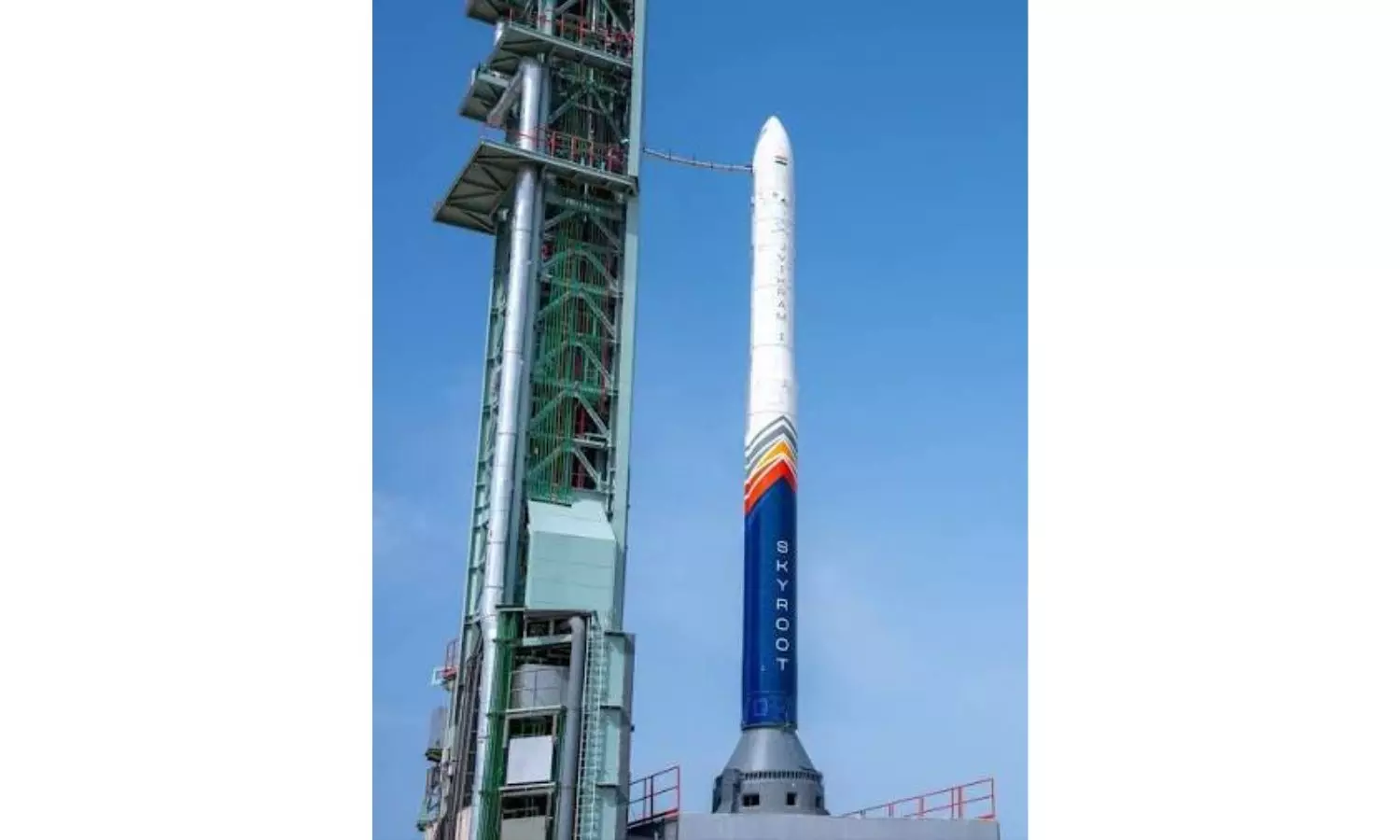
The successful maiden launch of Skyroot Aerospace’s Vikram-1 — the first rocket manufactured by a privately owned company — has opened a new chapter in India’s space voyage, exactly 36 years after the fund-strapped Isro launched its first experimental satellite launch vehicle, SLV-3.
The first privately developed multi-stage orbital rocket successfully lifted off from the Satish Dhawan Space Centre, Sriharikota, at 12.05 pm under Mission Aagaman on July 18, catapulting India into an elite group of countries with private space-launch capabilities.
The success of the maiden launch is quite significant because many rockets, including SpaceX’s Falcon 9, have failed on their maiden flights. Skyroot plans to conduct two developmental flights — Vikram-2, carrying a 1,000 kg payload, and a reusable launch vehicle — before entering the crowded commercial small-satellite launch market.
The success of Skyroot — a startup founded by former Isro engineers Pawan Kumar Chandana and Naga Bharath Daka in Hyderabad in 2018 — has validated the Indian government’s belief in the private sector and its decision to open up the space sector to private companies.
The policy change has resulted in the establishment of several private players, such as Pixxel, Bellatrix Aerospace and Dhruva Space. The recent public offering of Elon Musk’s SpaceX, whose valuation soared to over a trillion dollars, demonstrated the promising prospects of the private space exploration business.
American space companies have also highlighted the advantages they enjoy over government-led agencies, including quick decision-making, fewer bureaucratic controls, a greater capacity for risk-taking and innovative approaches. If Indian space companies follow the same route, the country may soon have a highly successful, profitable and vibrant space sector.
The rise of private space companies, however, is having a rather disappointing impact on the state-run Indian Space Research Organisation (Isro), from which over 100 scientists have reportedly resigned, ostensibly to pursue promising careers in the new space companies.
Although the government has tightened the exit process at Isro, it is unlikely to stem the tide, as private companies have often grown at the expense of state-run institutions. This pattern can be seen in telecom with BSNL and VSNL, oil exploration with ONGC, pharmaceuticals with IDPL, and aviation with Air India. Therefore, instead of competing with private companies, it is high time that Isro assumed a mentoring role and focused on deep-space exploration in collaboration with the new spacefarers.
The launch of Vikram-1 is not merely the success of a company; it also marks the maturing of the country’s space sector, with thousands of suppliers and tens of thousands of engineers, scientists and space enthusiasts. The credit for the development of this space-launch ecosystem must go to the pioneers of the Indian space programme at Isro, who tirelessly nurtured the country’s capabilities while eschewing opportunities to take up cosy, high-paying jobs at well-developed Western space agencies.
The Central government, which administers the department of space, should focus on creating a collaborative mechanism that harnesses the strengths of Isro and new space startups, enabling India to undertake deep-space voyages and uncover the deeper secrets of space and time.
