DC Edit | Trump-Xi Summit Delivers Very Little Beyond Optics

China’s Xi may believe he has found a way to manage the world’s most capricious leader, but it is too well-known that Mr Trump has perennially reserved a soft corner for the authoritarians of the world, a privilege he does not grant leaders of fellow democracies
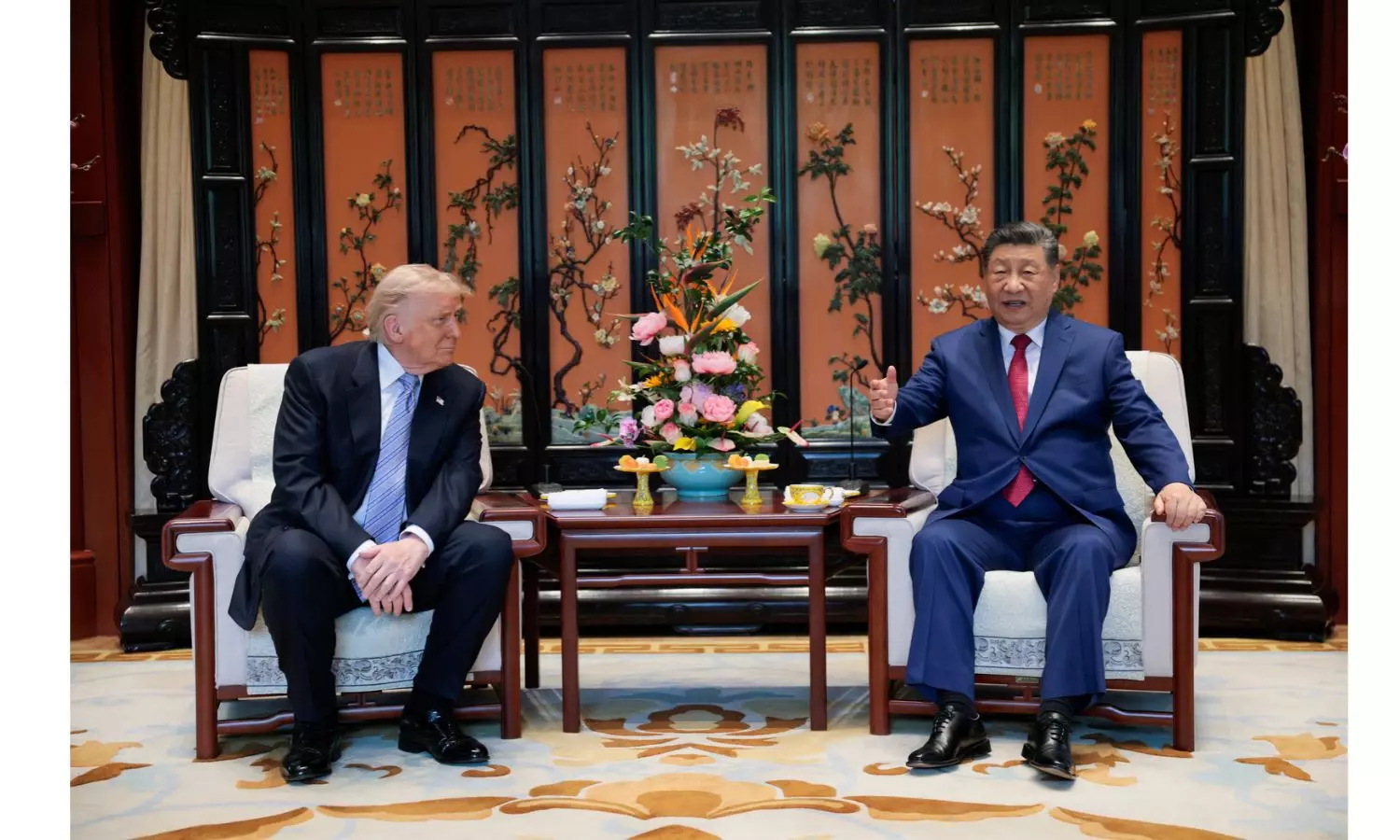
The extension of a fragile truce keeping at bay an intense trade war is all that was achieved during the high-profile visit of Chinese President Xi Jinping to the United States. The spectacle the pomp and pageantry in Washington provided may have given the Chinese supremo the impression that the US President Donald Trump has granted China an equal place as a superpower, including in his personally welcoming Mr and Mrs Xi on the tarmac at Joint Base Andrews.
In concrete terms, all that has been delivered is a two-month extension given to the trade truce that was to expire on Nov. 10. Even then, the threat hangs of an imposition of 100 per cent tariff over purchase of Russian crude that would be equally applicable to China as India. It remains to be seen if Mr Trump, who is a master at delivering personal friendship optics in lieu of granting any ground to a super-competitive rival for world power, has done it again.
China’s Xi may believe he has found a way to manage the world’s most capricious leader, but it is too well-known that Mr Trump has perennially reserved a soft corner for the authoritarians of the world, a privilege he does not grant leaders of fellow democracies. To what extent that will translate into giving some ground in an already vastly unequal trade to a global competitor remains to be seen as China’s global trade surplus ticked up a healthy $1.2 trillion last year.
There has been little for the world racked by two to three major wars in the sensitive West Asia region and Ukraine-Russia to draw any hope from the much-hyped meeting of the leaders of the two most powerful countries militarily and economically. But then expectations were always low considering nothing much happened during Mr Trump’s visit to Beijing earlier this year either.
The Iran war was said to have come up in discussions again, but not even Mr Xi Jinping may have been in any position to suggest a way for Mr Trump to extricate himself from what he has gotten the US and its Middle Eastern allies into in waging war against Iran or said he could do anything about Russia’s continuing aggression against Kyiv.
This might be a mere assumption, but it does appear as if Mr Trump may be increasingly inclined to leave the regional affairs of Asia to be led and managed by the Asian countries themselves while the USA takes more interest in what is happening nearer home in Central and South America and the Caribbean. Mr Xi would certainly feel China’s sphere of influence would be more complete if the US declines to get involved in Asian affairs.
The building anxieties over the existential threats artificial intelligence could pose may have represented the biggest common ground even as the US’s arms supply to Taiwan may have been the point of highest disparity. Here too, China may have been quietly covering the gap in AI development in ripping off US models while agreeing to talk about the possible dangers posed by the technology.
It is open to question what actions nations can take as AI is developing in leaps and bounds in a free America and in a more controlled environment in China. The seeking of a “coexistence in peace” is, however, the one promising call that came from China even as Mr Trump has his own battles to fight on home turf as the midterm polls are nearing.
