DC Edit | Return To Democracy To Bangla Will Be Tribute To Khaleda

Prime Minister for two full terms, Khaleda was the wife of the first of Bangladesh’s many military rulers in the nation’s numerous turbulent swings from democracy to rule by military chiefs in its 54-year existence as an independent nation since it broke away from Pakistan in 1971
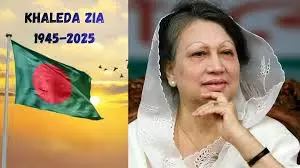
Khaleda Zia, Bangladesh’s first woman Prime Minister, passed away at a time when her Bangladesh Nationalist Party is in pole position to win the polls ordered for February 12, 2026 by the transitional government advised by Muhammad Yunus. Prime Minister for two full terms, Khaleda was the wife of the first of Bangladesh’s many military rulers in the nation’s numerous turbulent swings from democracy to rule by military chiefs in its 54-year existence as an independent nation since it broke away from Pakistan in 1971.
The anarchy protests involving the public, but driven principally by restive students, had brought about was instrumental in the regime change that saw the ouster of Khaleda’s rival Sheikh Hasina Wazed in August 2024 and her exile in India. The road back to the people choosing their ruler may be marked with a degree of uncertainty now in the wake of anti-India protests this month, but it was on the cards that Khaleda’s BNP would enjoy an alternating salience again in the bitterest imaginable partisan politics of Bangladesh.
It is tragic that her life would ebb out because of protracted illness at this juncture. Her return from treatment in London had symbolised a moment of hope and resilience for her party which will, of course, be actively run by her son Tarique Rahman who himself returned to Dhaka after 17 years of a self-imposed exile to escape the clutches of Hasina’s regime that had tormented his mother and him with imprisonment, though Khaleda was sent to prison more often by military regimes.
The partisan politics of the two ladies whose decades-long rivalry saw them go head-to-head in a clash of diametrically opposed dynasties of Sheikh Mujibur Rahman and Ziaur Rahman that had led to several political assassinations may not end with Khaleda’s demise. It is interesting that Khaleda is even accused of changing her birthday to August 15 in order to make a very tragic date in the life of the family of Mujibur Rahman, seen as the liberator of Bangladesh, a day of celebration.
The one commonality they shared was in 2006 when both were imprisoned by an interim government backed by the military charged them with corruption, a theme that runs like a red thread across the fabric of Bangladesh’s party politics. The one great difference in their approach was that Khaleda was always willing to align with the Islamist party Jamaat-e-Islami, and took an anti-Indian stance while Hasina tried to adapt a far more secular outlook and actively sought to rein in the religious zealots and was pro-Indian.
What Bangladesh needs most is for a stable government to emerge from free, fair and open polls. Khaleda’s commitment to polls-based democracy often wavered with her party boycotting polls including the one held in January 2024 in which Hasina had a path to power cleared with BNP, the main opposition to the Awami League, withdrawing from the fray. The turmoil must end along with the interim government if the economy is to recover to the levels both Khaleda Zia and Hasina had shaped in their time as PMs.
