DC Edit | North Star for Indian Physicists

He inspired India’s scientists and showed the universe can be seen in new ways
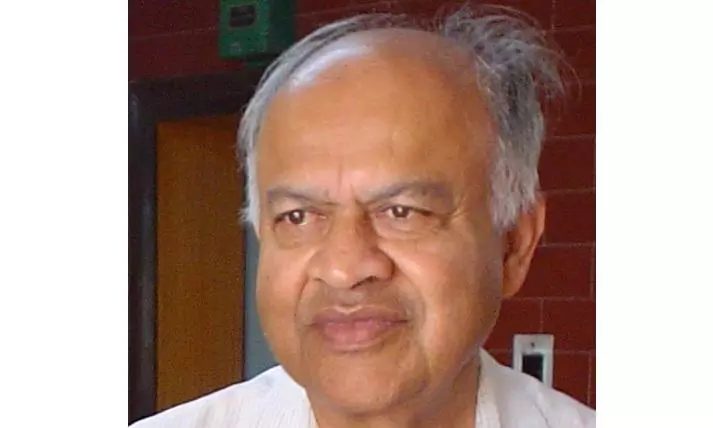
Curiosity and inquisitiveness are the bedrock of science. The fundamental quality required of science practitioners is non-conformity to established opinion until it has been subjected to rigorous validation tests. Jayant Vishnu Narlikar, the country’s most respected astrophysicist, pioneered this breed in India.
Born on July 19, 1938, in Kolhapur, Maharashtra, Narlikar was the son of Vishnu Vasudev Narlikar, a renowned mathematician who gave him a strong foundation in mathematics and a love for analytical thinking. After completing his education at the University of Mumbai, he went on to the University of Cambridge, where he worked under the mentorship of the British astrophysicist Fred Hoyle.
In a move that reflected his courage to challenge accepted scientific theories, Narlikar, along with Hoyle, questioned the widely accepted Big Bang theory and proposed an alternative: the quasi-steady state theory. Unlike the Big Bang theory, the steady-state cosmology theory, proposed by Narlikar and Hoyle, claims that the universe has no beginning or end in time and remains largely unchanged on a large scale.
Unlike many astrophysicists who chose to remain in Western countries, Narlikar returned to India to inspire young people to pursue careers in science. He founded the Inter-University Centre for Astronomy and Astrophysics (IUCAA) in Pune in 1988, which fostered collaboration between universities and mentored a new generation of Indian scientists.
He also continued his tireless advocacy of science through books, articles and television appearances, in which he demystified the cosmos for generations of Indians. Though he remained something of an outsider to the global astrophysics community, Narlikar groomed a generation of Indian astrophysicists by encouraging them to study the cosmos from within India. In his death, India lost one of her greatest and brightest sons, and he will always remain the North Star for the Indian astrophysics community.
