Sunanda K. Datta-Ray | Why 100% Tariffs on India, China Unlikely

Trump can impose tariffs of up to 100% on countries buying Russian oil and gas
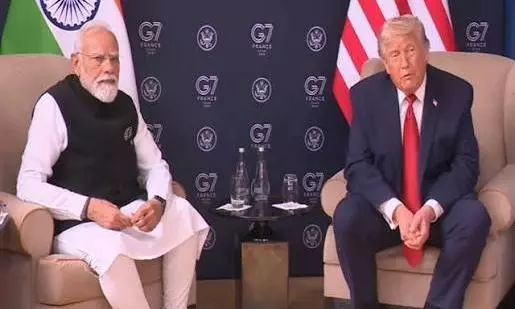
By so expeditiously signing the Russia sanctions bill into law, US President Donald Trump appears to have paved the way for up to 100 per cent tariffs on countries buying Russian oil and gas, putting India and China under threat. But that need not mean that a huge hike in tariffs is imminent. We know from experience that Mr Trump’s bark is often worse than his bite.
Moreover, not for nothing has diplomacy been called a feminine art involving a great deal of delicately suggestive moves and contortionist footwork. This is where the comparison/contrast between a diplomat and a lady comes in. As an old English saying has it, if a diplomat says “yes”, he means “maybe”, if he says “maybe” he means “no”, and if he says “no”, he's no diplomat. If a lady says “no” she means “perhaps”, when she says “perhaps” she means “no”, and if she says “yes”, she is NO LADY!
Or to be candid, can people who ride roughshod over their own high-falutin’ rules when it comes to making a fast buck (as the American slang has it) be called gentlemen? The United States’ imports from Russia were valued at $4.05 billion during 2025, according to the United Nations COMTRADE database on international trade. Such heavy purchases deprive Mr Trump of the moral right to point any kind of accusing finger at anyone else who tries to follow the same path.
The “Lindsey O Graham Sanctioning Russia and Iran Act of 2026”, as the new US measure named after the late Senator Lindsey Graham — one of Ukraine’s staunchest defenders in Washington who died in July this year shortly after returning from a trip to Kyiv — is no exception. But although Mr Trump’s nod came only two days after the Republican-led House of Representatives passed the sweeping sanctions bill by a vote of 262-159 following no less than 17 months of discussions on Capitol Hill, even that may not signal immediate and dire follow-up action.
For one thing, even after Mr Trump’s signature, the bill doesn’t automatically target India even if we are the second biggest buyer of Russian oil and gas. Secondly, even if it did, 100 per cent is the upper limit of the punitive tariff that can be imposed, it is not the new default tariff.
The intention of the US legislation is to reduce the financial resources sustaining Russia’s war against Ukraine. It targets Russian officials, banks, energy interests, and foreign entities supporting Moscow’s military operations. The law authorises Mr Trump to impose tariffs on countries doing business with Russia in order to cut their dependence on Russian oil and gas.
According to the US House Ways and Means Committee, the legislation directs tariffs of up to 500 per cent on Russian goods. It also provides for duties of up to 100 per cent on goods from countries covered by its Russian oil and gas purchase provisions — which cover major Russian energy importers and leading facilitators of oil sanctions evasion.
Additionally, the bill includes sanctions against the Russian President, Vladimir Putin, personally, as well as against other senior figures in the Kremlin regime.
Undeniably, India faces a new tariff threat now that Mr Trump has signed the Russia sanctions bill into law.
An amendment introduced by Democratic Congressman Steny Hoyer had called for explicitly naming 10 nations — starting with India, but including China, the UAE, Turkey, Singapore, Azerbaijan, Kazakhstan, Hungary, Kyrgyzstan and Slovakia — to be eligible for tariffs of up to 100 per cent under the bill's secondary tariff provisions. However, the amendment does not itself impose a 100 per cent duty on India. The tariffs could be imposed on India only if Trump chooses to exercise his power under the new law.
If he does do so and levies the 100 per cent tariff on India, it would be on top of a 10 per cent tariff that the US currently imposes on imports from New Delhi as a penalty for allegedly not doing enough to stop the import of goods made using forced labour.
However, the exact impact of new tariffs on Indian exports can be assessed only after the US announces the tariff rates.
Despite all that we are told at home by various levels of official and semi-official spokesmen about how hunky-dory relations are between those best of global chums, Narendra Modi and Vladimir Putin, ties between India and the US were strained last year when Mr Trump imposed an additional 25 per cent tariff on Indian imports of Russian crude, on top of a 25 per cent reciprocal tariff. But better sense prevailed in the Kremlin and the damaging impact wasn’t long-lived. The additional tariffs were removed in February 2026, while the reciprocal tariff was reduced to 18 per cent as part of a slightly more relaxed US-India trade framework.
Perhaps this was in recognition of the fact that India had made it abundantly clear when the US Congress passed the Russia sanctions bill that it is determined to take all necessary measures to protect its trade and economic interests. “As stated on several earlier occasions, India remains firmly committed to ensuring energy security for its 1.4 billion people. It will continue to do so through diversified sourcing and based on evolving market dynamics,” declared an external affairs ministry statement.
According to the external affairs ministry, the issue of India’s oil trade with Russia has been discussed at high levels in recent months with various US interlocutors. “Its potential implications for not just the bilateral relationship but also the international energy market has been very clearly articulated by the Indian side,” the ministry said.
While most Republican lawmakers supported the legislation, privately, many urged party leaders to take out new tariff powers from the bill, reported CNN. According to media reports, they warned that the tariffs could further hike prices.
That is also something for Mr Trump to bear in mind. But the guessing seems to be that he is possibly looking for some advantage in the long, protracted negotiations over a bilateral India-US trade agreement. Some form of transactional advantage also often passes for diplomacy.
