Sunanda K. Datta-Ray | Targeting Muslims, Jews: How Minorities Face Flak

Israel’s arrogance recalls how roles are reversed in George Orwell’s Animal Farm, where yesterday’s victim becomes today’s oppressor.
REFLECTIONS
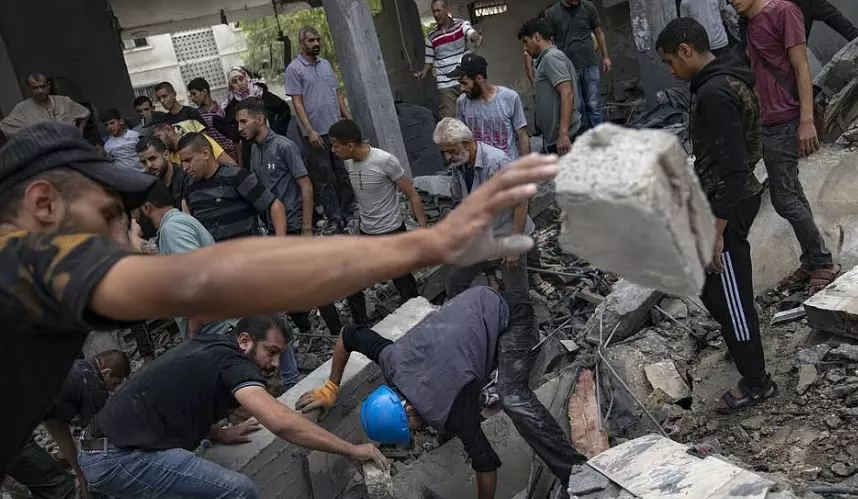
India’s cozying up to Israel for security talks at a time when most of the civilised world condemns Israeli brutality against the Palestinians might be justified in terms of Chanakya’s “enemy’s enemy is a friend” dictum. But self-respecting Indians can’t be proud of the relationship after seeing pictures of dying children in Gaza where, at the time of writing, Israel largely refuses to allow food, humanitarian aid or international journalists.
Even Mohandas Karamchand Gandhi would not have approved. A veteran Israeli diplomat who was in the Zionist delegation that sought Gandhi’s help told me that the Mahatma put up his hands and refused to be involved. Agreeing that the Jews had been “cruelly wronged,” he wrote in Harijan that “they have erred grievously in seeking to impose themselves on Palestine with the aid of America and Britain and now with the aid of naked terrorism.”
Muslims often appear to be the new Jews. Israel’s arrogance recalls how roles are reversed in George Orwell’s Animal Farm, where yesterday’s victim becomes today’s oppressor. The Holocaust cannot justify Jewish tyranny over the helpless Palestinians. Jeremy Corbyn’s sacking as British Labour Party leader because of alleged anti-Semitism was another instance. “One anti-Semite is one too many,” Mr Corbyn himself stated, adding that “the scale of the problem was dramatically overstated for political reasons.” He was probably too radical for Her Majesty’s Prime Minister-in-waiting in a world where any criticism of Israel is branded anti-Semitic.
Dame Penny Mordaunt, former Conservative defence minister, and Lord Mann, the Labour peer and the UK government’s anti-Semitism adviser, claim that anti-Semitism is “rife among the middle class.” As authors of a report commissioned by the Board of Deputies of British Jews, they had been “stunned into silence” by evidence of the anti-Semitism pervading the National Health Service, British universities and the arts.
Noting an “identifiable lack of consistency and capacity in anti-Semitism training,” they recommended the creation of a specific anti-Semitism training qualification, adding that such training should be included within equality, diversity and inclusion in organisations and institutions. The 10 recommendations by Lord Mann and Dame Penny called on educators, public services and trade unions to do more to tackle anti-Semitism, including “basic training on contemporary anti-Semitism.”
Prejudice is often unconscious. At school in Calcutta, we often chanted “Justin Aaron, king of the Jews, sold his wife for a pair of shoes” at the only Jewish boy in my class. Sometimes we threw our rulers asking Justin to turn them into serpents like the Biblical Aaron. One day when I wanted to borrow his pen and Aaron demurred, I expostulated: “Don’t be a Jew!” His retort, “I am a Jew,” made me realise how innocent our teasing was.
Hermann Kisch, an English Jew who joined the Indian Civil Service in 1873, wrote that “Mr Gubbay” — a Calcutta Jew of Baghdadi descent like Aaron — was a nice man but would rather not invite him “in his red fez and black dressing gown” with European guests.
The last time the British Parliament discussed anti-Semitism, which has been called “the oldest hatred,” a veteran Black MP, Diane Abbot, quoted Rabbi Herschel Gluck, chairman of the Arab-Jewish Forum and founder-chairman of the Muslim-Jewish Forum, to make a significant point. “Minorities, and especially the Jewish community in Europe, are the weather vane of discontent and a wider feeling of insecurity as people look for easy and quick answers to their problems.”
That is doubly true of India, the land of minorities, although the term now denotes the biggest minority of all. As the Sachar Committee confirmed, Muslims lag behind other communities, including Dalits, in most indicators of social, economic, and educational development. The remedies that Dr Manmohan Singh had pioneered have had some effect, but thanks to newer forms of social injustice, Muslims have lost on the swings what they gained on the roundabouts.
Despite the bravery of two young Moradabad girls who flouted orthodoxy to choose their own spouses, the Netflix version of Vikram Seth’s hugely entertaining A Suitable Boy confirms how orthodoxy has weaponised inter-faith romance to create the stiletto of “love jihad.”
Time was when India defied American wrath to feed Fidel Castro’s Cuba while angry protesters against the Vietnam War ground Calcutta to a halt. The Cuban deal was a tribute to P.V. Narasimha Rao’s diplomatic finesse in quietly ordering the sale of 10,000 tonnes of rice to Cuba with a ₹10-crore price tag that was quietly waived.
Perhaps some awareness of that independence explained 15 protesters gathering by Mahatma Gandhi’s statue in London’s Parliament Square the day the anti-Semitism report was released. Most were elderly. Some carried placards reading “I oppose genocide. I support Palestine Action,” the group that Britain has banned as terrorist. A few wore the traditional checked scarf, keffiyeh, symbol of the Palestinian struggle, that is now manufactured in India or China and exported to Palestine. Curiously, while the police arrested all the protesters sheltering by Gandhi’s statue, the 15 beside a graven Nelson Mandela nearby were not touched.
Orwell argued that the British went to India not for money or power, but because servants and the rituals of drawing and dining room allowed them to pretend to be gentry. Kisch may even have revised his view of Mr Gubbay when his son married Sir Albert Sassoon’s daughter in England.
There were many Jews in India like Bombay’s Bene-Israel, Cochin’s Paradesi Jews who created the modern world’s first Jewish homeland, the Malayalam-speaking Black Jews packing blue roses I met in Beersheba but could not converse with since they had no Hindi or English, and Mizoram’s Tibeto-Burmese Bnei Menashe. Now, a 13th-century tombstone has stirred speculation about a colony of Yemenite Jews in Tamil Nadu. Yet, Indira Gandhi stumbled when Ed Koch, New York’s mayor, asked her about Jews here. I doubt if her successors are any better informed.
Minority means for them the Muslim question, which home minister L.N. Agarwal in Seth’s novel tries to wish away by insisting that Independence gave Muslims a country of their own and that India is for Hindus. Many of the Mann-Mordaunt recommendations to counter anti-Semitism would also apply to anti-Muslim fanatics. The authors rightly say that “if our Jewish community is facing discrimination, this is a failure of our society.”
Similarly, the problems Indian Muslims complain about only proclaim the failure of Indian society at large.
