Sunanda K. Datta-Ray | Amid Friction in PoK, Why Delay Over J&K Statehood?

PoK protests, Kashmir's future and concerns over India's political direction
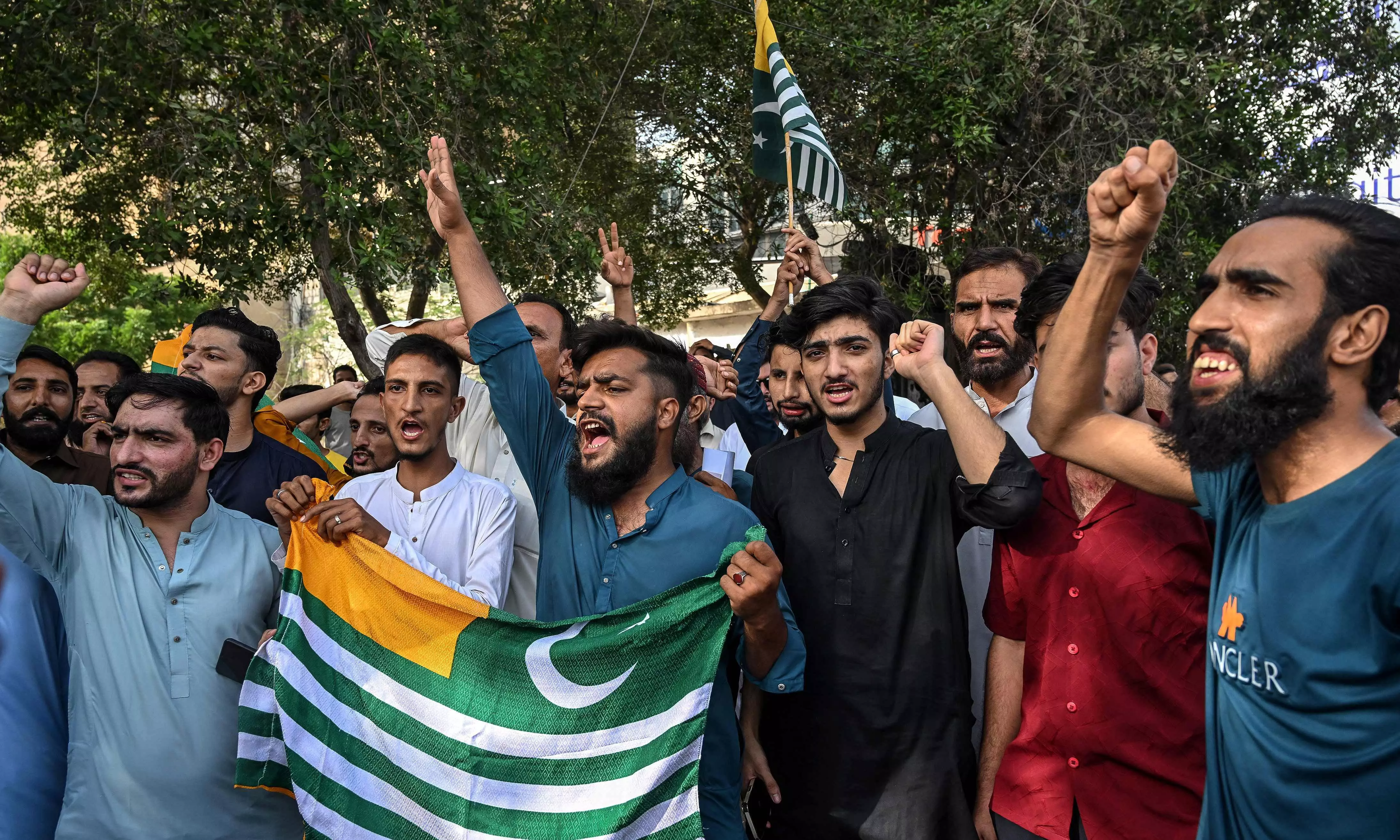
It must have been the unkindest cut of all for the approximately four million people of “Azad Kashmir” -- “Pakistan-occupied Kashmir” or PoK to us -- when Pakistan’s defence minister, Khawaja Muhammad Asif, dismissed them as “enemies like India”. The insult followed deadly clashes in Rawalakot and Mirpur, both in PoK, where Pakistani security forces were accused of using lethal force against civilian demonstrators, including women and children, seeking relief for economic and administrative grievances.
While “Azad Kashmir” struggles with a war within the bigger war for the former princely state of Jammu and Kashmir, and, indeed, for India itself, a dark cloud may loom over 1.4 billion Indians, including J&K inhabitants. It is the threat of rituals and ostentatious religiosity replacing the scientific temperament that India’s founding Prime Minister, Jawaharlal Nehru, sought to inculcate in all Indians. His successors squander fortunes on huge statues and ostentatious shrines, while prostrating before deities in temples where lavish donations are reportedly robbed right, left and centre by unscrupulous managers.
Not that that abuse of faith and worship has any bearing on the friction that has flared up between the federal Pakistani authorities in Islamabad and a recalcitrant PoK. However, the strictly secular crisis of thieving -- petty in itself -- might inadvertently reveal something of Narendra Modi’s much more ominous long-term plans for the country. The allegedly fundamentalist Muslim politician, Asaduddin Owaisi, president of the All India Majlis-e-Ittehadul Muslimeen, known as AIMIM, may only have put into words what others, including many Hindus, suspect, when he recently dismissed Mr Modi’s actions as a “bid to create Hindu Rashtra”.
That is probably a major reason why no discernible attempt has been made to restore Article 370 of India’s Constitution which was revoked seven years ago, or to repeal the Jammu and Kashmir Reorganisation Act 2019, that New Delhi enacted on August 9, 2019, reducing what had been a full-fledged state since 1947 to the level of a Union territory ruled by a lieutenant-governor appointed by New Delhi and not accountable to anyone outside the top tier of the power hierarchy at the Centre.
That J&K is the only Muslim-majority state in an overwhelmingly Hindu India and that it has always been ruled by a Hindu hereditary monarch, Maharaja Hari Singh was the last, makes the demotion especially significant. Intriguingly, Hari Singh’s principal support came from his Muslim prime minister, Sheikh Mohammed Abdullah, who felt that secular India was a safer bet than theocratic Pakistan for his liberal Islam and his state’s distinctive cultural and ethno-national social identity.
Playing the communal card, Pakistan sent an invading army into J&K on October 22, 1947. Thanks to India’s military intervention, the Pakistanis were unable to occupy more than about six per cent of the total area (about 13,297 sq. km out of roughly 222,236 sq. km) which it calls “Azad Kashmir” (Free Kashmir), and pretends is an autonomous entity. But as the recent fracas confirmed, the relationship is far from amicable.
Meanwhile, the continuing war for Kashmir periodically erupts in savage terrorism. Even otherwise, it prejudices and poisons perceptions and keeps alive and exacerbates grievances, real or imaginary, dating back to Partition. For instance, when Pakistan’s high commissioner in Singapore was asked in a TV programme celebrating the 50th anniversary of South Asian Independence, why Pakistan did not enjoy a stable democracy like India instead of veering from one military coup to another, he shot back that Pakistan’s soldiers are aggrieved because India had kept back military assets that should have been shared in 1947.
On the Indian side, there is a tendency to forget -- deliberately or otherwise -- that the “Instrument of Accession” that Hari Singh signed on October 26, 1947 was only in respect of defence, external affairs, and communications. New Delhi acquired other powers mainly through the courtesy of tame Kashmiri politicians holding office in Srinagar.
Syama Prasad Mookerjee, a Bengali politician who founded the Bharatiya Jana Sangh (predecessor of Mr Modi’s ruling BJP) and former president of the All-India Hindu Mahasabha, has posthumously shot up in the popularity stakes as the embodiment of Hindu revivalism. Refusing to accept that J&K was not legally a part of India, Mookerjee tried illegally to enter the state in 1953. He was arrested, suffered a heart attack, died the next day and is now revered as a martyr. Two further India-Pakistan wars and constant friction, not to mention an unending stream of propaganda, have done nothing to end a bitterness whose only positive outcome may be the emergence of an independent Bangladesh.
“Azad Kashmiris” complain of high inflation, heavy taxation, and the extortionate price of electricity in a state that is partly snow-bound for some months. Citizens’ committees say they are denied fundamental political rights, subjected to administrative suppression, and exclusion from local natural resources. Regular government crackdowns and the use of force against peaceful demonstrators add insult to injury and deepen the alienation between residents and Islamabad. The unrest has claimed over 90 lives since the civil rights protests began on June 5, 2026 but Mr Asif was referring to the latest bunch of 32 “Azad Kashmir” protesters that the Pakistan Army mowed own. That’s when Mr Asif had declared in a video that has gone viral: “I put the protesters of Azad Kashmir in the same category as India and consider them also as enemies like India.”
A small straw in the wind of the future is the sudden switch to saffron jerseys, instead of the customary blue, for India’s male and female hockey teams, by Hockey India, the officially empowered organisation which plans, directs and conducts all activities for hockey enthusiasts. Taken by surprise, many veteran players like the former India hockey captain and Olympian, Viren Rasquinha, point out that blue is traditionally the colour associated with the game, and that the sudden imposition of saffron will contribute nothing to winning matches. Another small sign of the times: West Bengal’s new BJP chief minister, the BJP’s Suvendu Adhikari, is the first in that job never to be seen without a vermilion daub on his forehead.
Little could Sheikh Abdullah have guessed back in 1947 that India might one day be labelled a “Hindu Pakistan”.
