Shikha Mukerjee | Why ‘Cockroaches’ Are Virtually Indestructible

The Cockroach Janta Party’s victory signals a new force in India’s democratic politics
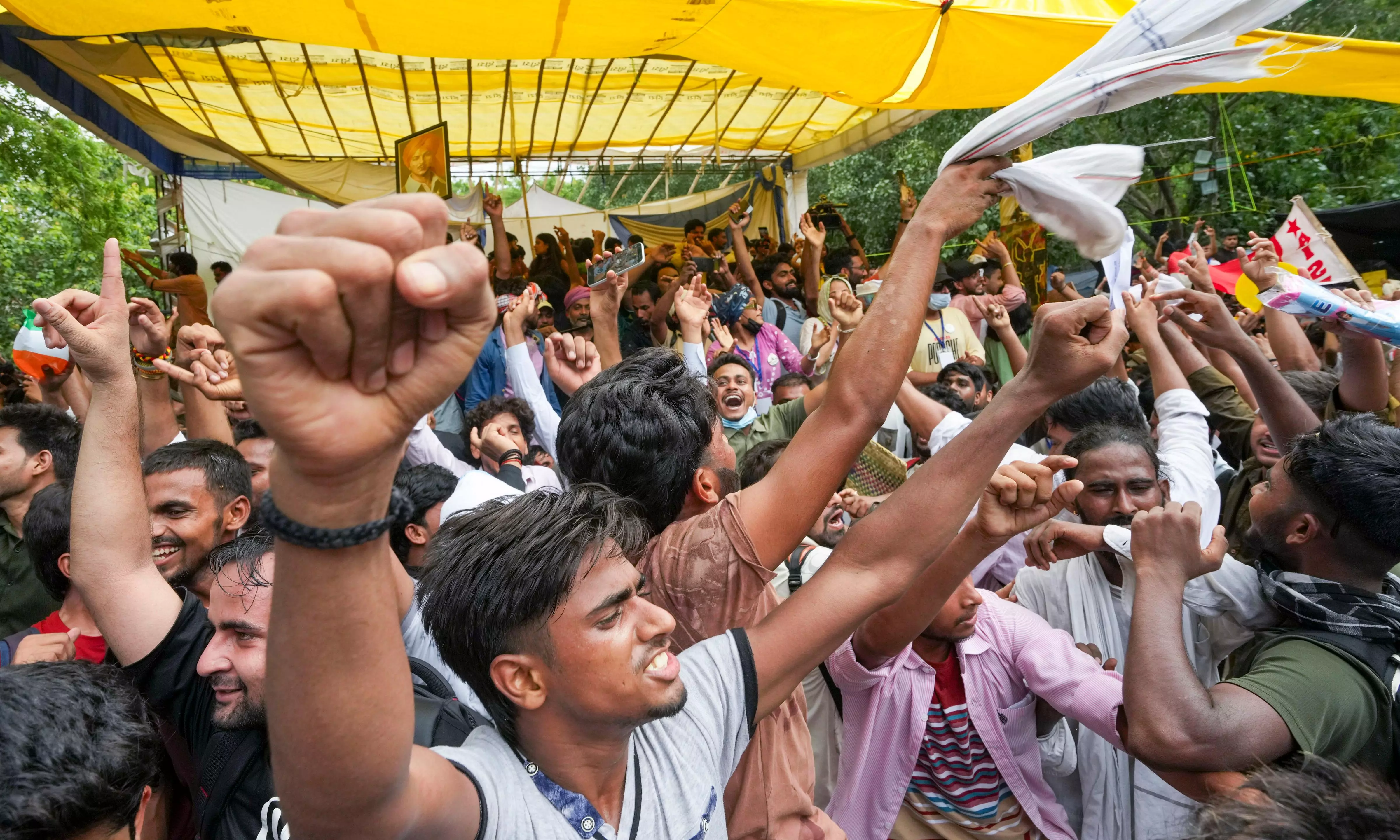
Measured in the binary of victory-versus-defeat, it’s true that the youth-initiated and youth led protest under the banner of the Cockroach Janta Party triumphed against the might of Narendra Modi’s BJP by compelling the discredited education minister, Dharmendra Pradhan, to resign. The resignation was the CJP’s top demand, its non-negotiable requirement to end the protest.
The youth who took to protests, negotiating and deal-making like ducks to water were born and nurtured within the system that the Modi government reconstructed to represent its ideology of Hindutva hegemony, centralisation of power, dismantling federalism and disenfranchising voters. The online party, which isn’t a “party” at all in the formal sense, took on the world’s largest party, BJP, which is supposed to be a well-oiled machine with disciplined cadres.
When organisation is taken on and defeated by an unorganised bunch of frustrated, discontented and disenchanted young people, with expectations and aspirations that link them to a particular cohort, huge in numbers, a new phenomenon is born. Abhijeet Dipke’s infuriated response to Chief Justice of India Surya Kant’s labelling of unemployed educated youth as “cockroaches” triggered a movement that describes itself as “a political front of the youth, by the youth, for the youth”.
What the slogan does not say is what makes the Jantar Mantar protest and the protests across India a vital testament to democracy. The movement is inclusive; if the ultra-left All India Students Association was there, so was the Congress’ student wing NSUI. So too was Sonam Wangschuk, who added moral heft to the protest by going on hunger-strike in support of the students’ demands. Farmers, traders, school teachers and professional politicians, retired persons, parents and survivors of the brutal system of education and examinations were also there. So too were elected and veteran leaders of the Opposition parties. As Rahul Gandhi explained, it’s “my job,” as Leader of the Opposition, to represent the side opposed to the government.
The movement challenged every narrative that the BJP-RSS has introduced into and effectively taken over the public discourse. It didn’t make distinctions between youth from different religions or from economic and social categories. Jai Bhim, Inquilab Zindabad and Vande Mataram found space, along with Bharat Mata Ki Jai — to show differences in affiliations and ideologies within the protest space.
It’s perfectly obvious that the politically astute Prime Minister and his trusted henchman Amit Shah realised that the new phenomenon that could call for a nationwide protest against the entirely prepared violence against protesters in New Delhi on July 20 and successfully pull it off, couldn’t be tackled with the usual negotiating and deal-making tactics.
Retreat was the only sensible option. Mr Pradhan had to go because the alternative was an intensification of the protest by young people across the country, prolonged dharna within sight of the seat of power, namely the Prime Minister’s office; and challenging his claim that the BJP rules from the Himalayas to the Bay of Bengal. To oust the protestors, the Modi Sarkar would perhaps have to stage a repeat of Tiananmen Square.
Having won its objectives, the CJP leadership declared it would go home and sleep. That too defines the youth and its attitudes. Education reform is what they have set as their target: they intend to get it done, step by step, starting a month from the resignation day, July 25.
What else the CJP aims to achieve is unknown. Its “manifesto” said it will fight against Rajya Sabha seats for retired CJIs, it will hold the Chief Election Commissioner accountable, under the UAPA, for deletion of voter names, and this accountability will be strictly time-bound, presumably fast-tracked. It did say it supported 55 per cent women’s reservation in elected bodies.
The CJP as a platform of dissent makes sense. Other and older democracies have birthed platforms like Black Lives Matter and “MeToo”, in response to specific issues of misgovernance, from extreme and murderous violence by the State to cover-ups of the elite and powerful over sexual abuse, violence, harassment. Anna Hazare’s movement demanding strict anti-corruption laws was a demand for accountability.
The CJP’s demand for Mr Pradhan’s ouster was a gesture towards accountability.
What is the next step for the CJP and its platform of dissent? Holding the government to account is like walking the talk; the price of liberty being eternal vigilance. If India’s democracy and its citizens are transiting to participation in politics, through a mechanism of eternal vigilance to protect and defend rights and entitlements, it is a maturing urgently desired.
Limiting one’s political participation to just voting hasn’t worked. In the years since Mr Modi came to power, the idea of participation has been reduced to listening in silence, denoting approval or acceptance, every harangue and diatribe the leader has chosen to inflict on a captive audience.
When public discourse is as controlled as it is now, the youth, educated, less educated and merely literate learn to find other ways of interpreting the real-time problems they confront. The Internet is a great educator. It also creates communities of the like-minded.
At Jantar Mantar, the like-minded discovered there were many more of a similar mind. Eric Hobsbawm vividly described it: “The activity combining bodily experience and intense emotion to the highest degree is participation in a mass demonstration at a time of great public exaltation” is, in his view, the “essence of collective experience”. If that connection persists, it is an unexpected and vital turn in how awareness, consciousness and action can come together to compel power to concede to a popular demand.
To scientists who study cockroaches, the triumph would be unsurprising: “They’ve really figured out how to exploit the opportunities we create, and in doing so, developed behaviours and life histories that prevent us from controlling them,” said Jeff Lockwood, professor of natural sciences and humanities at the University of Wyoming. It is this capacity to evolve and disarm every toxic chemical aimed at its obliteration that distinguishes cockroaches.
And India’s youth, entirely aware they have not been enabled to access the rewards of the democratic dividend through education and misleading claims about employment, have figured out a new identity and collective strength. Constituting about 40 per cent of the population, youth as voters need to be respected by the legacy political establishment that has till now seen them as pawns categorised into caste, community and regional identities.
Like the National Eligibility-cum-Entrance Test, voters will be challenged, to convert sentiment into substance; to make choices and decide with elections in Uttar Pradesh, Punjab, Gujarat, Himachal Pradesh, Uttarakhand, Goa, Manipur coming up in 2027.
Shikha Mukerjee is a senior journalist
