Shikha Mukerjee | The Politics Of Protest: Why Wangchuk Arrest Is A Blunder

Fighting politics with the State’s coercive machinery, as determined by the government, is a classic reaction of authoritarianism. It is tantamount to tyrannising the protesters through the deployment of the means of violence available to the government, like police firing on angry protesters, more usually referred in police and government parlance as a “mob” or “unruly mob”
One day before he was arrested and flown out of cool and clean Leh to hot and dusty Jodhpur under the National Security Act, Sonam Wangchuk, the indefatigable warrior for the rights of the people of Ladakh, told the world there was a move afoot by the Union home ministry “to bring me under the Public Safety Act and throw me in jail for two years”. What he then said is a master class add-on: “I am ready for that, but Sonam Wangchuk in jail may cause them more problems than a free Sonam Wangchuk.”
On September 24, two days before he was arrested and deported from his home base, Sonam Wangchuk called off yet another hungerstrike he had undertaken to demand statehood for Ladakh and inclusion in the Constitution’s Sixth Schedule, that would mean special status and accompanying privileges for the people. Mr Wangchuk is a celebrity activist; whatever happens to him is big news that quickly spreads worldwide, because among other things he is an innovator, who is concerned about the environment and founded the Himalayan Institute of Alternatives; he is an education reformer and he is a person who protests and leads protests for the rights of his people; above all else, he is the role model for Three Idiots, a Bollywood box-office success that became a hit film even in places like China.
Mr Wangchuk was therefore entirely correct that “in jail” he would “cause more problems”, as he is not the faceless, niche activist, who can be tidily tucked out of sight as a solution to the problem of the Narendra Modi government’s creation, after the 2019 abrogation of Article 370 and breakup of the Jammu and Kashmir state and its reduction to the Union territories of J&K and Ladakh. Not all protests are the sort of fluff that is routinely staged by political parties in season and out of season for reasons as ephemeral as an off-the-cuff comment or even a deliberately stated position.
Politicians, especially in campaign mode, can take offence over anything and everything, as Mr Modi did in a speech in Bihar earlier in September when he hit out at the Congress and RJD: “My mother was abused. These abuses are not just an insult to my mother, it is an insult to the mothers, sisters, and dau-ghters of the country.” The incident was his reaction to the antics of a person at a Darbhanga rally in August during the Voter Adhikar Yatra. The trading of creative insults, like “Jersey Cow” and “Congress ki Vidhwa”, as a reference to Mrs Sonia Gandhi, have been normalised since 2014. The best that can be said about the trading of such abuses is one man’s meat is another man’s poison; Mr Modi’s mother is hands off; Rahul Gandhi’s mother is not.
The point is that the legitimacy of a protest can’t be decided by the police, Ladakh’s lieutenant-governor, the Union home ministry, the BJP or any other political party for that matter. The legitimacy is not determined by either the police, the bureaucracy or the government of the day.
The police and the judiciary can declare a particular protest is illegitimate; that does not make it so. The legitimacy or illegitimacy of protest or opposition in a democracy is determined by the popular support it receives, the size of the masses, who mobilise to support it and the durability of the protest.
Fighting politics with the State’s coercive machinery, as determined by the government, is a classic reaction of authoritarianism. It is tantamount to tyrannising the protesters through the deployment of the means of violence available to the government, like police firing on angry protesters, more usually referred in police and government parlance as a “mob” or “unruly mob”.
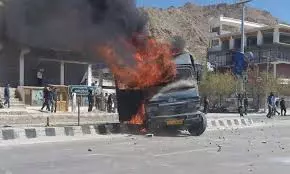
The question to be asked is, even if there’s no one answer: Was it necessary for the police in Ladakh to fire at the crowds and in the process kill four people, and injure over 50 others, and then blame the failure of crowd management on Sonam Wangchuk and declare him dangerous to national security?
Protest is a constitutionally guaranteed fundamental right; so is demanding statehood for Ladakh and inclusion in the Sixth Schedule. Why that becomes an issue of national security is an explanation that is necessary but is unlikely to be forthcoming from the Union home ministry.
The pessimism is based on the curious directive by Union home minister Amit Shah to the Bureau of Police Research and Development at a two-day National Security Strategies conference. The bureau, an otherwise obscure entity, was told to dig into the post-Independence past on “mass agitations by vested interests”, in order to develop a standard operating procedure, or playbook, analysing the reasons, “financial aspects,” final outcomes and “behind-the-scenes players” of these protests.
The details were not reported on what kind of protests and what final outcomes were particularly problematic for the Union home ministry and why it wanted this research done. One simple explanation could be that following the youthled protests in Nepal and Bangladesh, and earlier in Sri Lanka, and the significantly large number of protests with high youth participation in Southeast Asia as well as the Middle East and Africa, the Narendra Modi government is nervous. Such protests, especially in the age of the Internet, have a life of their own, that no amount of repression and blackouts can actually work in blacking out information.
The other obvious reason for the compulsion to research is the lack of political acumen. Political leaders are expected to be able to read the pulse of the people or feel the earth rumbling under their feet long before the tremors and the quakes are felt by the rest. If political leaders do not have their ear to the ground about protests and they fear that such articulations or demonstrations can snowball and overturn the order of things, it does imply that there is incompetence at the top. Or, perhaps, the political leadership, living in a bubble, has lost touch with the ground.
Mr Wangchuk’s detention under the NSA is one more instance when State power is being deployed against a popular agitation that could spiral into a mass movement — the final outcome of which would be a change in the status of Ladakh in recognition of the legitimate demand of the people.
As a possibility, it does seem quite realistic; three terms in office with the entire and augmented apparatus of surveillance and coercion at their beck and call, any government can be excused for losing the magic touch that separates success from failure.
Shikha Mukerjee is a senior journalist
