Shikha Mukerjee | RSS’ 100 Years: Cult Of The National In A Diverse India

Tagore warned: “Crowd psychology is a blind force. Like steam and other physical forces, it can be utilised for creating a tremendous amount of power… unreasoning pride in their own race, and hatred of others”
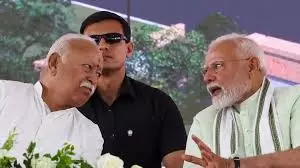
There are a few different ways to make sense of two important speeches delivered to celebrate the centenary of the Rashtriya Swayamsevak Sangh, which brags that it is the world’s largest non-governmental organisation, with an unspecified number of members, subsidiaries and mass organisations.
Prime Minister Narendra Modi’s speech was that of an ardent devotee to the RSS’ ideals and ideology, which from its inception was committed to nation-building, with its mantra of “Nation First”. The base of the massive structure was “the unique, simple and enduring mechanism of the daily shakha”.
The other speaker, Mohan Bhagwat, the RSS’ current head, seemed different, more prosaic and less emotional, a direction setting message to the millions who think and work at his bidding. If not exactly a vision statement about how the RSS cadres must learn to see and act within the changing reality of a climate crisis and a fragmenting world order disrupted by America’s trade and tariff policies under President Donald Trump’s leadership, it was a call. Mr Bhagwat’s call was aptly defined by, of all people, Rabindranath Tagore. Writing in 1922, before the formation of the RSS, Tagore in “Creative Unity” said: “The Cult of the National is the professionalism of the people. This cult is becoming their greatest danger, because it is bringing them enormous success, making them impatient of the claims of higher ideals.”
Reading Tagore and Mr Modi together on the consequences of the “cult of the national” is one way of making sense of the PM’s speech on one hand and Mr Bhagwat’s message to RSS cadres, affiliates, sympathisers and fellow travellers. Mr Modi, talking of “conspiracies to divide our unity, demographic changes through infiltration and more”, made it clear the government and the RSS were on the same page. He said: “Our government is actively countering these. I am glad the RSS too has prepared a concrete roadmap to face them.”
The PM takes pride in his roots and his rise from membership in a “shakha”, the lowest unit of the massive RSS structure; thus his admiration for the shakha as “an inspiring place where every swayamsevak begins his journey… and goes through a process of personal transformation,” is wholly understandable. It also reveals the “professionalism” that worried Tagore. The poet, educationist and author of India’s national anthem, had warned in 1922: “With the growth of nationalism, man has become the greatest menace to man. The continual presence of panic goads that nationalism into ever-increasing menace.”
Tagore warned: “Crowd psychology is a blind force. Like steam and other physical forces, it can be utilised for creating a tremendous amount of power… unreasoning pride in their own race, and hatred of others.” He added: “Newspapers, school books, and even religious services are (used) for this object; and those who have the courage to express disapprobation of this blind and impious cult are either punished in the law courts, or are socially ostracised.”
It is curious Tagore listed the ways in which the professionalism of the Cult of the National worked. Considering that the RSS maintains it has millions of cadres, affiliate organisations and their members and sympathisers, as well as the inevitable army of fellow travellers and opportunistic hangers-on, attracted by the link between the RSS and BJP, that has been built over 100 years and continues to grow, the influence it exerts and the power it wields is immense.
The RSS and its networks constitute a nation within a nation; a membership or affiliation of an estimated 10 million (the organisation does not officially declare its membership size), is about the same as the population of Cuba, Sweden, Portugal and greater than the population of Israel, Greece and Austria. It has and will continue to play a significant part in Indian politics, regardless of whether it retains power at the national level through yet another election victory of the BJP in 2029 and in the states, where the BJP is in power.
The BJP’s membership is over 100 million. Given that some of the RSS millions are also leading lights of Indian politics, including the Prime Minister, the collective strength of the RSS and BJP is formidable. It works as a vote bank across North India and to a lesser extent elsewhere in the country.
Mr Bhagwat, taken at face value, is addressing a diverse nation. Given the physical size and population of India, there will always be parts that will be on the boil. His centenary call to “embrace our differences”, for instance, can be read in two ways: as a caution to Muslims to submit and embrace differences by doing what RSS affiliates want, such as giving up claims to land and mosques that these organisations claim were Hindu structures desecrated by Mughals, or it can be a warning to his constituency, based on recent events in Nepal, Sri Lanka and Bangladesh.
He may be reading the tea leaves differently from the BJP; the resentment evident in J&K BJP leader Jahanzaib Sirwal against Uttar Pradesh chief minister Yogi Adityanath’s crackdown on Muslim protesters over the “I love Mohammed” posters, who called it “baseless legal actions, heavy-handed crackdown and divisive threats”, in Mr Bhagwat’s view may be a sign of unwanted rebellion. Hence, his warning; probably to the BJP and the government, that “violent outburst of public anger is a concern for us… The forces wanting to create such disturbances in Bharat are active both inside and outside our country”.
The RSS’ cure for discontent and violence by sections of people is simple; the State shall intervene with the full strength of the coercive apparatus: “Some differences may lead to discord. Differences must be expressed within the law. Provoking communities is unacceptable. The administration must act fairly, but the youth must also stay alert and intervene if needed. The grammar of anarchy needs to be stopped.”
The subsidiary clause, inserted within Mr Bhagwat’s message, is a call to his cadres to operate like vigilantes, the “private army” as Sardar Patel described it when banning the RSS.
One series of electoral setbacks for the BJP in any of the states where elections are due in 2025, 2026 and in 2027, when Uttar Pradesh is scheduled to vote, will not change the power and influence the RSS wields. The loyalties of the armies of professionals and the professionalism of the people it directly controls is a sort of Deep State. After 100 years of dedication to its mission, the RSS will do everything it can to protect its achievements, including the success of the BJP, led and manned by its swayamsevaks.
