Shikha Mukerjee | Is ‘Double Engine’ Politics Of Discrimination Normal?

Mr Modi’s campaigns are blatant in propositioning voters on the basis of promising discrimination. His guarantee is conditional; if voters help the BJP win, then there will be rewards
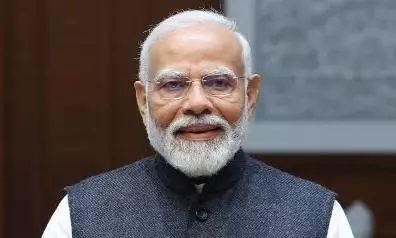
The politics of discrimination is a binary and that has been so normalised that no one seems shocked or even bothered that every time a state comes up for election, the BJP’s campaign machine led by its helmsman and star propagandist, Narendra Modi, unrolls a narrative to captivate his audiences by promising the “double engine sarkar” as the panacea for all ills. The “double engine sarkar” idea splits the states into two groups — the first, BJP-led governments and the second, non-BJP-led governments.
The vision of the nation unrolled by Mr Modi’s superior skills as campaigner, charismatic leader and mass icon is simple; the nation ought to be “one nation-one party”. If parts of the nation are delinquent enough to choose other parties, then the fault-line separating the good from the bad is the concept of the “double engine sarkar”.
There are problems with this concept. Mr Modi’s campaigns are blatant in propositioning voters on the basis of promising discrimination. His guarantee is conditional; if voters help the BJP win, then there will be rewards. The “double engine sarkar”, that is a BJP government in the state and the National Democratic Alliance government at the Centre will work in coordination to rev up the delivery of services, infrastructure, investment, Central funding and Central schemes to power up “development” in the state.
If this promise of goodies and windfalls were limited to the campaign, which is always fierce and intensely competitive, then it would be perfectly in order; all political parties have the freedom to sell themselves to voters in election time in creative and blatantly biased ways, bordering on unethical. What is not in order is for Mr Modi’s BJP to normalise discrimination by showing off the rapid change in backward states once voters opted for the “double engine sarkar” model and warn voters in states that are not run by the BJP that they will continue to lag behind, if there is no change of government.
Discrimination as a policy instrument is creating inequality where it cannot be seen to exist. That trashes the promises in the Preamble of the Constitution of equality, fraternity and justice, and distorts the value of liberty by arm-twisting the freedom to choose of voters. Mr Modi’s campaign content in Bihar and West Bengal reveal the nature of the discrimination and threat that it contains if voters don’t do what he tells them to. Earlier in July, the Prime Minister unveiled a Rs 7,200-crore development package in Bihar; he also unveiled a Rs 5,400 crore development package in West Bengal. In November, for the byelections to four state Assembly seats, the Prime Minister announced a Rs 6,650-crore development package for one district, Jamui, which has a significant tribal population. The PM did not distribute cash for votes, but he did imply that there would be more money if the BJP won.
Every time Mr Modi campaigns, he talks of how Uttar Pradesh’s development speed has zoomed after the BJP was voted to power, how Assam has moved away from turbulence and is racing ahead with infrastructure development, how backward Tripura is fast catching up and Chhattisgarh after its change of heart is going forward with leaps and bounds. The “double engine sarkar” will transform the fortunes of states that lag behind is his promise for West Bengal if it votes the BJP to power in 2026 when the Assembly elections are due.
The grouse of the Member of Parliament in Bihar’s Banka, JD(U) leader Giridhari Yadav, contradicts Mr Modi’s claim. The MP was scathing; he said after 11 years of the BJP-led NDA in power, Bihar has continued to lag behind. His yardstick for measuring neglect was his grievance that not one new train has been launched on the Delhi-Patna and Patna-Mumbai routes in the time that Mr Modi has been Prime Minister, even though Bihar’s population has grown and more people travel on those routes.
One disgruntled MP from a party that is in alliance with the BJP in Bihar is not necessarily a representative sample of how the “double engine sarkar” model works. The best performing state in terms of a combination of state GDP, the maximum number of factories and GST collection is probably Tamil Nadu, an Opposition-ruled bastion that the BJP has not breached in 11 years. The other best performing states by a mix of measures are Maharashtra, that has swung between the Opposition and the BJP over the last 11 years, Gujarat, that is a BJP-ruled state, and Karnataka, that is more or less a Congress bastion now. Andhra Pradesh and Telangana have done well and the BJP is not the dominant party in either state. Uttar Pradesh has surged forward, but is not as yet near catching up with Tamil Nadu.
If regime change made all the difference as the “double engine sarkar” model suggests, then it is remarkable how voters and political parties have been stubbornly resistant to the BJP’s attractions. It suggests that voters and political parties have other considerations when the BJP offers to team up. State Assembly elections are due in Assam, West Bengal, Tamil Nadu and Kerala in 2026. The “double engine sarkar” voter seduction exercise will be presumably unleashed for maximum effect in the next few months.
This is not to argue that the Congress, when it was in power at the Centre and in the states, did not have a dark past; West Bengal’s one-time finance minister, Ashok Mitra, had famously declared that the Centre was meting out “step-motherly” treatment to his state. That was back in the day when the CPI(M)-led Left Front had come to power in 1977. The Centre versus State conflicted relationship, a byproduct of the peculiar federal arrangement that was put in place by the Constitution in 1950, is as much history as it is reality. The difference between now and then is the demolition of platforms and institutions where conflicts could be aired and satisfactory resolutions found.
As M.K. Stalin of the DMK, Mamata Banerjee of the Trinamul Congress and Pinarayi Vijayan of the CPI(M) tackle the BJP’s divisive campaign, the Opposition would be better off undertaking a joint effort to formulate a white paper on the “development by discrimination” model that Mr Modi’s BJP has normalised as the best mechanism for leading India down the path of “Amrit Kaal” by 2047. Instead of simply accepting the flagrantly discriminatory design deepening the inequalities between states, regions and citizens, the Opposition, comprising ruling parties in different states, has a responsibility to focus on it collectively and separately.
Shikha Mukerjee is a senior journalist based in Kolkata
