Shikha Mukerjee | Amid Buzz After Bhagwat’s Remarks, Clarity Is Needed

Citing how the CPI(M) handled the retirement of Jyoti Basu makes sense, since both parties, the CPI(M) and the BJP, are organised in similar ways. In both organisations, there are rules and processes and both organisations tend to abide by them
Transitions are not easy; smooth transitions are carefully prepared movements from one state of being to another. Which is why the country is increasingly more curious about what Prime Minister Narendra Modi may do; on street corners amongst like-minded persons, there are quick conversations about if and when the great leader will or will not gracefully retire from active service.
There are few instances of voluntary retirement from office by political leaders in India; Jyoti Basu retired in 2000 at the age of 86 years after serving as chief minister in West Bengal’s CPI(M)-led Left Front government for 23 years. He chose his moment to retire after grooming and then easing in his successor, Buddhadeb Bhattacharjee. It was not an easy change of guard and Bhattacharjee later famously declared that he was not stepping into Jyoti Basu’s shoes. The message was simple and clear: Bhattacharjee would do things his own way and not follow in his predecessor’s footsteps.
Citing how the CPI(M) handled the retirement of Jyoti Basu makes sense, since both parties, the CPI(M) and the BJP, are organised in similar ways. In both organisations, there are rules and processes and both organisations tend to abide by them. Leadership is not about membership of a ruling dynasty; it is earned by rising, on the basis of merit, through the ranks. Both organisations tend to groom the successor team.
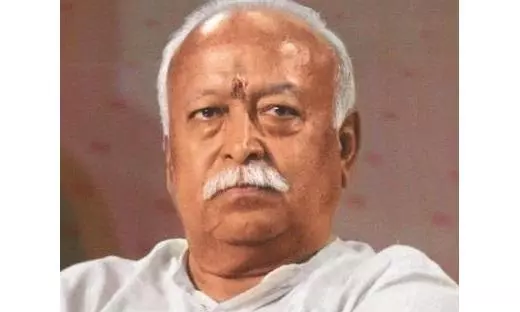
The speculation, however, has less to do with the BJP and is more a response to the tantalising messages that have been delivered by the RSS boss, Mohan Bhagwat, about what is the appropriate age of retirement, that is, 75 years, in recent months. In July, Mohan Bhagwat made a pointed reference to Moropant Pingle’s decision to retire after reaching 75 years. No one is sure what Mr Bhagwat meant, because as soon as he said it, from within the RSS there were efforts to play down the interpretations that followed. The message was: “This is being over-interpreted. Bhagwat Ji was simply telling a humorous story about how self-effacing Moropant Ji was, not laying down a principle. There are no plans for the sarsanghchalak’s retirement, nor should this be seen as any kind of message to the Prime Minister.”
The buzz around the age bar started when the BJP made it a point in 2014 of setting up a “Margdarshak Mandal” within the party as a niche for elders to transition from holding high office to becoming mentors, as former deputy prime minister Lal Krishna Advani and Murli Manohar Joshi did, when both leaders were over 80 years old and both had won Lok Sabha seats in the historic 2014 elections. Another veteran, Jaswant Singh, also joined the Margdarshak Mandal, and he made his displeasure known about the transition.
Since curiosity is spiralling and it is entirely speculative, as the reaction has come not only from within the RSS, but from someone who is perceived as close to Mr Modi and his most dependable ally, home minister Amit Shah, who said there is no age limit on holding office within the BJP, it is time for the BJP and for the Prime Minister to be clear, definite and decisive. The speculation is unhealthy for the people who are engaging in conversations about it on street corners; it is unhealthy for the endless games of thrones that are played out in the corridors of power in India; it is unhealthy and unsettling for India vis-à-vis its relations with the rest of the world, particularly in a turbulent period when upheaval is becoming the norm instead of the exception.
The problem is that the speculation is happening not just on the streets; it is happening within the RSS and its legions of devoted cadres, and within the BJP, which has two parallel streams of party people, those who began their political careers from within the fold and those who were inducted from other parties, when the BJP opened its doors wide to invite in fellow travellers, including those who were already ideologically inclined and others who realised that opportunity was best served by joining up.
The BJP is in a flux; it has not, as yet, found a successor for its president, J.P. Nadda, who currently is holding office as party head and Union minister, in violation of the well-defined precedent of one person-one office. Speculation over who will lead the party is rampant, as the unofficial shortlist of probable heads keeps changing every few weeks.
More speculation about Mr Modi holding office as Prime Minister is undesirable for the BJP as an organisation, the RSS as the parent body and the country. If there is any truth whatsoever in the speculation, it would mean that there would be a process of transition. And any transition of power is a time uncertainty. That said, the point is that the BJP is not the decision maker about Mr Modi’s continuation in office as the Prime Minister. The pattern was set, according to both party insiders and observers outside the organisation, that at the start of the Modi era in national politics in 2014, there was a substantial churn within the BJP. The party, despite its organisational structure and systems of internal control, was greatly influenced by the vision and success of the Prime Minister, who was transformed for all practical purposes as the great helmsman, steering the BJP to its present dominant position in Indian politics and near hegemonic control over the national discourse.
The RSS will certainly not wish to be perceived as directly engaging on who will succeed whom, when and how, regardless of the various interpretations of Mohan Bhagwat’s ambiguous remarks about age and office. The RSS has problems of its own; if the age bar is of consequence, then the sarsanghchalak could face the same dilemma: to be or not to be. Other RSS bosses like K. Sudarshan had stepped down after crossing 75 years of age. With the centenary celebrations kicking off in New Delhi later this month, the three-day event organised by the RSS under Mohan Bhagwat’s stewardship is bound to ignite gossip and speculation.
It is, therefore, necessary for the BJP that the Prime Minister makes a clear and definitive statement setting speculation at rest and ending the currently unsettling times. In any system of parliamentary politics, a change in the Prime Minister’s post sets in motion a complex web of processes and concomitant networks of cross-cutting alliances; it did so when successive Conservative leaders tried to step in when Boris Johnson quit. Some things need to be said, and the sooner they are said the better.
Shikha Mukerjee is a senior journalist based in Kolkata
