Sanjeev Ahluwalia | Nepal Crisis: Fault Lines or Democratic Aspirations?

The spontaneous eruption of youth violence last week in Nepal, against the shutdown of social media apps, illustrates a government out of sync with deeply engrained, youthful, digital, social expectations
Democratic governments are expected to be sensitive to simmering public discontent. Youth unrest is a troubling variant. It presages a generation going awry.
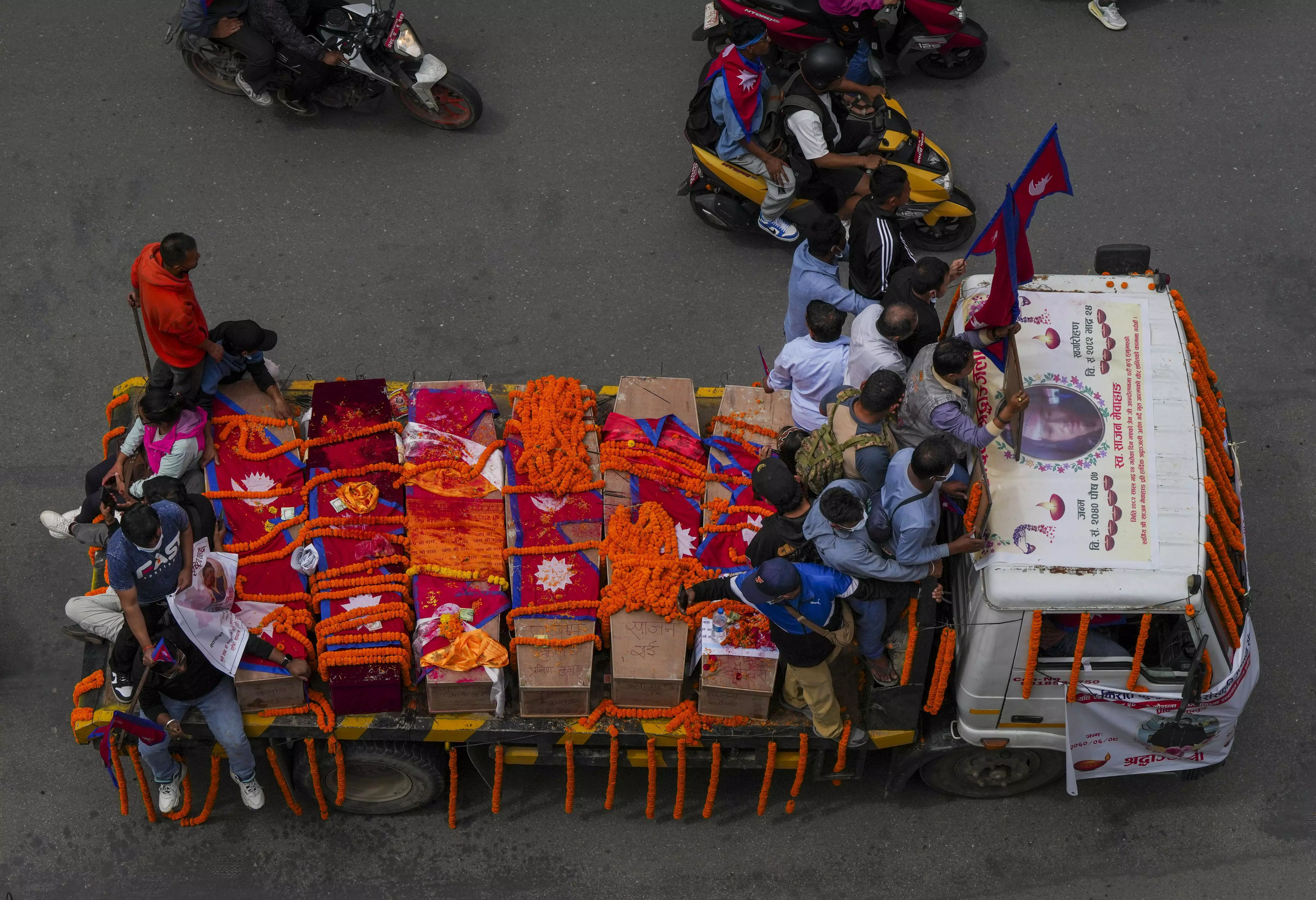
The spontaneous eruption of youth violence last week in Nepal, against the shutdown of social media apps, illustrates a government out of sync with deeply engrained, youthful, digital, social expectations. It is a different matter that the so-called “Nepo Kids” -- the scions of the rich and the powerful -- seem to have been unmindful of the angst their flamboyant lifestyle posts evoked amongst their less fortunate Gen Z compatriots.
Nepal is the safest country in South Asia, after Bhutan, with respect to crime. Bangladesh is the least safe, followed by India and then Sri Lanka. Nepal is a nascent democracy. The constitution establishing democratic government is just a decade old. Till 2008 the Hindu monarchy ruled. But its legitimacy was steadily eroded from the 1990s, when a Maoist insurgency challenged it by practically taking over rural areas. The 2001 internecine massacre in the royal family ended all pretensions of divine legitimacy or the rule of dharma. A failsafe explanation for inexplicable public outbursts is a “foreign hand” stirring up trouble to pressure the government. China or India, Nepal’s northern and southern neighbours respectively, are the usual suspects.
India has multiple historical connects with Nepal. The first is pervasive faith in Hinduism common to both countries, though neither describes itself as a Hindu country. Nepal’s 2015 constitution describes it as an “independent, indivisible, sovereign, secular, inclusive, democratic, socialism-oriented, federal democratic republican state”. India’s Constitution somewhat similarly defines itself as a “sovereign, socialist, secular, democratic republic”, though the words “socialist” and “secular” had been inserted through an amendment in 1974. In Nepal, the Left parties are more firmly entrenched than in India, where their hold has waned. The ultra-left Communist Party of Nepal (Maoist Centre), led by Pushpa Kamal Dahal “Prachanda”, the Left-centric CPN (Marxist-Leninist) led by K.P. Sharma Oli (the leader ousted last week) and the centrist, social democracy-oriented Nepali Congress under Sher Bahadur Deuba have all been in power for brief stints over the past decade, sometimes in coalition with each other, despite their significantly varying political philosophies and global alignments.
Multi-party, congenial democracy is not necessarily a bad thing. But it can get caricatured as transactional alliances for self-aggrandisement, if the public interest is not served. Patriarchy and gerontocracy (all three Nepali national political leaders are more than 70 years old) are a toxic combination in poor developing countries with young populations. Having said that, “meritocratic gerontocracy” is a global trend now that even tech barons want to live and work forever. Six of the G-20 nations have executive heads of state above 70 years of age, including the United States, China, Russia, India, Brazil, Turkey and South Africa, while Japan, Germany and the European Union are near the cusp.
The second attribute of Nepal-India peaceful coexistence is an open border which millions of Nepalis and Indians cross for tourism or work. The Madhesi community in the lowlands of Nepal, bordering India, have close familial and cultural links with Uttar Pradesh and Bihar in India. The trending Madhesi is the mayor of Kathmandu, 35-year-old Balendra Shah, an independent not linked to any party, a rapper and by profession an engineer, who represents the politics of “New Nepal”, focused on delivering development, rather than political survival of the “ancien regime”.
The third similarity with India is a professionally trained army which is apolitical, though it supports the police to quell civil disturbances. In conformity with Nepal’s nascent democratic roots, it was to the Army Chief in Nepal that Gen Z looked for political negotiations around appointing an interim Prime Minister acceptable to all parties including, the President of Nepal.
In comparison, the India military has never played such a high-profile political role, even during the 21-month-long 1975-77 Emergency, when all civil liberties were suspended, resulting in nationwide civil unrest. The impasse ended when the embattled Prime Minister, Indira Gandhi, took a political decision to re-establish civic trust and legitimacy by calling for fresh elections. The ruling party was decisively defeated for the first time since 1947. The Janata Party, a coalition of Opposition groups, formed the new government and ushered in constitutional reform to prevent a similar future misuse of the Centre’s emergency powers. This sequencing of reform syncs with what has been agreed in Nepal: first elections to establish political legitimacy, followed by constitutional reform as needed.
Testing how deep distrust extends via elections is appropriate. The constitutional basis for appointing Sushila Karki, a former Chief Justice, as the interim PM is open to legal critique for the precedent established, blurring the red line between judicial and political power. Nevertheless, the choice of a woman legal luminary is a progressive one and plays to aspirational Nepal. A few additional advisers to the President or interim ministers could broaden the political representation for core decision-making on steps towards an early and fair election.
All South Asian economies are at lower middle-income levels as per the World Bank. Nepal has the lowest level of debt and enjoys concessional lending -- the most recent a $500 million support from the US government for infrastructure development.
With the median age between 25 to 27 years, there is enough youthful energy to build upon. A quarter of Nepal’s 29 million citizens live abroad, a testament to their enterprising spirit. The total fertility ratio is already below 2.0 and the population is expected to peak at 36 million in 2065. The literacy levels of youth (15-24 years) are high, at 92 per cent, similar to India (91 per cent), but enrolment in tertiary education is low, at about 14 per cent, versus 28 per cent in India, 21 per cent in Bangladesh and 32 per cent in Sri Lanka. This feeds into high youth unemployment, at 20 per cent, versus just 12 per cent in Bangladesh and 17 per cent in India. The open border is a key asset, providing access to India’s fast-growing markets. Bilateral collaboration can enhance the private sector’s share in Nepal’s non-agricultural economy from 60 to 65 per cent to equal India’s 70 to 75 per cent share, with associated benefits in employment and well-being. The recent civic unrest is best viewed as an expression of aspirational Nepal, and not as a fault line. It is in India’s interest to help realise these democratic aspirations and ensure a progressive and resilient Nepal.
