SANJAYOVACHA | To Win Trump Back, Time To Mobilise Indians In US | Sanjaya Baru
Where have all those 50,000 gone now that Mr Trump has dumped Mr Modi? How many of them have tweeted criticising President Trump for referring to India as a “dead economy”? What happened to that guy in Washington DC that lady in New York and all the NRI bhakts who cried, cheered, became delirious hailing the Trump-Modi partnership?
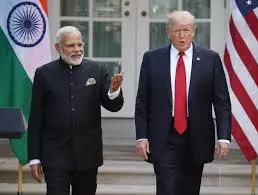
They poured in by the thousands in Houston’s NRG Stadium barely six years ago. Over a hundred organisations of Indian Americans mobilised a crowd of over 50,000. Four hundred performers kept them entertained till President Donald Trump and Prime Minister Narendra Modi walked in. Deafening cheers welcomed them. “Modi, Modi, Modi” they yelled. “My friend, Donald”, said Mr Modi proudly introducing Mr Trump.
Congresswoman Tulsi Gabbard was chuffed. External affairs minister S. Jaishankar could not hold back his visible excitement. Nothing like this had ever happened before. The President of the United States sharing a podium at a public rally of Indian Americans and non-resident Indians with the visiting Prime Minister of India.
Where have all those 50,000 gone now that Mr Trump has dumped Mr Modi? How many of them have tweeted criticising President Trump for referring to India as a “dead economy”? What happened to that guy in Washington DC that lady in New York and all the NRI bhakts who cried, cheered, became delirious hailing the Trump-Modi partnership? Where is Tulsi Gabbard? What did Vivek Ramaswamy have to say about the 25 per cent tariff imposed on India?
Forty-eight hours after President Trump stunned India with his tariff tweet, the diaspora has remained silent. Maybe it’s because it’s the weekend and they are all away on picnics, beer and barbecue. Fair enough. Maybe Indian diplomats are busy scouting for friendly tweets. May be the Hindu American Foundation (HAF) is sending out emails and WhatsApp messages mobilising support. So let us wait and see if by
early this week there is any mobilisation of support for India and its present government and attempts to influence President Trump and his administration into giving India a breather.
Back home in India the Sangh Parivar twitterati are busy abusing President Trump. Just as there was an outpouring of enthusiasm for Mr Trump when he was friendly towards India, there is an outpouring of vitriol against him. Make no mistake, most tweets are from nameless individuals or from those who have no intention to travel to the United States.
Indian Americans, NRIs and Indians hoping to visit the US have been and will remain circumspect. Twentysomethings on American campuses are asking their parents to remain discreet. “Don’t say anything controversial on the social media, in your emails or on WhatsApp. That could get you into trouble with Trump’s digital police. You will not be able to visit me. I may have trouble here.”
The great Indian American diaspora does not want to get caught in Mr Trump’s crosshairs. Many now carry their identity cards with them in case they are asked to prove their nationality by some random cop. There are a few brave ones who still remain socially or politically active but they have their US citizenship stamped and sealed. They are not the ones living in the phantom zone of the “Not-Returning Indian” -- the new definition of NRI.
The Hindu American Foundation has come out with many posts on the Pahalgam terror attack but none as yet on Operation Sindoor or President Trump’s tweets. Indian diplomats would be busy mobilising opinion within the diaspora to help get some positive focus on US-India relations. India has extended its reach within the US by opening eight new consular centres located in Boston, Columbus, Dallas, Detroit, Addison, Orlando, Raleigh and San Jose. The external affairs ministry has spun the story by suggesting that even as US-India relations had become testy, India was widening and deepening its relations with the US through this initiative.
The Indian American community has been used before as an instrument of diplomacy. In the 1990s Indian diplomats worked hard to increase membership of the India Caucus in the US Congress and the policy initiatives taken by Prime Minister P.V. Narsimha Rao helped get positive focus on to India within the US Congress. For a long time, Pakistan had more supporters within its portals, but by the late 1990s India was well ahead.
The diaspora came in handy during the negotiation of the US-India civil nuclear energy deal. The US India Political Action Committee (USINPAC) played a key role in this regard. Surprisingly though, USINPAC’s website still does not feature President Trump. All the photographs of USINPAC’s leaders on its website even today are only with President Joe Biden. None with either President Trump or any member of his Cabinet.
The fact is, according to surveys conducted before the US elections, a hefty 70 per cent of Indian American voters favoured the Democratic Party and only 30 per cent said they would vote for Mr Trump. This could partly have been on account of the fact that the Democratic candidate was Kamala Harris. However, it is also in part due to concerns about Mr Trump’s anti-immigration policies. Can at least those Indian Americans who funded and voted for Mr Trump be mobilised now to curry favour with the US President?
Given the importance that Prime Minister Modi’s has been attaching to the diaspora and the exaggerated role assigned to its supportive members on the PM’s travels overseas, including the United States, it remains to be seen how he and the foreign ministry intend to mobilise this group to stabilise and improve US-India relations now.
Contrast the masterly inactivity of Indian diplomacy in the US in recent months with the clever manipulations of Pakistani diplomats and lobbyists. The stunning manner in which the Pakistani business and diplomatic leadership has been able to pull President Trump and his family into their corner, albeit through allegedly questionable means, shows up India in poor light. This is not to suggest that Indian diplomatic and political leadership should also use the questionable tactics that Pakistan has reportedly used, but then all is fair in love and war, and indeed in diplomacy.
Perhaps external affairs minister S. Jaishankar and foreign secretary Vikram Misri should visit the United States and travel around the country meeting influential Indian Americans and explore ways in which they can help stabilise the presently rocky relationship. Despite Donald Trump and his crude put downs of India, the fact is that there is considerable goodwill within the US for India and for the US in India. This goodwill remains the ballast in navigating choppy diplomatic waters.
Sanjaya Baru is a writer and an economist. His most recent book is Secession of the Successful: The Flight Out of New India.
